
Syllabus: Conservation, environmental pollution and degradation, environmental impact assessment.
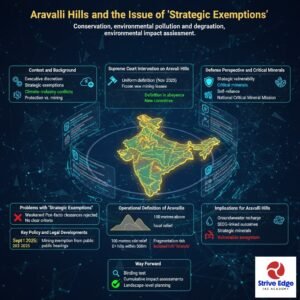
Context and Background
- India frequently resolves climate–industry conflicts through executive discretion, not clear statutory rules.
- Environmental scrutiny is often bypassed citing national defence or strategic considerations.
- This approach has intensified debate over protection versus mining in the Aravalli Hills.
Defence Perspective and Critical Minerals
- Defence establishment highlighted dependence on critical minerals as a strategic vulnerability.
- Global mineral supply chains are concentrated and exposed to geopolitics and export controls.
- Self-reliance in defence manufacturing requires secure domestic mineral value chains.
- The National Critical Mineral Mission was identified as the primary policy instrument.
Supreme Court Intervention on Aravalli Hills
- On November 20, the Supreme Court adopted a uniform definition for Aravalli Hills and ranges.
- It froze new mining leases until a sustainable mining plan was prepared.
- Mining was prohibited in core or inviolate areas, except for strategic, critical, or atomic minerals.
- This carve-out was explicitly termed a “strategic exemption” by the Court.
Operational Definition of Aravallis
- An Aravalli Hill is a landform rising at least 100 metres above local relief.
- An Aravalli Range includes two or more such hills within 500 metres.
- Environmental groups argue this definition fragments the landscape into isolated hill “islands”.
- Valleys, plains, scrubland, and forests connecting hills risk losing protection.
Judicial Reconsideration
- Due to concerns, the Supreme Court later placed the definition in abeyance.
- A new committee was constituted to re-examine Aravalli protection comprehensively.
Problems with ‘Strategic Exemptions’
- The Environment Ministry has weakened safeguards to promote ease of doing business.
- India lacks transparent rules to balance climate commitments with industrial demand.
- Executive tools like office memoranda and ad hoc appraisals enable opaque exemptions.
- The EIA framework allows exemption from public consultation for strategic projects.
- Absence of clear criteria makes “national interest” determinations arbitrary.
Key Policy and Legal Developments
- Since 2014, environmental clearance processes have been repeatedly diluted.
- In May 2025, the Supreme Court rejected ex post facto clearances as unconstitutional.
- In November 2025, the Court recalled this view, reopening post-facto regularisation.
- In September 2025, mining of critical minerals was exempted from public hearings.
- The Forest (Conservation) Amendment Act, 2023 expanded exemptions and modified clearances.
Implications for Aravalli Hills
- Aravallis support groundwater recharge and prevent desertification.
- They underpin SDG-linked outcomes like clean air, water security, and habitability.
- The region holds base metals, strategic minerals, and green-transition minerals.
- Weak safeguards combined with strategic exemptions make the ecosystem highly vulnerable.
Way Forward
- India requires a binding test for invoking strategic exemptions.
- Landscape-level cumulative impact and groundwater assessments must precede all leases.
- Public disclosure of rejected alternatives like imports or recycling is essential.