

Syllabus: Issues and challenges pertaining to the federal structure
Background: Centre–State Transfers
- Central tax revenues are shared with States based on Finance Commission (FC) recommendations.
- Transfers occur through tax devolution, grants-in-aid, and Centrally Sponsored Schemes (CSS).
- The 15th Finance Commission recommendations are in force; 16th FC report is pending.
- Debates focus on fiscal autonomy erosion after GST implementation.
- Concerns include GST revenue losses, rising cesses and surcharges, and CSS spending rigidity.
- High-performing States allege declining devolution shares despite strong revenue contributions.
- FCs historically prioritised equity over efficiency, using income distance and population criteria.
Tax Collection versus Economic Contribution
- States like Maharashtra, Karnataka, Tamil Nadu argue they contribute more than they receive.
- Direct tax data reflect place of collection, not place of income generation.
- Multi-State firms pay taxes where registered offices are located, distorting State attribution.
- Labour migration and multi-location operations further weaken PAN-based tax attribution.
- Hence, direct tax figures are unreliable for estimating State-wise tax contribution.
GSDP as a Proxy for Tax Accrual
- Gross State Domestic Product (GSDP) represents the underlying tax base of a State.
- Assuming uniform tax efficiency, GSDP share approximates tax accrual capacity.
- GST, being destination-based, poses fewer attribution concerns.
- Empirical evidence supports GSDP relevance.
- In 2023–24, correlation between GSDP and direct taxes was 0.75.
- Correlation between GSDP and GST collections was higher at 0.91.
Transfer Outcomes under Current System
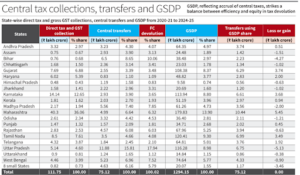
- From 2020–21 to 2024–25, States received 41% of gross tax revenues.
- Total transfers amounted to ₹75.12 lakh crore.
- Uttar Pradesh, Bihar, West Bengal received high transfers despite low tax shares.
- Maharashtra, Karnataka, Tamil Nadu contributed heavily but received modest transfers.
- Devolution shares correlated 0.99 with actual transfers, but only 0.24 with tax collections.
- GSDP share showed 0.81 correlation with tax collections and 0.58 with devolution.
Implications of a GSDP-Based Formula
- Pure GSDP-based transfers would benefit Maharashtra, Gujarat, Karnataka, Tamil Nadu.
- Uttar Pradesh, Bihar, Madhya Pradesh would face moderate reductions.
- GSDP balances efficiency and equity, improving fairness and system credibility.
- Higher GSDP weight acknowledges State contributions to national income.
