

Syllabus: Government policies and interventions for development in various sectors and issues arising out of their design and implementation
Context
- The Supreme Court in State of Uttar Pradesh vs Anurudh (January 10, 2026) flagged misuse of POCSO in adolescent romance.
- It urged the Union government to consider exempting genuine adolescent relationships from harsh prosecution.
Existing Legal Framework
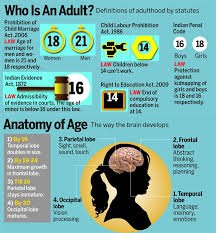
- The age of consent in India is 18 years, fixed by the gender-neutral POCSO Act, 2012.
- Anyone below 18 is legally a “child”, making consent irrelevant for sexual acts.
- Section 19, POCSO mandates mandatory reporting of suspected offences to police.
- The Criminal Law (Amendment) Act, 2013 aligned IPC Section 375 with the 18-year threshold.
- The Bharatiya Nyaya Sanhita, 2023, retains this rule under Section 63.
- The minimum age of marriage remains 18 for females and 21 for males.
Arguments for Lowering the Age
- A large share of POCSO cases involve 16–18-year-olds in consensual relationships.
- NFHS-4 showed 11% of girls had first sexual experience before 15, and 39% before 18.
- An Enfold study found 24.3% of 7,064 POCSO cases involved romantic relationships.
- In 82% of such cases, victims refused to testify against the accused.
- Another Enfold-Project 39A study found 25.4% of Section 6 cases were consensual.
- Many countries like the U.K., Canada, and EU States use 16 years with ‘Romeo-Juliet’ safeguards.
Arguments Against Lowering
- The bright-line rule of 18 years ensures clear and uniform protection for children.
- A 2007 Ministry of Women and Child Development study found over 50% of abusers were known to the child.
- Lowering the age could legitimise coercion, suppress disclosures, and aid trafficking.
- Parliamentary Committees (2011, 2012) rejected recognising minor consent.
- The Law Commission’s 283rd Report (2023) warned that lowering the age would make POCSO ineffective.
Judicial Views
- Delhi HC (2025) and Bombay HC (2023) supported sexual autonomy with protection.
- Delhi HC also reiterated that consent below 18 is legally immaterial.
- The Supreme Court (2024) reaffirmed that POCSO does not recognise minor consent.
- In August 2025, Justice B.V. Nagarathna acknowledged trauma from POCSO misuse in adolescent elopement.
Way Forward
- Parliament must weigh child protection against adolescent autonomy.
- Courts need clarity to ensure uniform enforcement.
- A holistic approach must include sex education, health services, and gender-sensitive policing.
- The challenge is to distinguish consensual adolescent relationships from exploitation without diluting safeguards.
