

Syllabus: Effect of policies and politics of developed and developing countries on India’s interests
Background of the Venezuela Action
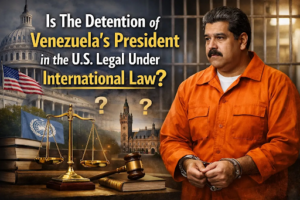
- U.S. President Donald Trump announced military action against Venezuela from Mar-a-Lago.
- He declared Nicolas Maduro and Cilia Flores would be captured and tried in New York.
- The U.S. claimed the action targeted “narco-terrorism” but made oil access explicit.
- Venezuela is a modest cocaine source, while 69% U.S. overdose deaths involve fentanyl.
- Precursor chemicals originate largely in China, weakening the narcotics justification.
- Venezuela holds the largest proven oil reserves globally, revealing economic motivations.
Violation of International Law
- The action violated Article 2(4) of the UN Charter, banning force against State sovereignty.
- Use of force is permitted only with UN Security Council approval or self-defence under Article 51.
- The U.S. intervention lacked both authorisation and legal justification under international law.
Breakdown of Balance of Power
- The incident reflects erosion of the balance of power principle in international relations.
- During the Cold War, U.S. and Soviet rivalry restrained unilateral military actions.
- Bipolarity ensured mutual deterrence, preventing unchecked use of force.
Historical Illustrations of Balancing
- In 1971 Bangladesh War, Soviet naval deployment neutralised U.S. Seventh Fleet pressure on India.
- During the 1973 Yom Kippur War, Soviet troop mobilisation forced Israeli restraint.
- The U.S. responded with DEFCON-3, preventing annihilation of the Egyptian Third Army.
Post-1991 Unipolarity
- The collapse of the Soviet Union removed the principal counterweight to U.S. power.
- The U.S. adopted a doctrine of pre-emptive war and regime change.
- Governments in Iraq, Egypt, Libya, and Syria were overthrown through direct or indirect intervention.
Emerging Counter-Balances
- China is the only credible emerging counter-balance to U.S. dominance.
- A Russia–China axis could challenge unipolarity, though internal differences persist.
Implications for India
- The U.S. has shown insensitivity to India’s security interests.
- India must strengthen its military-industrial base and pursue innovative defence strategies.
