

Overview and Institutional Framework
- Startup India was launched on January 16, 2016, to promote entrepreneurship, innovation, and investment-led economic growth.
- The initiative is implemented by a dedicated team under the Department for Promotion of Industry and Internal Trade (DPIIT).
- The mission aims to transform India into a job-creator economy instead of a job-seeker economy.
Recent Performance and Key Statistics
- Nearly 44,000 startups were registered in 2025, the highest annual increase since launch.
- India has emerged as the third-largest startup ecosystem globally, reflecting strong innovation momentum.
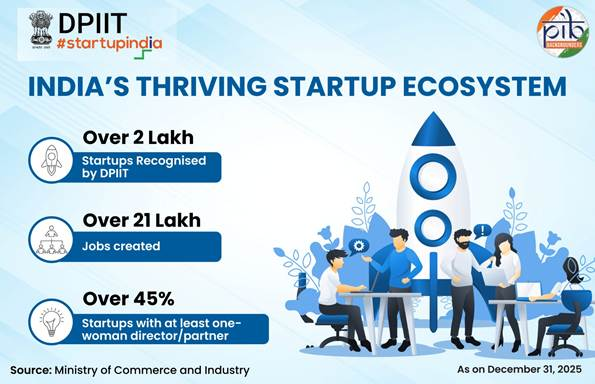
- Startup numbers expanded from fewer than 500 in 2014 to over 200,000 currently.
- The country hosts nearly 125 active unicorns, compared to only four unicorns in 2014.
- More than ₹25,000 crore has been invested through the Fund of Funds for Startups.
Funding Architecture and Policy Instruments
- Fund of Funds 2.0, approved in April 2025, carries a ₹10,000 crore corpus for risk capital.
- The new phase prioritises deep technology sectors, including AI, machine learning, quantum, defence, and aerospace.
- A Credit Guarantee Fund is operated through SIDBI, with ₹500 crore annually for four years.
- Eligible startups receive three-year income tax exemptions and capital gains tax relief.
Ecosystem Support and Institutional Features
- Startups benefit from self-certification, simplified compliance, and a unified digital portal.
- The initiative promotes industry–academia partnerships through incubators and research parks.
- Atal Innovation Mission supports student innovation, early-stage mentoring, and institutional incubation.
- The Startup India Hub serves as a single-window platform for funding, regulation, and knowledge access.
Sectoral and Regional Expansion
- The mission extends beyond technology into agriculture, manufacturing, healthcare, education, and social enterprises.
- Special emphasis targets Tier-2 and Tier-3 cities, including semi-urban and rural entrepreneurship.
- The programme supports spreading innovation ecosystems across non-metro industrial and services clusters.
Significance for Growth and Employment
- Startup India strengthens job creation, innovation-driven productivity, and global market integration.
- The ecosystem supports high-growth areas such as renewable energy, digital services, and advanced manufacturing.
- Risk-taking culture has gained social acceptance, encouraging venture creation and capital mobilisation.
Challenges and Structural Gaps
- Startups face regulatory delays, compliance complexity, and uneven policy implementation across States.
- Early-stage funding access remains limited, particularly outside major metropolitan clusters.
- Awareness gaps persist in smaller towns, reducing equitable access to incentives and schemes.
- Inadequate mentorship, research infrastructure, and incubation quality constrain deep-tech and manufacturing startups.
Way Forward
- Enhance early-stage financing through faster Fund of Funds disbursements and expanded seed funding mechanisms.
- Simplify regulatory frameworks by harmonising State-level compliance and reducing approval timelines.
- Strengthen incubation quality by upgrading research infrastructure and mentor networks in non-metro regions.
- Promote deep-tech commercialisation through stronger industry linkages and public procurement support.
- Expand global market access using trade missions, innovation corridors, and international startup partnerships.
Conclusion
- Startup India has reshaped India’s entrepreneurial landscape through policy support, funding access, and innovation networks.
- Sustained focus on deep technology, regional inclusion, and regulatory simplification can consolidate India’s global startup leadership.
