

Background and Policy Context
- NITI Aayog released a January 2026 report proposing convergence to improve MSME scheme efficiency.
- The policy blueprint was prepared by the Administrative Staff College of India for institutional assessment.
- The study analysed 18 centrally administered MSME schemes for coordination and resource optimisation.
- The objective focuses on reducing duplication, strengthening outcomes, and enhancing last-mile delivery.
Key Facts of MSME Sector
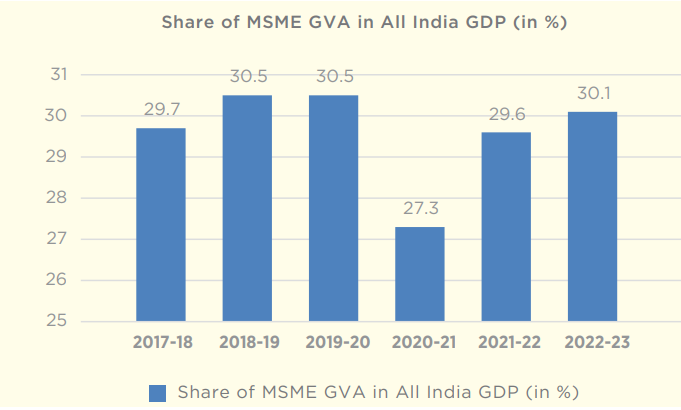
- MSMEs contribute approximately 29–30% of national GDP, reflecting their macroeconomic significance.
- The sector employs over 28.7 crore people, ranking second only to agriculture.
- MSMEs account for about 45–46% of exports, despite limited direct exporter participation.
- India hosts 6.3 crore MSMEs, with nearly 51% located in rural areas.
- Government budget outlay increased from ₹6,717 crore in 2019–20 to ₹22,094 crore in 2023–24.
Opportunities for Scheme Convergence
- Unified digital window can reduce compliance costs and improve access to eligibility information.
- Cluster scheme rationalisation can improve infrastructure quality and collective industrial competitiveness.
- Skilling programme alignment can reduce duplication and strengthen industry-relevant employment outcomes.
- Marketing support integration can enhance coordinated domestic and international MSME promotion.
- Innovation ecosystem consolidation can strengthen rural enterprise incubation and funding efficiency.
Major MSME Initiatives Highlighted
- Udyam Registration and Udyam Assist Platform support formalisation and improved access to finance.
- PMEGP and PM Vishwakarma promote entrepreneurship and traditional artisan livelihood sustainability.
- CGTMSE and SRI Fund address financing gaps through collateral-free credit and equity support.
- RAMP Programme strengthens productivity, resilience, and global competitiveness through reforms.
- GeM and Public Procurement Policy ensure assured market access through transparent digital procurement.
Challenges in Convergence
- Inter-ministerial silos restrict data sharing and coordinated programme implementation.
- Risks of diluting targeted schemes affecting vulnerable social and regional beneficiaries.
- Field-level capacity constraints limit effective management of integrated digital platforms.
- Data integration barriers hinder real-time monitoring and evidence-based policymaking.
- Transition risks may disrupt benefits and delay disbursements during scheme mergers.
Conclusion
- The report identifies fragmented delivery, not scheme availability, as the primary MSME policy challenge.
