


United Nations Economic and Social Council (ECOSOC)
Context
- ECOSOC will commemorate its 80th anniversary on 23 January 2026.
- The milestone marks eight decades of coordinating global development, social, and environmental governance.
About the Body
- One of the six principal organs of the United Nations, coordinating global development policies.
- Serves as the central UN platform for economic, social, and environmental cooperation.
- Establishment and History
- Established in 1945 under the United Nations Charter.
- Held its first session on 23 January 1946 in London.
- Aim
- Promote sustainable development integrating economic growth, social inclusion, and environmental protection.
- Ensure global development efforts leave no country or community behind.
- Key Functions
- Policy Coordination: Coordinates activities of UN specialised agencies, programmes, and development bodies.
- Global Platform: Facilitates international dialogue, consensus-building, and policy innovation on development challenges.
- SDG Review: Conducts High-Level Political Forum (HLPF) to monitor Sustainable Development Goal implementation.
- Inclusive Engagement: Grants consultative status to over 6,500 NGOs, enabling structured civil society participation.
- Institutional Linkage: Oversees functional commissions, regional commissions, and expert advisory bodies.
- UN System Governance: Elects executive boards of agencies like UNDP, UNICEF, and UNHCR.
- Composition and Structure
- Comprises 54 Member States elected by the UN General Assembly.
- Members serve three-year terms with equitable regional representation.
- Significance
- Aligns global economic, social, and environmental governance under a unified UN framework.
- Strengthens multilateral cooperation among governments, civil society, academia, and private sector.
Chips to Start-up (C2S) Programme
What it is?
- A national initiative to build industry-ready chip design talent and indigenous semiconductor ecosystem.
- Focuses on hands-on training, R&D exposure, fabrication access, and start-up enablement.
Launch and Implementation
- Launched in 2022 by the Ministry of Electronics and Information Technology (MeitY).
- Implemented through academic institutions, national labs, and industry partnerships.
Aim
- Create a robust pipeline of skilled chip designers and semiconductor innovators.
- Promote IP creation, start-ups, and technological self-reliance in critical technologies.
Financial Outlay
- ₹250 crore allocated for a five-year national capacity-building programme.
Human Resource Targets
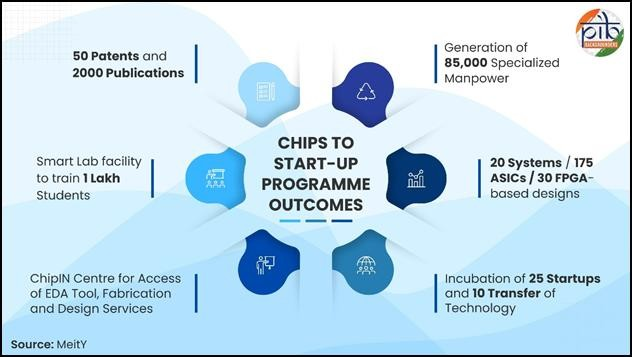
- Train 200 PhDs in advanced semiconductor and chip design domains.
- Support 7,000 M.Tech students in VLSI and chip design specialisations.
- Cover 8,800 M.Tech students in allied engineering streams with VLSI exposure.
- Enable 69,000 B.Tech students with foundational and applied chip design skills.
Infrastructure and Tools Access
- Provides shared EDA tools, high-performance computing, FPGA boards, and SMART laboratories.
- Ensures nationwide academic access to advanced semiconductor design infrastructure.
Hands-on Fabrication Support
- Facilitates shared wafer runs through Semiconductor Laboratory, Mohali.
- Enables students to fabricate and test real silicon prototypes and ASIC designs.
Chip Design Enablement Platform
- Operates National ChipIN Centre under C-DAC, Bengaluru.
- Supports SoC design, IP core development, and national chip repositories.
Innovation and Industry Linkages
- Encourages patent filings, IP generation, and semiconductor start-up incubation.
- Partners with global EDA firms and semiconductor industries for advanced training.
UN Biodiversity Beyond National Jurisdiction (BBNJ) Treaty
Context
- The BBNJ Treaty entered into force after crossing the 60-ratification threshold in September 2025.
- It creates the first legally binding global framework to protect biodiversity in international waters.
About the Treaty
- What it is?
- A legally binding international agreement under UNCLOS to conserve and sustainably use high-seas biodiversity.
- Applies to areas beyond national jurisdiction, covering nearly two-thirds of the global ocean.
- Origin and History
- Negotiations initiated in 2008 due to concerns over unregulated high-seas exploitation.
- Finalised in March 2023 after fifteen years of multilateral negotiations.
- Entered into force 120 days after the 60th ratification milestone.
- Targets and Vision
- Supports the global “30 by 30” ocean protection target by 2030.
- Expands conservation governance across international marine commons.
- Key Features
- Marine Protected Areas (MPAs): Enables designation of MPAs in international waters to protect vulnerable marine ecosystems.
- Environmental Impact Assessments (EIAs): Mandates prior assessment of high-seas activities with potential significant ecological harm.
- Marine Genetic Resources (MGRs): Establishes equitable benefit-sharing mechanisms for biotechnology and pharmaceutical applications.
- Capacity Building and Technology Transfer: Supports developing states through training, scientific cooperation, data access, and marine technologies.
- Ecosystem-Based and Precautionary Approach: Promotes decisions based on best scientific evidence and precautionary principles.
- No Sovereignty Clause: Reaffirms that no nation can claim ownership or sovereign rights over high-seas biodiversity.
- Significance
- Strengthens global ocean governance beyond national maritime zones.
- Protects marine biodiversity, genetic resources, and fragile deep-sea ecosystems.
- Enhances equity between developed and developing countries in ocean resource utilisation.
Indiaphonte Bijoyi

Context
- Scientists discovered a new microscopic crustacean species in Kavaratti lagoon, Lakshadweep.
- The species was named Indiaphonte bijoyi, marking the introduction of a new genus Indiaphonte.
About the Species
- A microscopic crustacean species belonging to the Copepoda class.
- Placed under the family Laophontidae within the order Harpacticoida.
- Location and Habitat
- Discovered in sediment-rich waters of Kavaratti lagoon, Lakshadweep Islands.
- Lives as benthic meiofauna in aquatic sedimentary environments.
- Physical Characteristics
- Has a semi-cylindrical, dorsoventrally depressed body with tapered posterior end.
- Possesses antennae-like appendages at the anterior region for sensory functions.
- Females are slightly larger than males, showing mild sexual dimorphism.
- Classified as meiofauna, measuring less than one millimetre in body size.
Kaziranga National Park
Context
- Kaziranga National Park reported three tiger deaths within a fortnight, attributed to territorial infighting.
- The 2024 tiger census recorded a rise in Kaziranga’s tiger population from 104 to 148.
- Experts link the incidents to population pressure within the 430 sq. km core area, limiting dispersal opportunities.
Kaziranga National Park
- Location and Extent
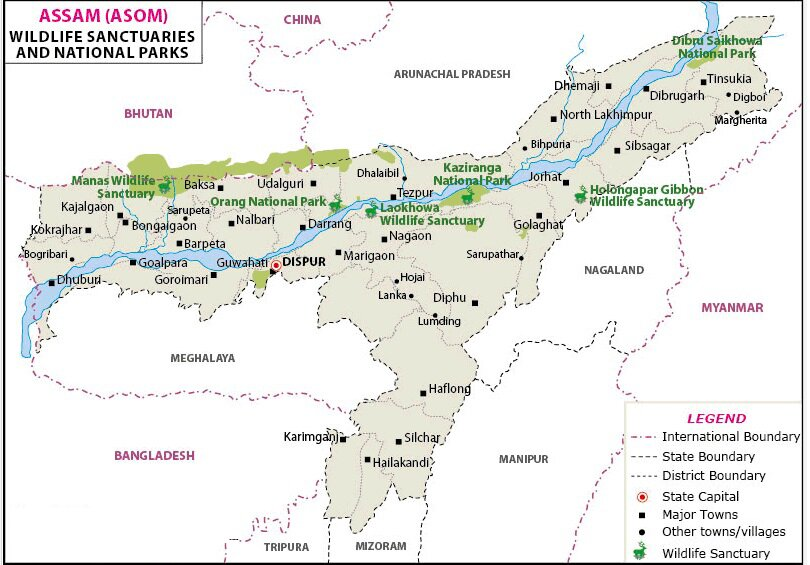
- Located in Assam between the Brahmaputra River and Karbi (Mikir) Hills.
- Forms the largest undisturbed floodplain ecosystem in the Brahmaputra Valley.
- Legal and International Status
- Declared a National Park in 1974.
- Recognised as a UNESCO World Heritage Site in 1985.
- Notified as a Tiger Reserve in 2006.
- Terrain and Physical Features
- Characterised by tall elephant grass, marshes, shallow pools, and alluvial grasslands.
- Includes wetlands, beels, sandbars, and seasonal floodplains.
- River System
- Diffalu River, a tributary of Brahmaputra, flows through the park.
- Mora Diffalu River forms the southern boundary of the protected area.
- Flora
- Dominated by dense tall elephant grasses and tropical moist deciduous forests.
- Aquatic vegetation includes water lilies, lotus, and water hyacinths.
- Fauna
- Hosts the world’s largest population of one-horned rhinoceros (Rhinoceros unicornis).
- Major mammals include Bengal tiger, Asian elephant, wild water buffalo, and swamp deer.
- Primate species include Hoolock gibbon and capped langur.
- Aquatic fauna includes the Gangetic river dolphin in riverine habitats.
- Ecological Significance
- Represents a globally important floodplain grassland and wetland ecosystem.
- Acts as a critical biodiversity corridor between Eastern Himalayas and Indo-Burma regions.
Soft Matter

What it is?
- Soft matter is a sub-field of condensed matter physics studying easily deformable materials.
- These materials change structure under small thermal fluctuations or weak external stress.
Constituents / Types
- Includes colloids, polymers, foams, gels, liquid crystals, and biological materials.
- Many living systems and industrial mixtures fall within this category.
Structural Scale
- Dominated by mesoscopic structures between atomic and macroscopic scales.
- Material behaviour depends on interactions among these intermediate-scale building blocks.
Binding Forces
- Building units are held together by weak intermolecular forces, not strong atomic bonds.
- This makes properties highly sensitive to temperature, pressure, time, and environment.
Key Properties
- Viscoelasticity: Shows both solid-like and liquid-like responses under stress.
- High deformability: Easily changes shape without permanent structural damage.
- Environmental sensitivity: Small changes cause large variations in material behaviour.
Everyday Examples
- Curd, toothpaste, shampoo, soap bubbles, and living cells.
- Widely encountered in food products, cosmetics, and biological systems.
Applications
- Medical: Drug delivery systems, biomaterials, tissue engineering.
- Industrial: Food processing, automotive materials, construction composites.
- Technology: Electronics coatings, flexible displays, and advanced manufacturing.
Significance
- Bridges the gap between solid-state physics and fluid dynamics.
- Supports innovation in healthcare, materials engineering, and sustainable manufacturing.
- Enhances understanding of biological systems, smart materials, and complex industrial fluids.
