

Syllabus: Inclusive growth and issues arising from it
Context
- Recent RBI and Budget data reveal stable growth, but emerging financial stress within households.
- Growth appears supported by lower savings and higher borrowing, transferring economic risks onto households.
Aggregate Indicators and Hidden Fragility
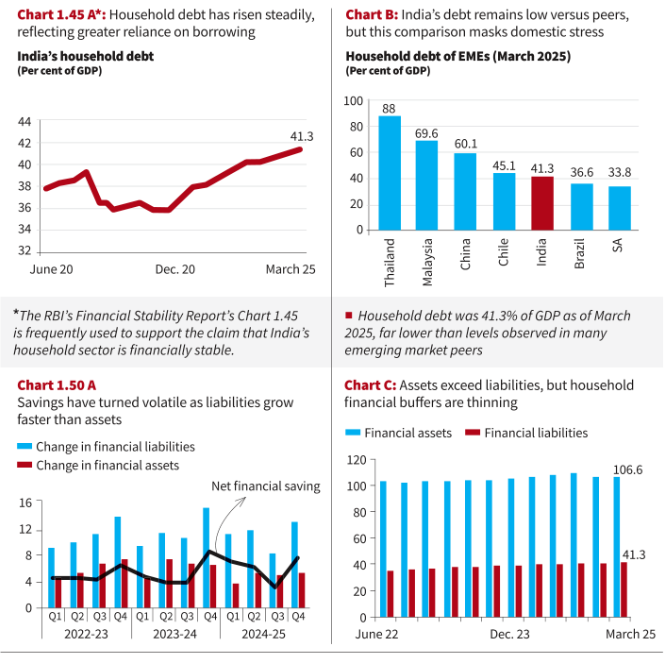
- RBI Financial Stability Report 2025 shows household debt at 41.3% of GDP.
- Debt levels remain lower than peers like China, Malaysia, and Thailand.
- Debt rose gradually from 36% of GDP in mid-2021 to current levels.
- Debt-to-GDP ratios indicate scale of borrowing, not households’ repayment capacity.
Income, Consumption, and Credit Dynamics
- RBI Annual Report 2024–25 highlights uneven real income growth, especially outside formal employment sectors.
- Consumption remains steady despite weak income expansion, prompting reliance on borrowing.
- Credit increasingly fills income–expense gaps, rather than financing long-term asset creation.
- Moderate debt becomes risky when it substitutes for savings and income growth.
Household Balance Sheet Trends
- Financial liabilities stood at 41.3% of GDP in March 2025.
- Gross household financial assets reached 106.6% of GDP, maintaining net wealth.
- Flow data shows volatile net financial savings, signalling underlying financial pressure.
- Net savings recovered to 7.6% of GDP in late 2024–25, after compressing to 3–4%.
- Faster liability accumulation than asset growth drives savings volatility.
Fiscal Structure and Risk Transfer
- States prioritise capital expenditure, limiting revenue spending for income support.
- Committed expenditures consume 30–32% of State revenues, reducing countercyclical capacity.
- Union Budget 2025–26 allocates ₹11.2 lakh crore to capital expenditure.
- Infrastructure investment boosts growth, but does not stabilise short-term household incomes.
Macroeconomic Risks and Outlook
- Private consumption forms nearly 60% of GDP, making households key economic stabilisers.
- Rapid expansion of unsecured retail credit sustains consumption on weaker financial buffers.
- Volatile savings and rising liabilities reduce households’ shock-absorption capacity.
- Economic slowdowns or interest rate rises may trigger abrupt consumption retrenchment.
Policy Implications for Budget 2026
- Fiscal strategy should enhance disposable incomes and labour-intensive employment.
- Growth must rebalance towards income security, savings restoration, and household resilience.
