

Syllabus: Effect of policies and politics of developed and developing countries on India’s interests
Macroeconomic Context
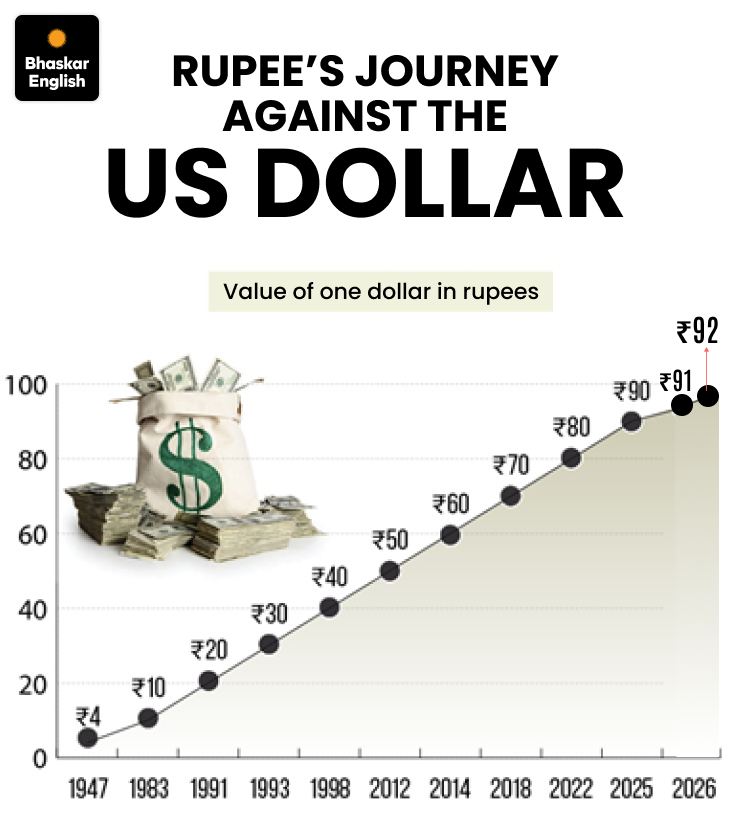
- Rupee declined around 6% since April 2025, despite strong domestic economic indicators.
- Growth rate estimated at 7.4% for the current financial year.
- CPI inflation ended 2025 at 1.33%, below RBI’s lower target band consecutively.
- Current account deficit stood at 0.76% of GDP in first half of 2025–26.
Primary Cause: Capital Outflows
- Trade deficit rose to $96.58 billion in April–December 2025, from $88.43 billion last year.
- Net capital inflows of $10,615 million in 2024 turned into $3,900 million outflows in 2025.
- Capital exit triggered by U.S. 50% tariff on Indian exports and geopolitical tensions.
- Additional U.S. tariff threats linked to India’s oil imports from Russia and trade with Iran.
Shift from Economics to Diplomacy
- Capital flows driven by political risk perceptions, not conventional economic fundamentals.
- Earlier rupee depreciation in 2022 linked to U.S. Federal Reserve interest rate hikes.
- Present depreciation reflects weaponisation of trade tariffs for geopolitical leverage.
- Diplomatic engagement with the U.S. identified as key stabilising factor for rupee.
RBI’s Exchange Rate Intervention Approach
- Since 1993, India follows a market-determined exchange rate regime.
- RBI intervenes to reduce volatility, not to peg the rupee’s value.
- Intervention aims to moderate sharp declines and ensure smooth market adjustment.
- Non-economic pressures now influencing rupee beyond traditional macroeconomic variables.
Limits of Devaluation as a Policy Tool
- Rising import content of exports weakens competitiveness gains from rupee depreciation.
- High U.S. tariffs restrict potential export expansion in American markets.
- Essential imports, especially crude oil forming 25% of merchandise imports, become costlier.
- Depreciation risks fueling domestic inflation, undermining price stability.
Strategic Implications and Outlook
- India’s inflation aligned with developed economies, reducing justification for devaluation strategy.
- Real Effective Exchange Rate used to assess relative currency competitiveness.
- Continued capital outflows may pressure stock markets and investment sentiment.
- Early trade and diplomatic resolution with the U.S. critical for currency stabilisation.
