

Syllabus: Issues and challenges pertaining to the federal structure
Changing Role of Central Tax Devolution
- States closely track Union Budget to assess their share in Central tax devolution.
- Tax devolution no longer provides stable fiscal support for State finances.
- Rising dependence on State Development Loans (SDLs) reflects weakening revenue certainty.
Expansion of State Borrowing
- In 2024-25 Revised Estimates, SDLs formed 35% of Tamil Nadu’s revenues.
- Maharashtra’s SDL share reached nearly 26% of total revenue receipts.
- Borrowing surge accelerated after COVID-19 shock in 2020-21.
- Dependence on debt has persisted, replacing devolution as primary fiscal stabiliser.
- State PSUs and Special Purpose Vehicles increasingly borrow for routine expenditure.
Erosion of Effective Devolution
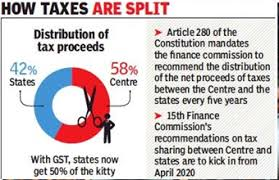
- 15th Finance Commission fixed States’ share at 41% of divisible pool.
- Growing cesses and surcharges lie outside divisible pool, reducing actual transfers.
- Industrialised States face greater impact due to large indirect tax bases.
- GST introduction in 2017 shifted major revenue collection to the Centre.
- Redistribution formula weakens link between tax effort and fiscal reward.
Welfare Financing and Growth Constraints
- Welfare commitments include pensions and mass health insurance for the poor.
- These obligations increasingly financed through domestic borrowing, not tax revenues.
- Debt reliance restricts public capital expenditure and private investment capacity.
Inter-State Borrowing Patterns and Risks
- West Bengal depends on devolution for 47.7% of average revenue receipts.
- SDLs still formed around 35% of its revenues over five years.
- Trend signals erosion of State fiscal autonomy and rising debt-to-GSDP ratios.
- Weak assured revenues create macroeconomic risks for federal fiscal sustainability.
Reform Imperatives
- Emphasise higher effective devolution instead of expanding State indebtedness.
- Rework horizontal devolution criteria to reward tax effort and efficiency.
- Bring cesses and surcharges into the divisible pool for equitable revenue sharing.
