

Policy Commitments under National Health Policy, 2017
- National Health Policy targeted government health spending at 2.5% of GDP by 2025.
- Union government share was envisaged at 40% of total public health expenditure.
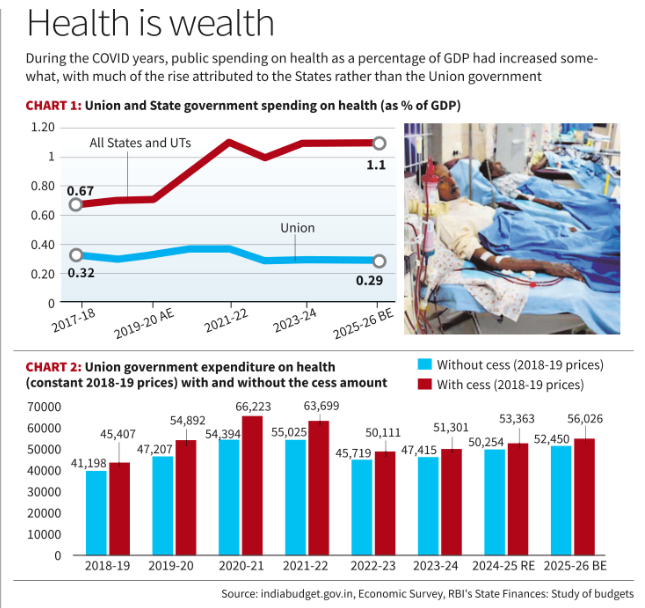
- This required raising Centre’s allocation from 0.29% to nearly 1% of GDP.
Comparative and Structural Context
- India’s public health spending remains low compared to regional and BRICS peers.
- Bhutan spent 2.5 times more per capita, while Sri Lanka spent three times more in 2021.
- Other BRICS nations recorded 14–15 times higher per capita health expenditure.
- Thailand and Malaysia spent at least ten times more per capita than India.
State-Level Spending Trends
- States and Union Territories increased allocations from 0.67% of GDP in 2017-18.
- Health spending reached 1.1% of GDP in 2025-26 Budget Estimates.
- Share of health in State budgets rose from 5% to 5.6%.
- Pandemic-related increases were largely driven by States, not the Union government.
Union Government Allocation Patterns
- Centre’s health spending declined from 0.37% of GDP in 2020-21.
- Allocation fell to 0.29% of GDP in 2025-26 Budget Estimates.
- Real health allocation in 2025-26 was 4.7% lower than 2020-21 levels.
- Share of health in Union Budget reduced from 2.26% to 2.05%.
Health and Education Cess Utilisation
- Health and Education Cess introduced in 2018-19 at 4% of taxable income.
- FY2023-24 collections reached ₹71,180 crore nationwide.
- Only one-fourth, about ₹17,795 crore, was directed toward health spending.
- Excluding cess, Union health allocation declined 22.5% in real terms since 2020-21.
Central Transfers and Scheme Funding
- Union transfers to States for health schemes declined from 75.9% in 2014-15.
- Transfers fell to 43% in 2024-25 Budget Estimates.
- Trend reflects financial centralisation despite health being primarily a State responsibility.
Impact on Key Health Programmes
- National Health Mission remains critical for rural and urban health service delivery.
- NHM spending growth averaged 7.4% during FY14–FY19.
- Real expenditure declined 5.5% during the second NDA tenure.
- Schemes for nutrition, research, and health infrastructure faced notable budget reductions.
