

Syllabus: Indian Economy and issues relating to planning, mobilization of resources, growth, development and employment
Strategic Context and Climate Commitments
- Union Environment Minister committed revised, ambitious NDC at COP30 in Belém, Brazil.
- Steel sector identified as hard-to-abate industry critical for economy-wide decarbonisation.
- Sector currently contributes around 12% of national carbon emissions due to coal dependence.
Growth Imperatives and Carbon Lock-in Risks
- Steel production must rise from 125 million tonnes to over 400 million tonnes by mid-century.
- Investments today determine long-term emissions trajectory and industrial competitiveness.
- High-carbon infrastructure risks locking billions into inefficient technologies and future market exclusion.
Global Signals and Competitive Pressures
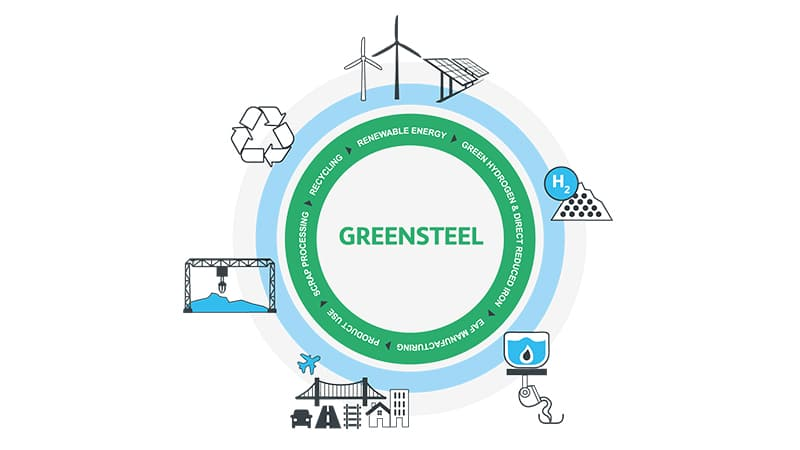
- China expanding scrap-based secondary steel and investing in green hydrogen integration.
- European Union’s CBAM penalises high-carbon steel exports entering European markets.
- Early adopters of low-carbon steel gain advantage in premium international markets.
Industry Initiatives in India
- Tata Steel piloted hydrogen injection, renewable power sourcing, and carbon capture exploration.
- JSW Steel and JSPL exploring green hydrogen pathways for low-carbon production.
- SAIL modernising blast furnaces and assessing alternative low-emission manufacturing routes.
Policy Framework and Progress
- Government released Greening Steel Roadmap outlining practical decarbonisation pathways.
- Green Steel Taxonomy 2024 formalised national definition for low-carbon steel.
- National Green Hydrogen Mission and CCTS targets cover 253 steel units.
Structural Barriers and Financing Challenges
- Limited and costly green hydrogen supply constrains industrial-scale adoption.
- Inadequate renewable energy dedicated for industrial transition needs.
- Informal scrap markets and insufficient natural gas availability hinder transition fuel strategy.
- Lack of long-maturity, low-cost debt increases risks for green steel investments.
Way Forward and Strategic Imperative
- Government must set clear short-, medium-, and long-term carbon targets for capital planning.
- Early rollout of carbon pricing regime to distribute transition costs across value chains.
- Develop public procurement market and certification systems for green steel demand.
- Establish regional green steel hubs to share infrastructure for energy and carbon management.
- Fiscal support essential for small and medium manufacturers ensuring equitable transition.
