

Western Disturbance

Context
- The India Meteorological Department issued an alert for consecutive Western Disturbances from January 31 to February 3, 2026.
What is a Western Disturbance?
- Extra-tropical low-pressure system originating over the Mediterranean region
- Travels eastward across Middle East, Iran, Afghanistan, and Pakistan
- Origin
- Develops over the Mediterranean Sea region
- Receives moisture from Caspian Sea and Black Sea
- Formation Mechanism
- Cold polar air interacts with warm moist Mediterranean air
- Forms extra-tropical depression system
- Guided by Subtropical Westerly Jet Stream toward Indian subcontinent
- Himalayan barrier forces uplift, causing condensation and precipitation
Impacts on India
- Winter Precipitation
- Primary source of non-monsoonal winter rainfall in India
- Causes snowfall in Western Himalayas and rain in northern plains
- Agricultural Effects
- Benefits Rabi crops like wheat, mustard, and gram
- Causes hailstorms and crop damage during intense disturbances
- Temperature Effects
- Raises night temperatures before arrival due to cloud cover
- Triggers cold waves after departure due to northerly winds
- Water Security
- Feeds Himalayan glaciers and perennial river systems
- Supports Ganga, Yamuna, and Indus river flows
Living Root Bridges – Meghalaya

Context
What is it?
- Pedestrian bridges grown from aerial roots of living trees
- Structures strengthen over time through natural biological growth
- Known locally as Jingkieng Jri among indigenous communities (Khasi and Jaintia).
Location
- Located in Meghalaya state of northeastern India
- Concentrated in East Khasi Hills and West Jaintia Hills
- Notable villages include Nongriat, Riwai, and Mawlynnong
Historical Background
- Developed as monsoon survival strategy for river crossings
- Oral traditions suggest some bridges over five hundred years old
Tree Species Used
- Grown from Ficus elastica, the Indian Rubber Tree
Construction Process
- Trees planted on opposite riverbanks for root guidance
- Roots guided using bamboo or hollowed Areca palm trunks
- Roots entwined and fused to form stable walking surface
- Stones placed between roots for flat and durable pathway
Timeframe and Durability
- Bridges become functional after ten to fifteen years
- Structures can last for several centuries
Menstrual Health as Right to Dignity
Constitutional Recognition
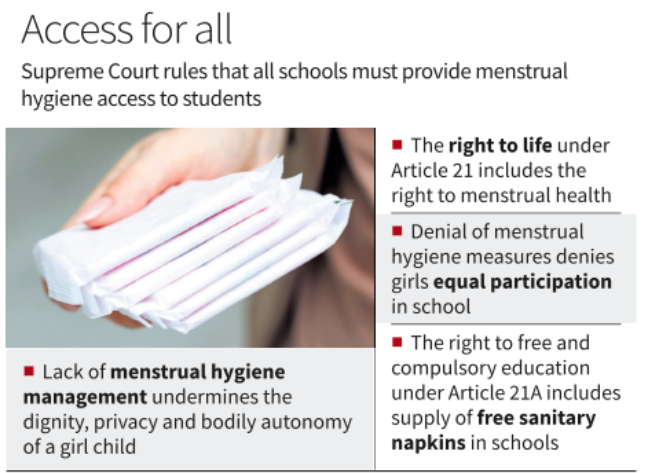
- Supreme Court declared menstrual health integral to right to life and dignity under Article 21.
- Court linked Menstrual Hygiene Management (MHM) to privacy, bodily autonomy, and decisional freedom.
- Judgment arose from a writ petition by Dr. Jaya Thakur on inadequate school facilities.
Impact on Education and Dignity
- Lack of MHM measures forces absenteeism or unsafe practices, undermining dignified student existence.
- Court held menstrual poverty restricts girls’ right to education on equal footing.
- Gender-specific barriers disrupt attendance and continuity, defeating free and compulsory education guarantees.
Directives to States and Schools
- States and Union Territories must provide functional, gender-segregated toilets in all schools.
- Schools must ensure free oxo-biodegradable sanitary napkins, preferably within toilet premises.
- Sanitary napkin vending machines mandated for easy and private student access.
Comprehensive MHM Infrastructure
- Schools must establish MHM corners with spare innerwear, uniforms, and disposable materials.
- Court emphasised availability of water and hygienic disposal mechanisms for meaningful autonomy.
- MHM extends beyond sanitation to include privacy, dignity, and bodily control.
Sensitisation and Accountability
- Court stressed educating male teachers and students on biological realities of menstruation.
- Objective is to prevent harassment, stigma, and invasive questioning of menstruating students.
- Government schools accountable under Section 19 of the RTE Act for compliance.
- Private schools face de-recognition and penalties for violating prescribed RTE norms.
New Aadhaar App

Context
- The Unique Identification Authority of India (UIDAI) launched the New Aadhaar App in January 2026 with privacy-first design.
What is it?
- Next-generation mobile platform for Aadhaar services and identity management
- Designed by UIDAI under consent-based data sharing framework
Difference from mAadhaar
- Focuses on data minimisation and user-controlled information sharing
- Aligned with Digital Personal Data Protection Act
Core Objectives
- Eliminates photocopy misuse during hotel and airport identity checks
- Provides identity at fingertips with selective data sharing control
- Reduces visits to Aadhaar Seva Kendras for routine updates
Offline Verification Features
- Enables identity verification without active internet connection
- Generates password-protected Share ID files with limited personal fields
- Provides QR-based digitally signed identity verification
Update Services from Home
- Allows mobile number update using Face Authentication
- Supports address update through application interface
- Charges ₹75 nominal fee per update request
- Updates reflected within fifteen days timeline
One Family – One App
- Manages up to five Aadhaar profiles on single smartphone
Selective Data Sharing
- Allows sharing photo and age only for low-security verification
- Allows sharing name and address only for service access
- Masks twelve-digit Aadhaar number completely
Biometric Security
- Enables one-click biometric lock and unlock feature
- Prevents unauthorised fingerprint and iris authentication usage
Significance
- Aligns with Digital Personal Data Protection (DPDP) Act compliance for digital identity protection
- Enables safe instant verification for service providers and gig workers
About Unique Identification Authority of India (UIDAI)
- Establishment
- Statutory body under Aadhaar Act, 2016
- Operational since July 12, 2016
- Headquarters and Ministry
- Headquarters located in New Delhi
- Functions under Ministry of Electronics and Information Technology (MeitY)
- Key Functions
- Issues 12-digit Aadhaar numbers to residents of India
- Provides biometric and demographic authentication services
- Ensures security and privacy of Aadhaar identity data
- Enables digital inclusion through welfare and financial services
- Establishes policies for Aadhaar lifecycle management
National Legal Services Authority (NALSA)

Context: The Minister of State for Law and Justice informed the Rajya Sabha about district legal services clinics under NALSA.
About
- Established under Legal Services Authorities Act, 1987
- Provides free and competent legal services to poor and marginalised sections
- Covers Scheduled Castes and Scheduled Tribes beneficiaries
- Headquarter: Housed at Supreme Court of India, New Delhi
Institutional Structure
- State Legal Services Authority in every State
- High Court Legal Services Committee in every High Court
- District Legal Services Authorities in all districts
- Taluk Legal Services Committees in most taluks
Free Legal Services Include
- Payment of court fees and legal process charges
- Provision of lawyers for legal proceedings
- Supply of certified copies of legal documents
- Preparation of appeals, paper books, translations, and printing
Eligible Beneficiaries
- Women and children
- Members of SC and ST communities
- Industrial workmen
- Victims of disasters and violence
- Persons with disabilities
- Persons in custody
- Low-income persons below prescribed annual income limits
- Victims of human trafficking
Income Eligibility Limits
- ₹1 lakh annual income for general legal services eligibility
- ₹5 lakh limit for Supreme Court Legal Services Committee cases
Stem Cell Therapy

Context: Supreme Court bans stem cell therapy for Autism Spectrum Disorder outside approved clinical trials.
More in news:
- SC criticizes government for failing to act against unproven ASD treatments.
- Lacks scientific evidence on efficacy and safety; informed consent not possible.
- Court directed government to constitute dedicated regulatory authority for stem cell research.
- Consent invalid as therapy is scientifically unvalidated and ethically impermissible.
- Clinics violated New Drugs and Clinical Trial Rules, 2019 promoting miraculous cure.
What is Stem Cell Therapy?
- Form of regenerative medicine repairing damaged cells and reducing inflammation
- Modulates immune system responses for treatment of various medical conditions
Process Involved
- Harvesting: Collection of stem cells from patient or donor source
- Conditioning: Prepares body to receive transplanted stem cells
- Transplantation: Infusion of stem cells into patient’s bloodstream
What are Stem Cells?
- Undifferentiated cells capable of forming specialised cells with specific functions
- Can divide to create new stem cells or specialised body cells
- Types of Stem Cells
- Pluripotent stem cells: Differentiate into all adult body cell types
- Adult stem cells: Regenerate cells specific to particular tissue or organ
Autism Spectrum Disorder (ASD)
- It is neurological and developmental disorder.
- Affects communication, learning, and behavior.
Jal Jeevan Mission (JJM)

Context: Jal Jeevan Mission achieved 98% tap coverage, but only 76% households have functional, reliable water supply.
More in news:
- 83% households received water in last seven days despite 98% tap availability.
- Only 80% households got sanctioned minimum 55 litres per person daily.
- 76% households met water quality standards for e-coli, coliform, pH levels.
- Bihar (61%), UP (72%), Nagaland (74%) reported lowest water availability among states.
- 2.72 lakh of 5.8 lakh villages certified as Har Ghar Jal villages.
About Jal Jeevan Mission (JJM)
- Background
- Restructured from National Rural Drinking Water Programme
- Implemented as Centrally Sponsored Scheme
- Nodal Ministry
- Department of Drinking Water and Sanitation
- Under Ministry of Jal Shakti
- Funding Pattern
- 90:10 for Himalayan and North-Eastern States
- 100 percent funding for Union Territories
- 50:50 funding for other States
- Mission Objective
- Provide functional household tap water connections in rural areas
- Core Components
- Ensures safe drinking water quality standards nationwide
- Promotes groundwater recharge and source sustainability
- Encourages greywater reuse and wastewater recycling systems
- Supports bottom-up community planning and local participation
- Strengthens women involvement in planning and monitoring
- Builds local skills for operation and maintenance workforce
- Prioritises tap water access for schools and Anganwadi Centres
- States with 100 Percent Coverage
- Arunachal Pradesh, Goa, Haryana, Himachal Pradesh, Gujarat, Punjab, Telangana, Mizoram
- Arunachal Pradesh, Goa, Haryana, Himachal Pradesh, Gujarat, Punjab, Telangana, Mizoram
Foreign Portfolio Investment (FPI)

Context: Foreign Portfolio Investors (FPIs) sold ₹35,962 crore in January 2025, highest in five months.
More in news:
- FPIs sold ₹1.66 lakh crore in Indian equities during CY2025.
- Weak earnings and rupee depreciation drove foreign institutional investor selling pressure.
- India-focused funds withdrew $340 million for third consecutive week in January.
- FIIs net bought ₹312 crore through mutual fund route showing cautious approach.
About FPI
- Foreign Portfolio Investment (FPI) refers to investments by foreign entities in financial assets like stocks, bonds, securities.
- Distinct from Foreign Direct Investment (FDI): does not involve acquiring control over business operations.
- Key Characteristics
- Passive investment: investors do not participate in company management or strategic decision-making processes.
- Short-term focus: aims for capital appreciation rather than long-term strategic interests in companies.
- Enhances market liquidity: provides capital flow into financial markets increasing efficiency and investment potential.
- Sensitive to market sentiments: highly volatile; investors can quickly withdraw funds during economic/political instability.
- FPI Policy in India
- A foreign investor can hold up to 10% total paid-up capital without being classified as FDI.
- Holding exceeds 10%: reclassified as Foreign Direct Investment (FDI) with different regulatory requirements.
- Regulated by SEBI, ensuring compliance with financial laws and market regulations for investor protection.
FII vs FPI
| Aspect | Foreign Institutional Investors (FIIs) | Foreign Portfolio Investors (FPIs) |
| Definition | Subset of FPIs, including Mutual Funds, Pension Funds, Insurance Companies, Hedge Funds | Broad category of foreign investors, including FIIs and individual investors |
| Investment Approach | Structured, strategic investment approach | Diverse investment strategies, can include speculative investments |
| Hierarchical Relationship | All FIIs are FPIs, but not all FPIs are FIIs | Higher level than FIIs in terms of investor types |
FDI vs FPI
| Aspect | Foreign Direct Investment (FDI) | Foreign Portfolio Investment (FPI) |
| Definition | Involves active management and physical business investment, like factories, offices | Involves passive investment, such as stocks, bonds only |
| Management Involvement | Actively manage business assets and operations | No direct management, only financial asset purchases |
| Exit Strategy | Difficult to exit, involves selling physical business assets (long-term commitment) | Easier to withdraw, as securities are highly liquid (short-term investment) |
| Market Type | Primary market (long-term focus) | Secondary market (short-term speculative investments) |
| Economic Impact | FDI boosts economic growth, employment, innovation | FPI primarily provides market liquidity |
Stock Exchanges in India
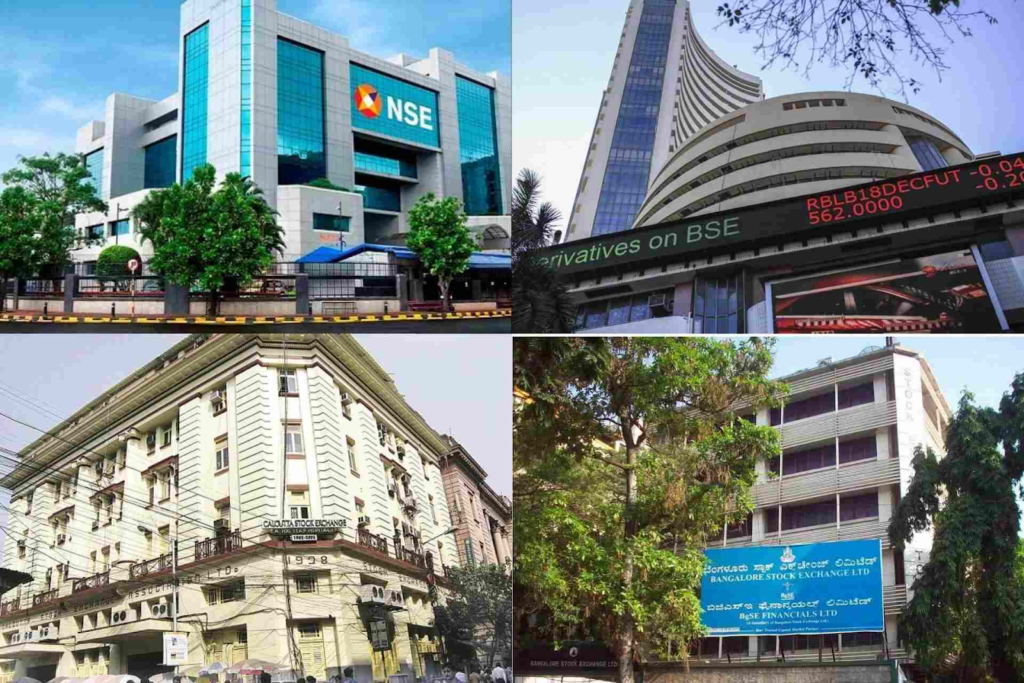
Bombay Stock Exchange (BSE)
- Oldest stock exchange in Asia
- Introduced SENSEX in 1986
- Tracks top 30 listed companies
- Ranks among top ten valued exchanges globally
- Offers equities, derivatives, and commodities trading
National Stock Exchange (NSE)
- Incorporated in 1992, trading began in 1994
- First fully electronic trading exchange in India
- Launched NIFTY 50 Index in 1995–96
- Introduced dematerialised securities trading and settlement
Multi-Commodity Exchange (MCX)
- One of largest commodity exchanges in India
- Used by hedgers, traders, businesses, and companies
- Focuses on non-agricultural commodity derivatives
National Commodity and Derivatives Exchange (NCDEX)
- Major commodity exchange focused on agricultural products
- Started operations around same time as MCX
- Trades agri-commodities only
India International Exchange (India INX)
- India’s first international stock exchange
- Opened in January 2017
- Subsidiary of BSE
- Located at IFSC, GIFT City, Gujarat
- Trades derivatives and international debt instruments
NSE IFSC (NSE International Exchange)
- Incorporated on 29 November 2016
- Wholly owned subsidiary of NSE
- Located at IFSC, GIFT City, Gujarat
- Offers derivatives and debt market instruments
Indian Commodity Exchange (ICEX)
- SEBI-registered permanent commodity derivatives exchange
- Only exchange offering diamond derivative contracts
- Trades agri-derivatives including spices and oilseeds
Calcutta Stock Exchange (CSE)
- One of oldest stock exchanges in India
- Granted permanent recognition in 1980
- Recognised under Securities Contracts Regulation Act, 1956
- Maintained index called CSE-40
Metropolitan Stock Exchange (MSE)
- Recognised by Ministry of Corporate Affairs in 2012
- Offers futures, options, currency, and debt instruments
Power Gap Index

Context: The Economic Survey 2025–26 cited the Power Gap Index, highlighting India’s negative strategic performance score.
What is it?
- Secondary measure derived from Asia Power Index
- Measures power efficiency converting resources into regional influence
- Assesses wealth and military versus diplomacy and networks
Score Interpretation
- Positive score: Overperformer or smart power state
- Negative score: Underperformer with unrealised strategic potential
Developed By
- Developed by Lowy Institute, Sydney-based international policy think tank
- Part of Asia Power Index project, launched in 2018
Core Objective
- Shows resources do not automatically create geopolitical influence
- Identifies failures in diplomacy, trade, and defence networks
Methodology
- Compares comprehensive power score with expected power from resources
- Uses 131 indicators across eight thematic measures
Resource-Based Measures
- Economic capability: GDP, technology, and global connectivity
- Military capability: Spending, forces, and signature weapons
- Resilience: Internal stability, energy security, nuclear deterrence
- Future resources: Demographics and economic projections for 2035
Influence-Based Measures
- Economic relationships: Trade ties and investment leverage
- Defence networks: Alliances, diplomacy, and arms transfers
- Diplomatic influence: Global standing and foreign policy ambition
- Cultural influence: Ability to shape international opinion
India – Asia Power Index 2025
- Ranked third after United States and China
- Classified as Major Power for first time
- Recorded power gap score of minus four
Digital Food Currency

Context
- The Government of India will launch a CBDC pilot in February 2026 for PDS beneficiaries in Chandigarh, Puducherry, and Gujarat districts.
What is it?
- Programmable e-Rupee tokens locked for foodgrain purchases at Fair Price Shops
- Serves as proof of concept for nationwide digital welfare currency rollout
Developed By
- Regulator: Reserve Bank of India (RBI)
- Implementer: Ministry of Consumer Affairs, Food and Public Distribution
- Supported by NPCI and State Governments
Primary Objectives
- Ensures subsidy usage strictly for foodgrain purchases
- Enables real-time tracking of foodgrain distribution
- Reduces biometric authentication dependency at ration shops
- Promotes digital-first inclusion through RBI digital wallets
How It Works
- Monthly digital coupons credited to RBI-enabled beneficiary wallets
- Beneficiary scans Fair Price Shop QR code for redemption
- Digital tokens transferred and entitled foodgrains dispensed
- Coupons carry time-bound validity to prevent accumulation
Key Features
- Covers urban UTs and PDS-active Gujarat districts
- Supports feature phones through SMS or offline digital modes
- Reduces e-POS biometric machine reliance for authentication
- Integrated with Food Corporation of India grain supply chain
Significance
- Replaces cash transfers and grain movement with digital ledger efficiency
- Positions India as early adopter of programmable CBDC in welfare delivery
- Ensures Right to Food through restricted digital spending mechanism
NPS Swasthya Pension Scheme (NSPS)

Context: The Pension Fund Regulatory and Development Authority launched NSPS as a pilot under the Regulatory Sandbox Framework.
What is it?
- Proof of Concept scheme under National Pension System framework
- Integrates health-related financial benefits with pension savings
- Operates within Multiple Scheme Framework of NPS
- Offered to Indian citizens on voluntary basis
Regulatory Framework
- Implemented under PFRDA Regulatory Sandbox Framework
- Certain PFRDA Exits and Withdrawals Regulations, 2015 relaxed
- Launched by Pension Funds with prior PFRDA approval
Pilot Design
- Enrolment limited to restricted number of subscribers
- Implemented for limited and controlled period
Eligible Subscribers
- Open to all Indian citizens
- Requires Common Scheme Account under NPS
Contribution Rules
- Allows flexible contributions under non-government NPS guidelines
- Subscribers above 40 years may transfer 30 percent contributions
Withdrawals for Medical Expenses
- Allows partial withdrawal up to 25 percent of contributions
- Requires minimum corpus of ₹50,000
- Permits 100 percent premature withdrawal for critical inpatient treatment
Claim Settlement Mechanism
- Payments made to Health Benefit Administrator or Third Party Administrator
- Hospitals receive funds based on verified medical bills
- Surplus transferred back to Common Scheme Account
Implementation Support
- Allows collaboration with FinTech firms and health administrators
Pechora Missile System

Context: Alpha Design Technologies Limited upgraded the Indian Air Force’s Pechora system under indigenous modernisation.
What is it?
- Soviet-origin medium-range surface-to-air missile system
- Designed for low and medium-altitude aerial target interception
- Official Name: Known as S-125 Neva/Pechora
- Service in India: Operational in Indian air defence network since 1970s
System Components
- Consists of radar-guided missile launcher and fire control unit
- Typically employs V-600 surface-to-air missile
Radar System
- Uses 4R90 Yatagan radar with five parabolic antennas
- Performs target detection, tracking, and engagement lock
Operational Capabilities
- Effective against slow-moving and low-flying aerial threats
- Suitable for drones and cruise missile interception
Network Integration
- Operates independently or within integrated air defence networks
- Functions under heavy electronic jamming environments
Range and Altitude
- Operational firing range up to thirty to thirty-five kilometres
- Engages targets from twenty meters to twenty-five kilometres altitude
Detection and Accuracy
- Radar detects targets up to one hundred kilometres distance
- Kill probability around ninety-two percent success rate
- Engagement CapacityCan engage two targets simultaneously at nine hundred meters speed
