

Syllabus: Issues relating to development and management of Social Sector/Services relating to Health, Education, Human Resources
Background and Judicial Intervention
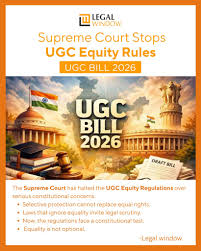
- On January 29, 2026, the Supreme Court stayed newly notified UGC equity regulations.
- The Court observed the rules were vague and susceptible to misuse.
- The 2026 framework was designed to replace the 2012 anti-discrimination regulations.
- The objective was to address caste discrimination in higher education institutions.
Core Features of the 2026 Regulations
- Notified on January 13, 2026, by the University Grants Commission.
- Defined “caste-based discrimination” as acts only against SC, ST, and OBC groups.
- Defined “discrimination” as unfair or biased treatment based on identity attributes.
- Introduced a layered grievance redressal structure across higher education institutions.
- Mandated Equal Opportunity Centres, Equity Committees, and Equity Squads at institutional levels.
- Provided for Equity Ambassadors in departments and academic units.
- Established an institutional accountability mechanism with penalties for non-compliance.
Grounds for Protests and Criticism
- Protesters argued the definition excluded general or upper caste protections.
- The absence of a “false complaint” provision raised concerns of procedural misuse.
- Ambiguity around the powers and functioning of Equity Squads drew criticism.
- Critics said the rules presupposed perpetrators belonged to specific social categories.
Origins and Supreme Court Supervision
- Drafted under supervision of a Supreme Court Bench hearing 2019 petitions.
- Petitions were filed by families of Rohith Vemula and Payal Tadvi.
- Allegations highlighted rampant caste discrimination under the 2012 framework.
- UGC constituted an Expert Committee led by Professor Shailesh N. Zala.
- The committee prepared a revised equity framework, finalised in 2026.
Comparison with 2012 Regulations
- The 2012 rules did not separately define caste-based discrimination.
- They listed 25 specific discriminatory practices across campus life.
- They mandated Equal Opportunity Cells, SC/ST Cells, and anti-discrimination officers.
- The earlier framework lacked protections for OBC groups.
- It also did not impose institutional penalties for non-compliance.
Current Status and Way Forward
- The Supreme Court directed temporary reversion to the 2012 regulations.
- Petitions will be heard alongside the original 2019 discrimination cases.
- The Court framed legal questions on scope, inclusivity, and institutional accountability.
- The next phase of hearings is scheduled for March 2026.
