Core Recommendation and State Response
- The 16th Finance Commission (FC-16) retained 41% vertical devolution for States from the divisible pool.
- Eighteen States demanded an increase to 50%, while others sought 45–48%.
- The Centre advocated moderation, favouring fiscal flexibility over higher State transfers.
Structural Issue: Shrinking Divisible Pool
- The divisible pool excludes cesses, surcharges, and collection costs, reducing shareable revenue.
- The Centre increasingly relies on non-shareable levies, limiting State fiscal space.
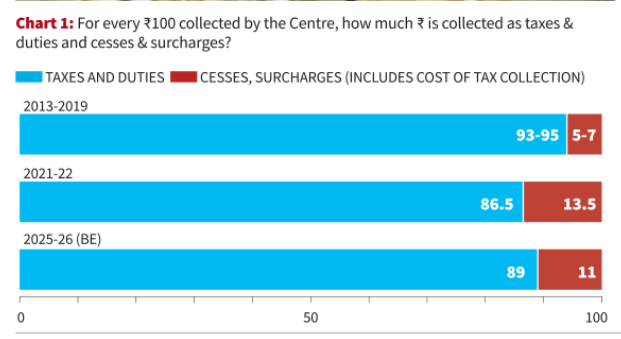
- Between 2013–2019, ₹93–95 per ₹100 formed the divisible pool.
- In 2021–22, only ₹86.5 per ₹100 was shareable, with ₹13.5 as cesses and surcharges.
- For 2025–26, estimates show ₹89 shareable and ₹11 non-shareable per ₹100.
Evidence from GDP and Absolute Collections
- Non-shareable revenues rose from 1.1% of GDP in 2011–12 to 2.2% in 2023–24.
- Divisible pool hovered around 9.1–9.4% of GDP, showing limited expansion.
- Cesses collections increased from ₹44,688 crore in FY15 to ₹3,52,650 crore in FY22.
- Surcharges rose from ₹15,702 crore in FY15 to ₹40,758 crore in FY22.
FC-16 Justifications
- The Constitution does not cap cesses and surcharges, allowing Centre fiscal discretion.
- These levies fund emergencies, including war, famine, and pandemics.
- The Commission highlighted defence needs and infrastructure efficiency as Centre priorities.
- It asserted States have sufficient resources to meet constitutional responsibilities.
Critiques and Unresolved Questions
- The rising share of non-divisible revenues weakens State fiscal autonomy.
- High-performing States receive limited gains despite productivity contributions.
- FC-16 suggested a voluntary Centre shift toward regular taxes to expand the pool.
- Critics question whether constitutional intent supports such cess-driven centralisation.
Implications for Fiscal Federalism
- Transfers to States grow, but 42% of increases come through Centrally Sponsored Schemes.
- This reinforces a model where States implement Centre-defined priorities.
- The article concludes structural reform is required to restore federal balance.