Scale and Fiscal Context
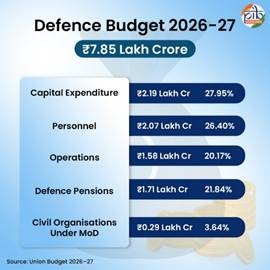
- Defence allocation for FY2026–27 reached a record ₹7,84,678 crore, nearing the ₹8 lakh crore mark.
- This equals 14.7% of total Union expenditure, stabilising defence share after pandemic-era decline.
- Defence share had fallen to 13.2% during FY2021–FY2022, raising security insulation concerns.
- Sustaining 14–15% expenditure share could shield defence priorities from fiscal consolidation pressures.
Shift Towards Capital Outlay
- Capital expenditure share increased to 27.9% of the total defence budget in FY2027 BE.
- This marks a rise from 24.9% in FY2023 Actuals and 24.5% in FY2020 Actuals.
- Absolute defence capex stands at ₹2,19,306 crore, reflecting a nearly ₹40,000 crore year-on-year jump.
- The rise departs from earlier trends where Revised Estimates trailed Budget Estimates and Actuals.
Geopolitical and Operational Drivers
- FY2027 Budget is the first full allocation after Operation Sindoor and Pahalgam terror attack.
- The conflict highlighted shortages in precision-guided munitions and loitering munitions stockpiles.
- Capex rise likely supports replenishment of war wastage reserves and two-front preparedness.
- Emergency Procurement mechanisms appear increasingly institutionalised for critical defence technologies.
Managing Committed Liabilities
- A large share of past capex is absorbed by installments for legacy contracts.
- Examples include payments for S-400 systems, Rafale aircraft, and Akash missiles.
- Higher untied capex enables new contract signings for advanced platforms and submarines.
- Defence contracts require 10–15% upfront funding availability in the signing fiscal year.
Revenue Expenditure Rationalisation
- Pension share declined to 21.8% in FY2027, from 26% in FY2020.
- Salary component moderated to 22.4%, down from 30% in FY2020.
- This trend reflects Agnipath implementation and policy to restrain revenue expenditure growth.
Aatmanirbhar Bharat and Industry Role
- Nearly 75% of capital acquisition budget reserved for domestic industry.
- Emphasis placed on “Buy Indian-IDDM” procurement route for indigenous platforms.
- Key challenge remains absorption capacity and timely delivery by defence manufacturers.
- Budget signals confidence in the maturity of India’s defence industrial ecosystem.