Syllabus: Government Budgeting.
Context: Development Vision and Spending Priorities
- Budget speech highlighted expenditure programmes aimed at achieving Viksit Bharat by 2047.
- Strong emphasis placed on advanced technology sectors like AI, biopharma, semiconductors, critical minerals.
- Implementation efficiency and execution pace remain key concerns.
Expenditure Restructuring for Fiscal Space
- Government undertook sustained restructuring of revenue expenditure to create fiscal room.
- Revenue expenditure share declined from 88% (2014-15) to 77% (2026-27 BE).
- Represents a fall of 11 percentage points over a decade.
- Central subsidies share alone declined by 7 percentage points.
- Simultaneously, capital expenditure share increased in total spending.
Capital Expenditure Trends
- Higher capex supported GDP growth in post-pandemic years.
- Growth rate declined from 28.3% (2023-24) to 10.8% (2024-25).
- Further slowed to 4.2% in 2025-26 (RE).
- Budget projects 11.5% growth in 2026-27.
- Capex remains nearly static at 3.1% of GDP.
- Previous year’s budgeted 10.1% growth realised only 4.2%.
Revenue Receipts and Tax Buoyancy
- Tax revenue projections for 2026-27 are cautious yet realistic.
- Overall gross tax buoyancy estimated at 0.8, below benchmark 1.
- Direct tax buoyancy: 1.1 with 61.2% revenue share.
- Indirect tax buoyancy: 0.3 with 38.8% share.
- Weak GST collections drive low overall buoyancy.
- Suggestion: strengthen indirect tax structure to raise buoyancy.
Transfers to States and FC-16 Impact
- Vertical devolution retained at 41% of divisible pool.
- States’ tax assignment steady at 3.9% of GDP.
- No revenue deficit grants recommended.
- Total FC grants declined from 0.43% to 0.33% of GDP.
- Contrary to past trends, first award year saw no grant expansion.
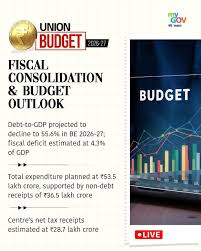
Pace of Fiscal Consolidation
- Fiscal deficit reduction pace has progressively slowed.
- Annual decline: 0.7 → 0.4 → 0.1 percentage points.
- Shift from deficit targeting to debt-GDP targeting noted.
- Calls for transparent glide path projections.
- FRBM 2018 targets: 3% fiscal deficit, 40% debt-GDP.
Debt Burden and Interest Pressures
- High debt increases interest payment obligations.
- Effective interest rate estimated at 7.12% (2026-27 BE).
- Interest payments nearly 40% of revenue receipts.
- Constrains fiscal space for primary expenditures.
Macroeconomic Implications
- Excess public borrowing crowds out private investment resources.
- Combined deficits of 8–9% of GDP reduce investible surplus.
Overall Assessment
- Budget provides a broad developmental roadmap towards 2047 goals.
- Sustained growth requires monetary stability and fiscal discipline.
- Fiscal consolidation path needs careful recalibration and transparency.