
Syllabus: Bilateral, regional and global groupings and agreements involving India and/or affecting India’s interests.
Context and Strategic Significance
- India’s evolving trade architecture reflects a strategic, partnership-driven economic diplomacy approach.
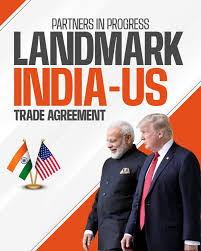
- Recent trade deal with the United States marks a major milestone.
- Negotiations involved sustained dialogue, technical consultations and quiet diplomacy.
- U.S. tariffs on Indian goods reduced to 18%.
- Provides improved market access, predictability and partnership opportunities.
Expanding Global Trade Network
- Deal strengthens India’s widening network of strategic trade agreements.
- Agreements concluded with EU, U.K., EFTA enhance European access.
- Trade pacts with Australia, New Zealand deepen Pacific integration.
- Agreements with Oman, UAE expand West Asian connectivity.
- Reflects India’s deepening global economic integration.
Importance of U.S. as Export Destination
- U.S. is the largest global import market.
- Also India’s biggest export destination, accounting for nearly one-fifth exports.
- Export basket includes apparel, gems, jewellery, agriculture, footwear, leather.
- Supports employment and manufacturing value chains.
Immediate Export Gains
- Earlier 50% tariffs had eroded competitiveness.
- Reduction to 18% restores price advantage.
- Enhances export viability and market share.
- Creates policy certainty for exporters.
- Provides momentum to India–U.S. Bilateral Trade Agreement negotiations.
Sector-Wise Benefits
- Apparel sector gains most; U.S. is largest apparel importer.
- India now faces lower tariffs than Vietnam, Bangladesh.
- Gems and jewellery benefit due to tariff-sensitive margins.
- Gains extend to marine products, processed foods, footwear, leather.
- Encourages capacity expansion across labour-intensive sectors.
Competitive Positioning Globally
- Improves India’s position vis-à-vis China, ASEAN, Brazil, Pakistan, Sri Lanka.
- Strengthens diversified global supply chain participation.
- Advances goal of becoming a global manufacturing hub.
Investment and Technology Linkages
- Opens pathways for joint ventures and technology partnerships.
- Encourages investments in high-value sectors.
- Promotes innovation, employment and skill development.
Strategic and Geopolitical Dimensions
- Strengthens broader India–U.S. economic partnership.
- Reinforces cooperation in digital trade, clean energy, innovation.
- Complements strategic platforms like the Quad.
- Enhances supply-chain resilience and trusted partnerships.
Long-Term Implications
- Moves engagement from tariffs to trust-based cooperation.
- Expands collaboration in technology, defence, energy, manufacturing.
- Consolidates India’s global economic leadership.
- Industry must now leverage opportunities through scale and competitiveness.