

Syllabus: Devolution of powers and finances up to local levels and challenges therein.
Context
- The 16th Finance Commission, chaired by Dr. Arvind Panagariya, submitted its report for 2026–31.
- The Union government has accepted its tax devolution recommendations.
Constitutional Framework of Tax Devolution
- Article 270 governs distribution of net tax proceeds between Centre and States.
- Shared taxes include corporation tax, income tax, CGST, and Centre’s IGST share.
- Distribution is based on Finance Commission recommendations under Article 280.
- Cess and surcharge are excluded from the divisible pool.
- Divisible pool forms about 81% of gross tax revenue (2025–26).
Evolution of Vertical Devolution
- Till the 13th Finance Commission, States received 32% share in Central taxes.
- Transfers were tied to Centrally Sponsored Schemes with conditionalities.
- The 14th Finance Commission raised devolution to 42%, ending tied transfers.
- The 15th Finance Commission reduced it to 41% after J&K reorganisation.
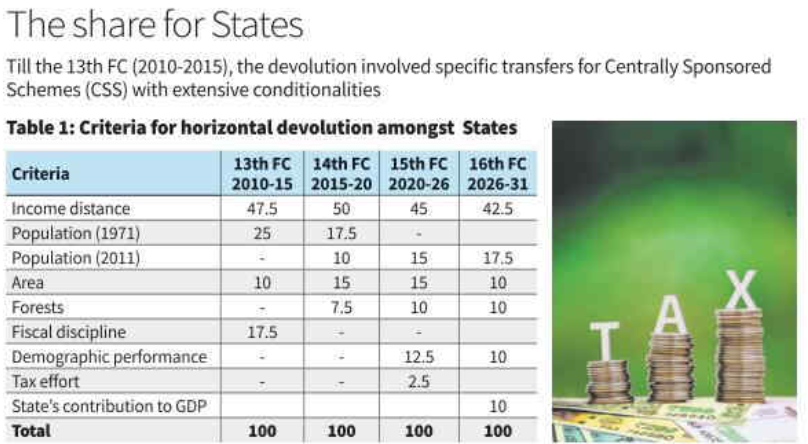
Horizontal Devolution Criteria
- Distribution among States uses equity, need, and efficiency indicators.
- Higher weightage given to income distance, population, and area.
- Efficiency factors include forests, demographic performance, and tax effort.
Demands Raised by States
- Vertical Devolution
- Eighteen States demanded increase from 41% to 50%.
- Some suggested 45–48% share.
- Many sought inclusion of cess and surcharge in the divisible pool.
- Some proposed capping Centre’s cess and surcharge levy.
- Horizontal Devolution
- Several States supported dominance of equity-based criteria.
- Many wanted reduced weight for income distance.
- Industrialised States sought inclusion of GDP contribution.
Key Recommendations of 16th FC
- Retained States’ vertical share at 41%.
- Cited Union needs for defence and infrastructure spending.
- Noted Union spending under CSS ultimately benefits States.
- Rejected capping or pooling of cess and surcharge.
New Horizontal Devolution Approach
- Added State contribution to GDP as a new efficiency criterion.
- Ensured gradual changes without drastic share redistribution.
- Southern and western States saw marginal share increase.
- Northern and central States witnessed marginal decline.
Additional Fiscal Observations
- Centre should reduce reliance on cess and surcharge.
- States must rationalise subsidies and power sector finances.
- Both levels should pursue public sector enterprise reforms.
