

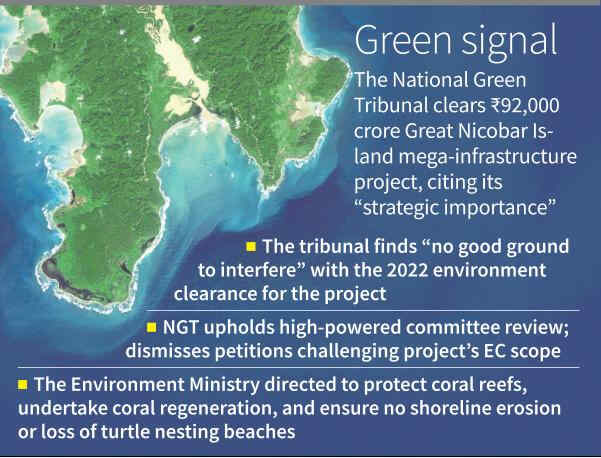
Context: The National Green Tribunal (NGT) has cleared the ₹92,000-crore Great Nicobar Island mega-infrastructure project.
More in News
- The tribunal cited the project’s strategic importance and found “adequate safeguards” in existing Environmental Clearance (EC) granted in 2022. The tribunal directed for strict compliance with the EC conditions rather than cancellation.
- NGT adopted a “balanced approach”, prioritising development under ICRZ Notification, 2019 over outright prohibition based on apprehension.
- Environment Ministry is now responsible for coral reef regeneration and preventing shoreline erosion caused by foreshore construction.
About the Project
- Overview
- Great Nicobar Project is a large Greenfield infrastructure initiative approved by the Union Cabinet (2021).
- Conceptualised by NITI Aayog to unlock strategic and economic potential of island territories.
- Implemented by Andaman and Nicobar Islands Integrated Development Corporation (ANIIDCO). The ANIIDCO functions as a government undertaking under the Companies Act, 1956.
- Core Infrastructure Components
- International Transshipment Port proposed at Galathea Bay on southern Great Nicobar coast.
- Port development overseen by Ministry of Ports, Shipping and Waterways.
- Project includes a Greenfield international airport to enhance regional air connectivity.
- A 450 MW power plant planned to meet industrial and residential energy demand.
- Development of a modern township to support workforce and logistics ecosystems.
- Strategic and Economic Significance
- Island lies near Malacca Strait, a corridor carrying one-third of global maritime trade.
- Proximity to Sunda and Lombok Straits enhances Indo-Pacific maritime relevance.
- Transshipment hub can reduce dependence on Singapore and Colombo ports.
- Nearly 75% of India’s cargo is currently transshipped through foreign ports.
- Naval port and airfield strengthen tri-services command in Andaman and Nicobar Islands.
- Enables deployment of ships, aircraft, and drones near critical sea lanes.
- Project promises forex savings, FDI inflows, logistics growth, and port-led development.
Concerns Regarding the Project
- Ecological and Tribal Concerns
- Great Nicobar retains over 85% tropical rainforest cover, marking extreme ecological sensitivity.
- Project threatens habitats of Shompen (PVTG) and Nicobarese tribal communities.
- Worker influx risks disease exposure among immunologically vulnerable tribal populations.
- Galathea Bay is a Ramsar wetland and key nesting site of Leatherback Sea Turtle.
- Dredging may damage coral reefs and seagrass ecosystems.
- Nearly 9.6 lakh trees may be felled, reducing regional carbon sequestration capacity.
- Mangrove removal weakens natural coastal defences against tsunamis and storms.
- Geological and Disaster Vulnerabilities
- Island lies within a high seismic zone along Indian Ocean megathrust fault lines.
- Same tectonic system triggered the 2004 Indian Ocean tsunami.
- Large infrastructure expansion heightens disaster exposure and recovery risks.
Balanced Development Pathway
- Project strengthens trade connectivity, maritime security, and regional economic integration. However, ecological fragility and tribal rights require careful safeguarding.
- Hence a phased, eco-sensitive and community-inclusive development offers a balanced way forward. Thus, aligning national security with biodiversity conservation ensures sustainable island governance.
National Green Tribunal (NGT)
- National Green Tribunal (NGT) is a specialised environmental court established under the National Green Tribunal Act, 2010.
- Became operational on 4 July 2011.
- Key Features
- Functions on principles of natural justice rather than strict civil procedures.
- Has both judicial members and expert members for balanced decision-making.
- Designed as a specialised forum for scientific and legal environmental disputes.
- Composition
- Chairperson: Retired Supreme Court Judge or Chief Justice of a High Court.
- Includes Judicial Members (former SC/HC judges).
- Includes Expert Members from science, engineering, or environmental fields.
- Members are appointed by the Central Government.
- Benches and Accessibility
- Principal Bench: New Delhi.
- Regional Benches: Bhopal, Pune, Kolkata, Chennai.
- Also uses circuit benches for wider access.
- NGT hears cases under major environmental laws, including:
- Water (Prevention and Control of Pollution) Act
- Air (Prevention and Control of Pollution) Act
- Environment Protection Act
- Forest Conservation Act
- Biological Diversity Act
- Public Liability Insurance Act
