

Context
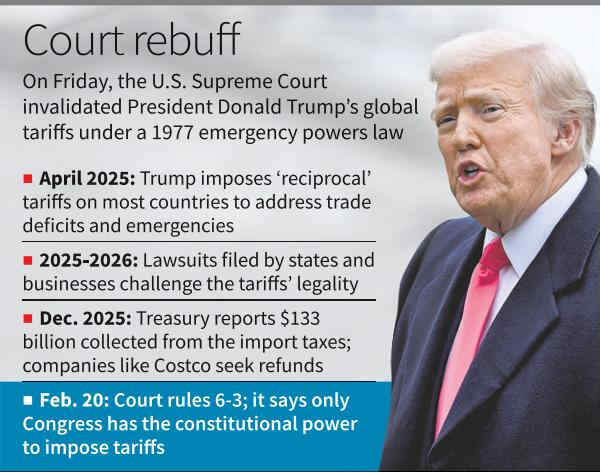
- The U.S. Supreme Court ruled that only Congress has constitutional power to impose taxes, including tariffs thus nullifying “reciprocal” tariffs imposed on nearly every country, including India, under an emergency powers law declared in April 2025.
More in News
- Trump imposed “reciprocal” tariffs on most countries in April 2025 to address trade deficits, declaring them a national emergency under emergency powers.
- Treasury had collected over $133 billion from import taxes under the emergency powers law as of December 2025, federal data shows.
- However the ruling doesn’t stop Trump from imposing duties under other laws, though those have more limitations on speed and severity of actions.
Economic Rationale Behind Reciprocal Tariffs
- The United States proposes reciprocal tariffs to counter perceived unfair trade practices.
- The proposal implies an average import tax rate of approximately 20 percent.
- Auto tariffs alone may generate $100 billion annually in revenue.
- The U.S. argues tariffs will protect domestic industries and strategic sectors.
Macroeconomic and Global Trade Implications
- Reciprocal tariffs may intensify inflationary pressures amid global economic instability.
- Higher auto tariffs could disrupt global supply chains significantly.
- Consumer prices may rise, affecting purchasing power in importing economies.
- Retaliatory measures by China, Canada, and Mexico may escalate trade tensions.
- WTO disputes could emerge, straining multilateral trade governance frameworks.
Risks of Trade Protectionism
- Escalating tariff wars may reduce investor confidence and slow global growth.
- Businesses dependent on imported inputs may face rising production costs.
- Persistent trade uncertainty could destabilise financial markets globally.
- Protectionist trends weaken the foundation of rules-based global trade.
- Canada has already introduced countermeasures worth billions of dollars.
Implications for India
- Higher U.S. tariffs may adversely affect India’s automobile exports and GDP growth.
- Trade diversification toward Europe, ASEAN, and Africa can reduce vulnerability.
- Strengthening domestic manufacturing through PLI schemes enhances resilience.
- Bilateral negotiations with the United States remain diplomatically essential.
- India may utilise WTO dispute mechanisms against discriminatory tariff actions.
