

Model Code of Conduct (MCC)

Context: An FIR has been registered in Jharkhand against Leader of the Opposition for allegedly violating the Model Code of Conduct (MCC) ahead of civic elections to 48 urban local bodies.
About Model Code of Conduct (MCC)
- The Model Code of Conduct (MCC) regulates political conduct during elections.
- Issued and enforced by the Election Commission of India.
- Applies to political parties, candidates, and ruling governments.
- Ensures elections remain free, fair, and transparent.
Objectives of MCC
- Maintain peaceful and orderly campaigning and polling process.
- Prevent misuse of government machinery and public funds.
- Check electoral malpractices and corrupt practices.
- Uphold the principle of level playing field in elections.
Duration & Scope
- Comes into force from announcement of election schedule.
- Remains effective until completion of election process, including counting.
- Applies nationwide during Lok Sabha general elections.
- Applies to entire State during Assembly elections.
- Applies only to concerned constituency during bye-elections.
Legal Status
- MCC is not a statutory law.
- It is a set of agreed guidelines.
- Violations may attract action under:
- Indian Penal Code, 1860
- Representation of the People Act, 1951
Key Provisions
- General Conduct
- Prohibits hate speech based on religion, caste, language, or community.
- Forbids bribery and impersonation of voters.
- Prohibits public meetings during 48 hours before polling ends.
- Meetings & Processions
- Parties must inform local police authorities in advance.
- Procession routes cannot be changed after permission.
- Conflicting routes must be resolved beforehand.
- Polling Day & Booth Rules
- No liquor distribution near polling stations.
- No display of campaign materials at polling booths.
- Only voters and authorised persons may enter polling stations.
- Party in Power
- Ruling party must not use official position for campaign purposes.
- Government machinery cannot be misused for electoral gain.
- Election Manifestos
- Manifestos must not make promises that unduly influence voters.
- Should not compromise purity of electoral process.
Enforcement Directorate (ED)
Context:
- The ED has identified eight priority focus areas for coordinated action during its 34th quarterly zonal officers’ conference held in Guwahati, headed by ED Director Rahul Navin.
- Eight priority areas identified: Foreign asset tracking, IBC misuse, trade-based money laundering, cyberfraud, illegal online gambling, drug financing, share market manipulation, and foreign interference funding.
About Enforcement Directorate (ED)
- Mandate: ED investigates money laundering and foreign exchange violations.
- History:
- Established in 1956 as the ‘Enforcement Unit’ under the Ministry of Finance.
- Renamed the Enforcement Directorate in 1957; control moved to the Department of Revenue.
- Headquarters & Offices:
- HQ: New Delhi.
- Regional offices: Mumbai, Chennai, Chandigarh, Kolkata, Delhi.
- Leadership: Headed by the Director of Enforcement; tenure 2 years, extendable up to 5 years.
- Key Laws Administered:
- Prevention of Money Laundering Act (PMLA), 2002: Detects and prosecutes money laundering; allows confiscation; burden of proof reversal.
- Foreign Exchange Management Act (FEMA), 1999: Governs foreign exchange violations; quasi-judicial powers to impose penalties.
- Fugitive Economic Offenders Act (FEOA), 2018: Attaches properties of offenders fleeing India.
- Conservation of Foreign Exchange and Prevention of Smuggling Activities Act (COFEPOSA), 1974: Enables preventive detention in foreign exchange offenses.
- Powers of ED:
- Investigative: Summon, record statements, conduct searches, seize property/documents.
- Arrest & Detention: Arrest suspects based on evidence with legal justification.
- Attachment & Confiscation: Temporarily attach assets up to 180 days; permanently confiscate after conviction.
- Quasi-Judicial: Adjudicate FEMA violations and impose penalties.
Regional Rapid Transit System (RRTS)
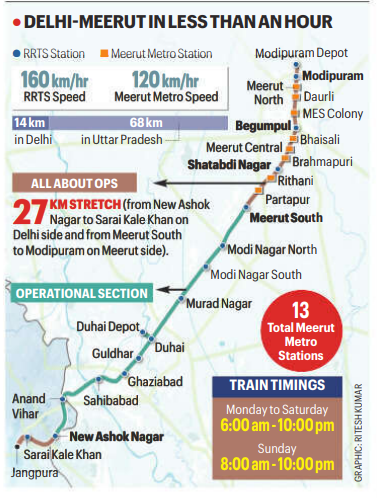
Context: PM Narendra Modi inaugurated the remaining sections of Namo Bharat Regional Rapid Transit System (RRTS). It is India’s first fully operational regional rapid transit system connecting Delhi-NCR.
About RRTS
- The Regional Rapid Transit System (RRTS) is an integrated mass transit network.
- It aims to enhance connectivity across the National Capital Region (NCR). The project promotes balanced and sustainable urban development.
- The concept originated from a study commissioned in 1998-99 and the NCR Planning Board adopted it in Transport Plan 2032.
Development & Implementing Agency
- The project is implemented by the National Capital Region Transport Corporation.
- NCRTC is a joint venture of Centre and NCR states.
- It operates under the Ministry of Housing and Urban Affairs.
- The RRTS is also branded as “Namo Bharat” services.
- The network spans nearly 55,000 square kilometres across NCR.
Key Features & Speed
- RRTS trains are designed for speeds up to 160 km per hour.
- Maximum operational speed can reach 180 km per hour.
- Delhi Metro typically operates between 100 and 120 km per hour.
- RRTS is ideal for covering longer inter-city distances rapidly.
- It operates at higher frequency compared to Indian Railways.
- The system offers improved passenger comfort and modern facilities.
Objectives of RRTS
- Improve multi-modal connectivity across major transport hubs.
- Reduce congestion on roads, highways, and railway networks.
- Encourage shift towards faster public transportation systems.
- Boost regional economic productivity through reduced travel time.
- Promote suburban development in Uttar Pradesh, Haryana, and Rajasthan.
Alpha Fade Rate

Basic Concept
- Alpha refers to excess return over a benchmark index.
- An alpha strategy aims to consistently generate positive excess returns.
- Alpha fade rate means gradual weakening of an alpha strategy. It reflects declining effectiveness of previously successful investment strategies.
Why Does Alpha Fade?
- Markets now show reduced information asymmetry among investors.
- Most participants access similar company data simultaneously. Cheap computing enables rapid testing of investment strategies. Competing institutions quickly replicate successful alpha strategies.
- When many investors follow same strategy, excess returns diminish. A strategy must remain unique to generate sustainable alpha.
Broader Implication
- Generating new strategies is easier than sustaining them.
- Alpha decay is common in developed markets like the United States.
- Emerging markets such as India may face similar trends.
- Investors must evaluate sustainability before choosing active funds.
Stem Cell Therapy

What is Stem Cell Therapy?
- Form of regenerative medicine repairing damaged cells and reducing inflammation
- Modulates immune system responses for treatment of various medical conditions
Process Involved
- Harvesting: Collection of stem cells from patient or donor source
- Conditioning: Prepares body to receive transplanted stem cells
- Transplantation: Infusion of stem cells into patient’s bloodstream
What are Stem Cells?
- Undifferentiated cells capable of forming specialised cells with specific functions
- Can divide to create new stem cells or specialised body cells
- Types of Stem Cells
- Pluripotent stem cells: Differentiate into all adult body cell types
- Adult stem cells: Regenerate cells specific to particular tissue or organ
Autism Spectrum Disorder (ASD)
- It is neurological and developmental disorder.
- Affects communication, learning, and behavior.
Biopharma SHAKTI

Basic Overview
- Biopharma SHAKTI stands for Strategy for Healthcare Advancement through Knowledge, Technology and Innovation.
- It is a national initiative to strengthen India’s biopharmaceutical sector and aims to position India as a global biomanufacturing hub.
- It focuses on biologics and biosimilars production within India and seeks to reduce dependence on imported advanced therapies.
Clinical and Manufacturing Strengthening
- Establishment of a National Clinical Trials Network across India.
- Aims to enhance domestic clinical research capacity.
- Investment in advanced biomanufacturing infrastructure facilities.
- Focus on quality assurance and regulatory compliance systems.
Innovation & Industry Collaboration
- Encourages collaboration between academia and pharmaceutical industry.
- Supports startups and indigenous biopharma innovation.
- Promotes technology transfer and domestic capability building.
Strategic Significance
- Enhances India’s pharmaceutical self-reliance and supply security.
- Supports treatment of non-communicable diseases like cancer and diabetes.
- Promotes development of monoclonal antibodies and advanced vaccines.
- Strengthens India’s role in global healthcare supply chains.