


Persian Gulf
Location and Basic Profile
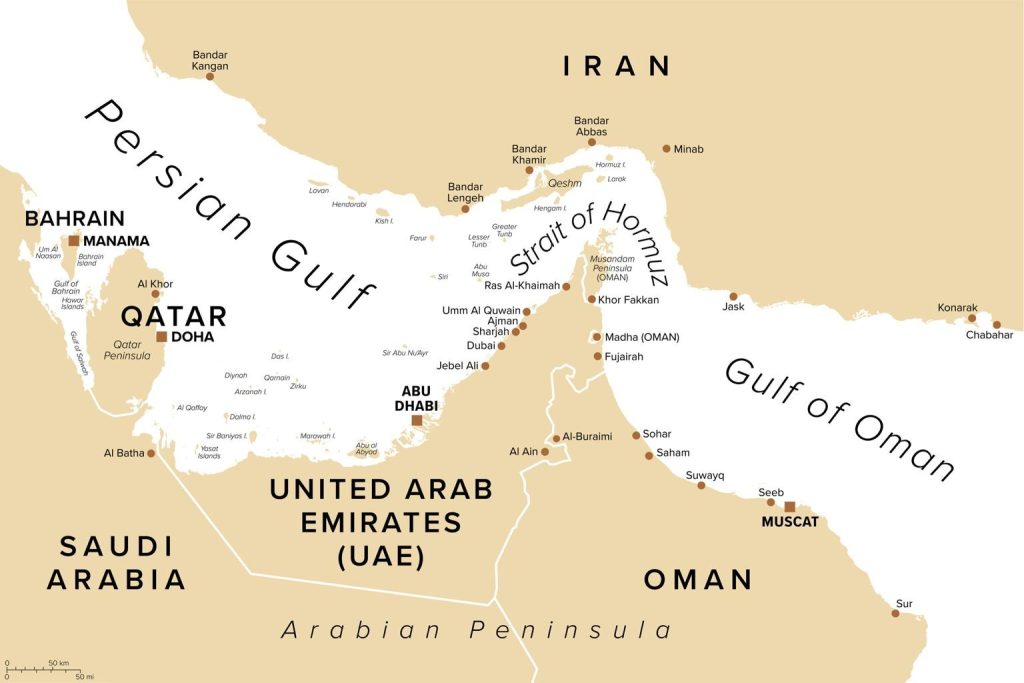
- The Persian Gulf is a shallow marginal sea of the Indian Ocean located in Western Asia.
- It lies between the Arabian Peninsula and southeastern Iran.
- The Gulf forms an important maritime region connecting West Asia with global sea routes.
Surrounding Countries
- Iran borders the Gulf to the north, northeast, and east.
- Saudi Arabia, Qatar, Bahrain, and the United Arab Emirates lie along the southwestern and southern coasts.
- Iraq and Kuwait are located on the northwestern side.
- Oman and the United Arab Emirates lie toward the southeastern side near the Gulf’s outlet.
Connection to the Arabian Sea
- The Persian Gulf is connected to the Arabian Sea through the Strait of Hormuz, a major global oil shipping chokepoint.
- The Strait of Hormuz and the Gulf of Oman together form the maritime passage linking the Persian Gulf with the Arabian Sea.
Major Physical Characteristics
- Area: Approximately 251,000 km².
- Average depth: About 50 metres.
- Maximum depth: Around 90 metres.
- Total coastline length: Nearly 5,117 km.
- Country with the longest coastline: Iran (about 1,536 km).
- Largest island: Qeshm Island (Iran) with an area of about 1,491 km².
- The western end of the Gulf contains the Shatt al-Arab delta, formed by the Tigris and Euphrates rivers.
Autonomous District Councils (ADCs)
About ADCs
- Autonomous District Councils (ADCs) are self-governing bodies created under the Sixth Schedule of the Indian Constitution.
- They provide administrative autonomy to Scheduled Tribes in certain tribal areas.
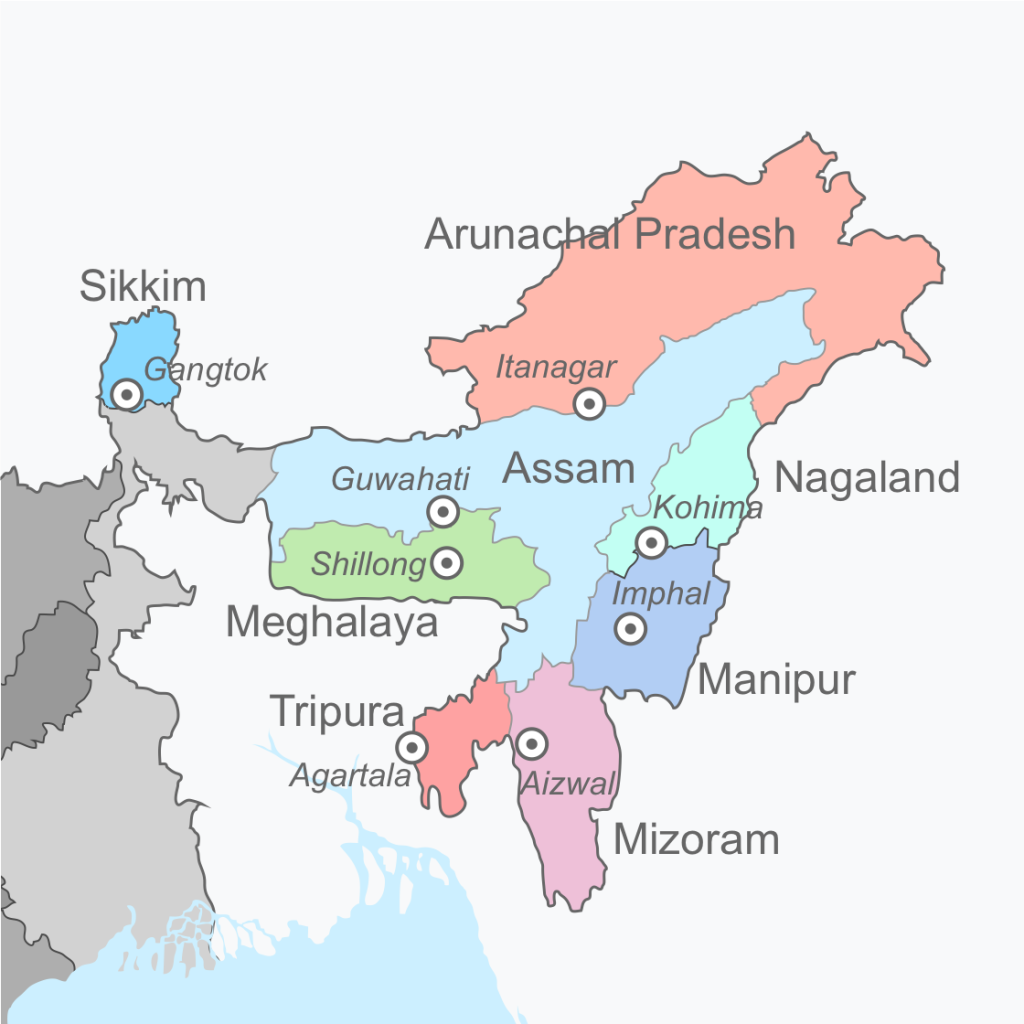
- ADCs exist in Assam, Meghalaya, Mizoram, and Tripura.
- Their purpose is to protect tribal customs, land rights, and local governance systems.
- Composition of the Councils
- The majority of members are elected through democratic elections for a five-year term.
- A limited number of members are nominated by the Governor to ensure representation of marginalised groups.
Powers of ADCs
- Legislative Powers
- Councils can make laws on land, forests, water resources, agriculture, public health, sanitation, and social customs.
- These laws mainly apply to tribal areas under the council’s jurisdiction.
- Executive Powers
- ADCs administer village councils, traditional chiefs, and aspects of local governance.
- They also regulate matters such as inheritance laws and community administration.
- Judicial Powers
- Councils can establish tribal courts to resolve disputes involving Scheduled Tribe communities.
- Such courts can impose sentences up to five years of imprisonment.
Functions of ADCs
- Govern tribal areas while safeguarding traditional customs and practices.
- Manage local natural resources such as forests and water bodies.
- Support development of basic infrastructure, including education, healthcare, and rural roads.
- Promote grassroots governance through village councils.
Revenue Sources
- ADCs have the authority to levy certain taxes and fees.
- These include taxes on land, buildings, vehicles, boats, and animals.
- Councils may also collect tolls on goods entering the district, ferries, and roads.
- Revenue can also be raised through general taxation for maintaining local infrastructure.
Revised Seismic Zonation Map of India
Background and Basis of the Revised Map
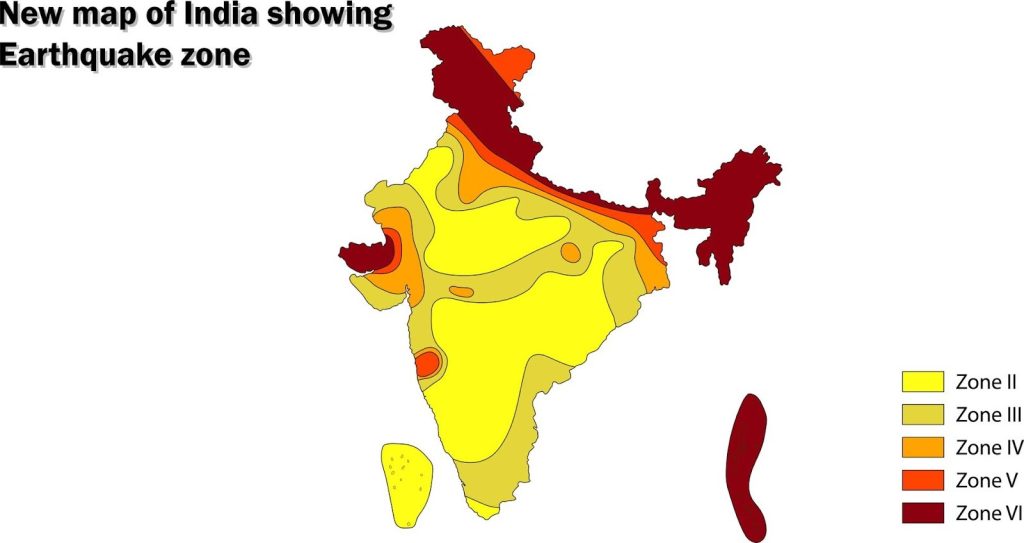
- India has released a revised Seismic Zonation Map under the updated Earthquake Design Code (BIS, 2025).
- The classification is based on scientific factors such as fault lines, tectonics, maximum likely earthquakes, attenuation, and lithology.
- The revised mapping gives priority to geological conditions rather than administrative boundaries while identifying seismic risk.
Changes in Seismic Zones
- Earlier, India was divided into four seismic zones: Zone II, III, IV and V.
- The revised map introduces a new highest-risk category, Zone VI.
- For the first time, the entire Himalayan arc has been placed in Zone VI, whereas earlier it was split between Zones IV and V.
- Towns located on zone boundaries will now automatically be classified under the higher-risk zone.
India’s Earthquake Vulnerability
- Around 61% of India’s land area now falls under moderate to high seismic hazard zones, compared to 59% earlier.
- Nearly 75% of India’s population lives in seismically active regions, indicating significant exposure to earthquake risk.
Implications and Institutional Framework
- The revised map encourages retrofitting of buildings in high-risk areas and discourages construction on soft sediments or near active faults.
- It also promotes uniform earthquake-resistant building standards, particularly in Himalayan states.
Institutional mechanisms
- NDMA sets national disaster management policies.
- SDMAs prepare and implement state-level disaster management plans.
- The National Seismological Network monitors earthquake activity and supports research on early warning systems.
Revised GDP Series with Base Year 2022–23
Meaning of GDP
- Gross Domestic Product (GDP) is the total value of final goods and services produced in a year, excluding material inputs.
- It is the most widely used indicator of a country’s economic size.
- GDP or Gross Value Added (GVA) estimates are compiled using data on production and prices, along with several statistical procedures.
- In India, the National Statistical Office (NSO) periodically revises the National Accounts Statistics (NAS).
- National accounts follow the UN System of National Accounts (UNSNA) framework.
Base Year Revision in GDP
- The base year for national accounts is typically revised every 5 to 10 years.
- The revision updates GDP estimates along with national savings, consumption, and investment data.
- Such revisions reflect changes in production patterns and relative prices as the economy evolves.
- The latest revision adopts 2022-23 as the base year and follows the 2025 edition of UNSNA.
- This revision came after 11 years, making it particularly significant.
Concerns with the 2011–12 Series
- The previous revision with base year 2011–12 was released in 2015.
- Many analysts questioned the accuracy of GDP growth estimates in that series.
- In sectors such as manufacturing, growth rates appeared higher and sometimes showed a different trend compared with earlier estimates.
- The non-financial private corporate sector (PCS) appeared much larger in the economy than previously reported.
- The IMF, in its review of member countries’ economic statistics, gave India a “C” grade for the quality of its national accounts data.
Key Findings of the 2022–23 GDP Series
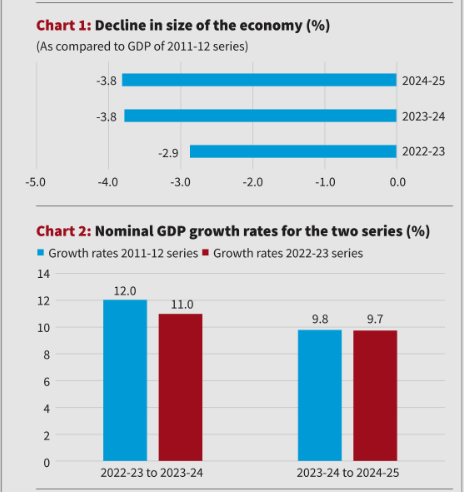
- The revised estimates show that India’s GDP size is about 3–4% smaller than in the earlier series.
- However, annual GDP growth rates remain broadly similar, differing by about ±1 percentage point from the previous estimates.
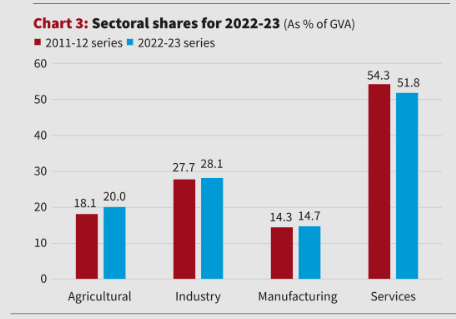
- The production structure of the economy has changed slightly:
- Agriculture and industry shares have increased.
- The services sector share has declined.
Changes in Sectoral and Institutional Shares
- Within the industrial sector, the share of manufacturing increased slightly from 14.3% to 14.7% of GDP.
- Despite this higher share, the absolute size of the manufacturing sector declined by about 1.5-1.6% compared with the earlier series.
- The share of the non-financial private corporate sector (PCS) declined:
- From 35.4% in the earlier series to 33.9% in 2022–23.
- The gap widened to 3.4 percentage points in 2023–24.
- The household or informal sector share increased slightly:
- +0.7 percentage points in 2022–23
- +2.7 percentage points in 2023–24.
- Much of this increase is linked to agriculture.
National Register of Citizens (NRC)

Why in News: Protests erupted in Imphal demanding an NRC-like exercise in Manipur before the upcoming Census.
National Register of Citizens (NRC)
- The NRC is an official register that lists Indian citizens with valid proof of citizenship.
- It was first prepared in 1951 after the first Census of independent India.
- Since then, the NRC has not been updated nationwide.
- At present, the NRC update has been carried out only in Assam to identify illegal migrants.
- NRC in Assam
- The process is based on the Assam Accord (1985).
- The Accord fixed 24 March 1971 as the cut-off date for citizenship in Assam.
- For inclusion in the NRC, a person or their descendants must show their name in:
- the 1951 NRC, or
- an electoral roll up to 24 March 1971.
- Persons excluded from the NRC may be treated as illegal migrants and may face legal proceedings.
National Population Register (NPR)
- The NPR is a database of usual residents of India.
- A usual resident is a person who has lived in India for at least six months or intends to stay for the next six months.
- It includes both citizens and foreign residents.
- Registration is mandatory for all usual residents.
- It is prepared by the Registrar General of India (RGI) under the Ministry of Home Affairs.
Legal Basis and Link with Census
- The NPR is prepared under the Citizenship Act, 1955 and Citizenship Rules, 2003.
- It is compiled at local, sub-district, district, state and national levels.
- NPR data is generally collected during the house-listing phase of the Census.
- The second phase of the Census deals with population enumeration.
Difference Between NRC and NPR
| Feature | NRC (National Register of Citizens) | NPR (National Population Register) |
| Purpose | Identifies Indian citizens | Records all usual residents |
| Coverage | Currently updated only in Assam | Conducted across all states and UTs |
| Population covered | Citizens only | Citizens and foreigners |
| Proof requirement | Proof of citizenship required | No proof of citizenship required |
| Legal basis | Linked to Assam Accord (1985) and court supervision | Based on Citizenship Act, 1955 and Rules, 2003 |
| Authority | Implemented by state authorities and RGI under Supreme Court monitoring | Conducted by Registrar General of India (RGI) |
| Relation with Census | Independent exercise | Conducted with Census house-listing phase |
GLP-1 Weight-Loss Drugs

Context: Central Drugs Standard Control Organisation warned pharmaceutical companies against advertising prescription anti-obesity drugs to the public. The advisory emphasised compliance with Drugs and Cosmetics Act, 1940 and Rules, 1945 in promotion practices. GLP-1 receptor agonists and similar medicines must be prescribed only by Registered Medical Practitioners.
Overview of GLP-1 Weight-Loss Therapies
- GLP-1 drugs are injectable medicines used for obesity and type-2 diabetes management.
- Pharmaceutical companies Novo Nordisk and Eli Lilly have introduced such drugs in India.
- Examples include semaglutide and tirzepatide.
- Clinical studies show these therapies can reduce 15–20% of body weight, a result comparable to bariatric surgery.
- They also show benefits for cardiovascular disease, kidney disease, fatty liver disease, and obstructive sleep apnea.
- Mechanism of Action
- These medicines belong to the class of GLP-1 receptor agonists, which mimic incretin hormones produced in the gut.
- Their major physiological actions include:
- Increasing insulin secretion to improve glucose use.
- Reducing glucagon release from the liver.
- Slowing gastric emptying, preventing sudden spikes in blood sugar.
- Suppressing appetite signals in the brain, promoting a feeling of fullness.
- Tirzepatide also mimics the hormone GIP (glucose-dependent insulinotropic polypeptide), enhancing its metabolic effects.
Discovery and Development
- Scientific interest in incretin hormones increased in the 1960s.
- The hormone GLP-1 was identified in 1986.
- Early GLP-1 treatments increased insulin levels but were chemically unstable.
- Novo Nordisk later developed liraglutide, although early use caused nausea, which was managed through dose adjustments.
- A more advanced drug, semaglutide, administered once weekly, showed stronger results and received approval for obesity treatment in 2021.
Clinical Benefits
- Weight reduction:
- Semaglutide users lost about 15% body weight.
- Tirzepatide users lost up to 20% body weight.
- Cardiovascular benefits:
- Semaglutide reduced major cardiovascular events by 20%.
- It also lowered all-cause mortality by 19%.
- Liver health:
- Resolved fatty liver disease in 63% of cases.
- Improved liver fibrosis in 37% of patients.
- Other potential benefits:
- Tirzepatide shows effectiveness in obesity-related sleep apnea.
- Research suggests possible benefits in Alzheimer’s risk reduction and addiction treatment.
About Central Drugs Standard Control Organization (CDSCO)
- The CDSCO is the National Regulatory Authority for drugs and medical devices in India.
- It functions under the Ministry of Health and Family Welfare.
- The organisation operates according to provisions of the Drugs and Cosmetics Rules.
- Headquarters: New Delhi.
- Under the Drugs and Cosmetics Act, CDSCO performs several regulatory functions:
- Approval of new drugs before they are introduced in the market.
- Oversight of clinical trials conducted in India.
- Establishing standards for drugs.
- Monitoring the quality of imported drugs entering the country.
- Coordinating regulatory activities with State Drug Control Organizations.
Strategic Petroleum Reserves (SPR)
Context: The International Energy Agency proposed a record oil release from strategic reserves amid rising crude prices.
What are Strategic Petroleum Reserves?
- Strategic Petroleum Reserves (SPR) are emergency crude oil stockpiles maintained by governments.
- They are used to manage supply disruptions or global oil crises.
- According to the IEA, member countries should maintain reserves equal to at least 90 days of net oil imports.
Management of SPR in India
- India’s SPR programme is managed by ISPRL (Indian Strategic Petroleum Reserves Limited).
- ISPRL functions under the Ministry of Petroleum and Natural Gas.
- India is the third-largest importer and consumer of crude oil in the world.
Current Capacity and Locations
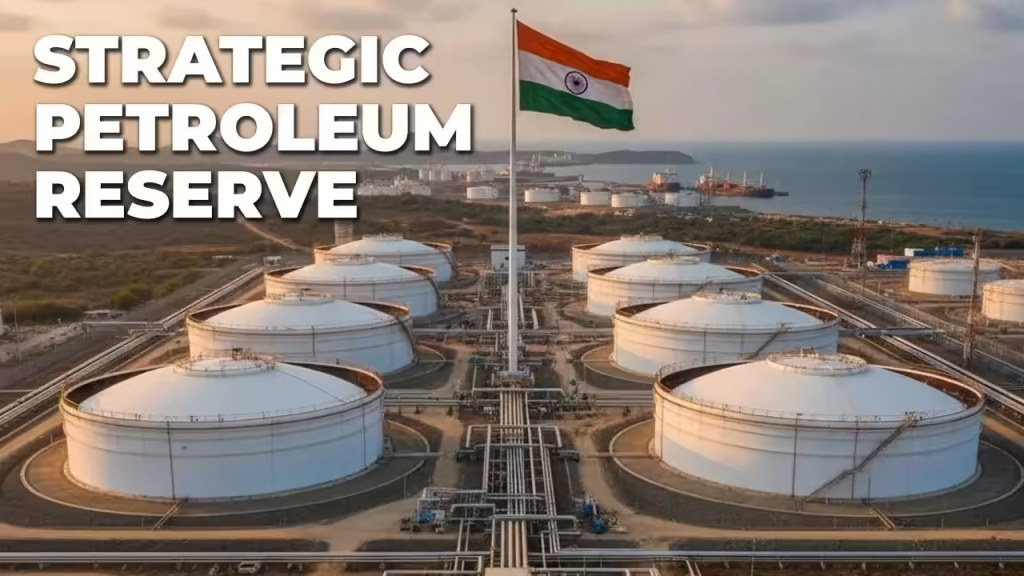
- India currently holds about 5.33 million tonnes (MMT) of crude oil in strategic reserves.
- These reserves are stored in underground rock caverns.
- The three operational sites are:
- Visakhapatnam – 1.33 MMT
- Mangaluru – 1.5 MMT
- Padur – 2.5 MMT
- Together they provide about 9.5 days of crude oil coverage.
Expansion Plans
- The government has approved expansion of the SPR network.
- Planned additions include:
- 2.5 MMT additional capacity at Padur (Karnataka).
- A 4 MMT facility at Chandikhole (Odisha).
- Other proposed sites include Bikaner, Mangaluru, Rajkot, and Bina (Madhya Pradesh).
Total Energy Buffer
- Strategic reserves complement commercial oil inventories maintained by oil companies.
- When combined with stocks at refineries, ports, and floating storage, India has an overall energy buffer of about 74 days.
Creamy Layer in OBC Reservation
Supreme Court Observation in 2025
- The Supreme Court observed that creamy layer status cannot be determined solely on the basis of income.
- While hearing petitions regarding horizontal reservations in public employment, the Court emphasised that social status and class background must also be considered.
- The Court noted that the 1993 Office Memorandum (OM) issued by the government provided criteria for identifying creamy layer among OBCs, including categories such as high-ranking government officials and professionals.
- The judgment highlighted that government servants and professionals who reach higher positions after reservation benefits should not automatically be excluded solely due to income considerations.
What is the Creamy Layer?
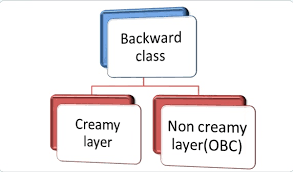
- The Creamy Layer refers to the socially and economically advanced section within the OBC category.
- Individuals in this group are excluded from reservation benefits in education, jobs, and welfare schemes meant for socially and educationally backward classes.
- The concept aims to ensure that reservation benefits reach the genuinely disadvantaged sections of OBCs.
Eligibility Criteria for Creamy Layer (Current Practice)
- Families with annual income above ₹8 lakh are generally classified as creamy layer (revision proposals in some states range between ₹8-15 lakh).
- Children of parents working in Group A or Group B government services are usually treated as part of the creamy layer.
- Professionals and high-income earners such as doctors, engineers, and entrepreneurs may also fall in this category.
- Persons in the creamy layer cannot claim reservation under OBC quotas.
Non-Creamy Layer of OBC
- The Non-Creamy Layer includes the economically and socially disadvantaged section of OBCs.
- Individuals in this group are eligible for reservation benefits in government employment, education, and welfare programmes.
- Criteria
- Annual family income below ₹8 lakh.
- Parents are not in senior government positions or high-income occupations.
- A Non-Creamy Layer certificate is required to claim reservation benefits.
- The purpose is to ensure targeted affirmative action for the most backward sections within OBC communities.
