

Autonomous District Councils (ADCs)
Constitutional Basis
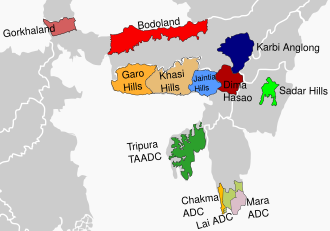
- Autonomous District Councils (ADCs) are established under the Sixth Schedule of the Constitution to provide self-governance in tribal areas.
- Covers 10 tribal areas across four States:
- Assam (3)
- Meghalaya (3)
- Tripura (1)
- Mizoram (3)
- Each notified tribal area is treated as an autonomous district.
Composition and Tenure
- Each ADC has up to 30 members.
- 26 members are elected through adult franchise.
- 4 members are nominated by the Governor.
- Tenure: 5 years from the date of constitution.
Powers and Functions
- Legislative Powers
- Can make laws on land, forests (except reserved forests).
- Regulate inheritance, marriage, divorce, and social customs.
- Control money lending and trade by non-tribals (with Governor’s assent).
- Administrative Functions
- Manage local institutions such as primary schools, dispensaries, markets and roads.
- Oversee village administration and traditional leadership.
- Judicial Role
- Can constitute village courts to resolve disputes within tribal communities.
Sources of Revenue
- ADCs have limited financial powers to sustain local governance:
- Taxes on professions, trades and employment.
- Taxes on animals, vehicles and boats.
- Taxes on entry of goods into markets.
- Tolls on ferries and transport.
- Taxes for maintenance of schools, dispensaries and roads.
Significance
- Ensures autonomy and protection of tribal identity.
- Preserves customary laws and traditions.
- Promotes decentralised governance in tribal regions.
Keeladi Excavation
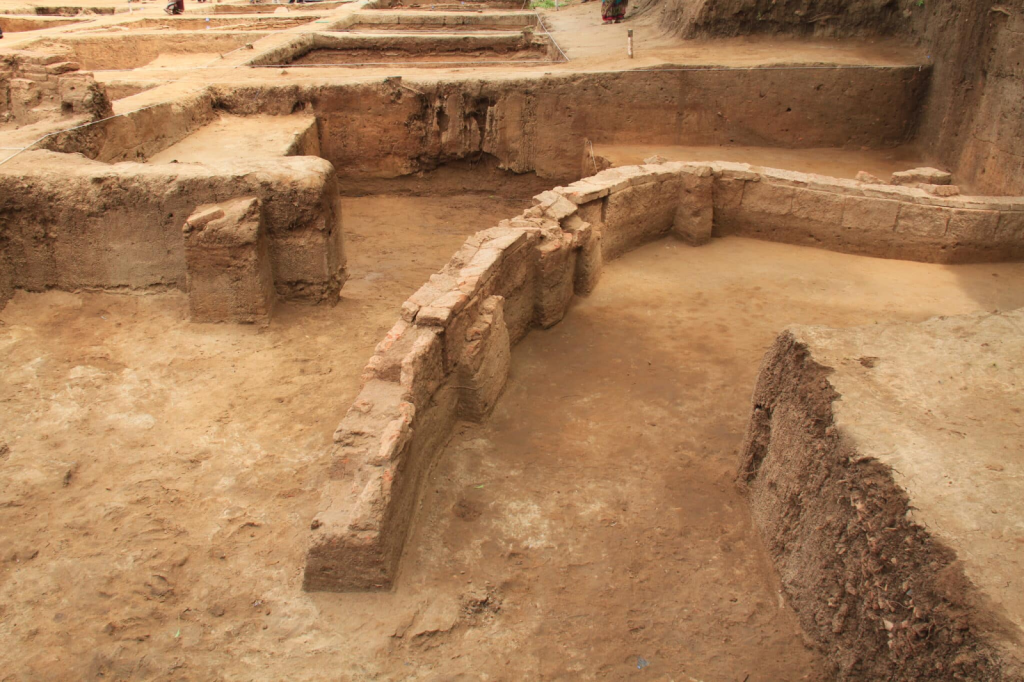
Context: The Archaeological Survey of India (ASI) has granted permission to the Tamil Nadu State Department of Archaeology (TNSDA) for conducting excavations at eight historical sites, including Keeladi.
About Keeladi Site
- Keeladi is a village in Sivaganga district (Tamil Nadu), located about 12 km south-east of Madurai along the Vaigai river.
- The site has emerged as an important archaeological centre for understanding early South Indian civilisation.
- The excavations (since 2015) reveal the presence of a well-developed urban settlement:
- Settlement dated to around 6th century BCE through carbon dating.
- Evidence of urban planning: burnt brick houses, drainage systems, water tanks and wells.
- Presence of industrial activities such as pottery, weaving, dyeing and bead-making.
- Discovery of furnaces with soot and ash, indicating organised manufacturing activity.
- Artefacts like spindle whorls, terracotta beads and tools reflect structured economic life.
- Over 120 potsherds with Tamil-Brahmi inscriptions found, including names like Aathan and Uthiran.
- Link with Sangam Age
- Traditionally, the Sangam Age is dated between 3rd century BCE to 3rd century CE.
- Findings from Keeladi push this timeline further back to 6th century BCE.
- A sample dated to 580 BCE provides strong archaeological evidence.
- The site helps bridge the gap between the Iron Age and the Early Historic Period.
- Linkages with Indus Valley Civilisation
- Keeladi is associated with the Vaigai Valley Civilisation.
- Some symbols on pottery show resemblance to Indus Valley signs.
- However, there exists a time gap of about 1000 years between the two civilisations.
- Iron Age materials in South India act as a link between these phases.
About Archaeological Survey of India (ASI)
- The Archaeological Survey of India (ASI) is the main government body that looks after India’s ancient monuments and archaeological heritage.
- Founded: 1861 by Alexander Cunningham
- Revived: 1871 as a separate department
- Headquarters: New Delhi
- Works under the Ministry of Culture
- Aim of ASI
- Protect and preserve historical monuments and sites.
- Study and document India’s ancient past through excavations.
- Key Functions
- Excavation & Survey: Studies buried remains to understand history.
- Conservation: Maintains 3,600+ protected monuments under the AMASR Act, 1958.
- Research: Publishes reports like Indian Archaeology – A Review.
- Underwater Archaeology: Explores submerged heritage through a dedicated wing.
Tropical Forest Forever Facility (TFFF)
What is TFFF?
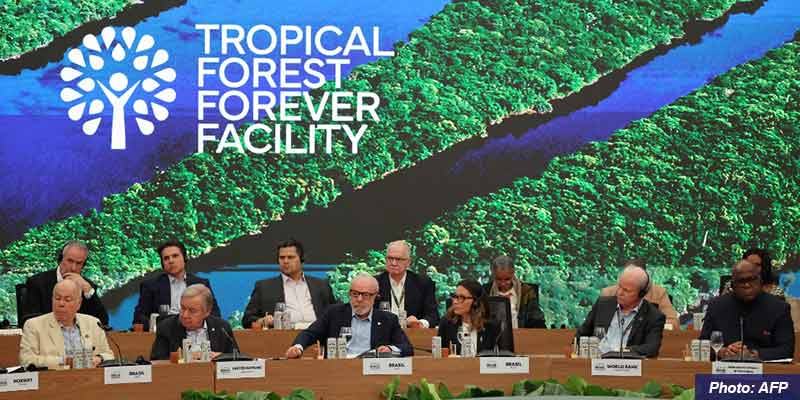
- The Tropical Forest Forever Facility (TFFF) is a proposed global investment fund created to support the long-term conservation of tropical forests.
- It aims to reward developing tropical forest countries for protecting their old-growth forests instead of clearing them for economic activities.
How the Initiative Works
- Countries will receive financial incentives for keeping forests intact.
- Payments will be based on annual satellite monitoring, ensuring transparent forest tracking.
- Around 74 tropical forest countries are expected to benefit from the mechanism.
Funding Structure
- The initiative aims to mobilise about USD 125 billion:
- USD 25 billion from governments and philanthropies.
- USD 100 billion from private investors.
- The fund will invest in public and corporate bonds, and the returns will be distributed to participating countries as incentives for forest protection.
Significance
- Encourages countries to view standing forests as valuable assets.
- Helps protect forests that support carbon storage, climate regulation and biodiversity.
- Seen as a major initiative giving the Global South a leading role in forest conservation.
POSHAN Abhiyaan
What is POSHAN Abhiyaan?
- POSHAN Abhiyaan (PM’s Overarching Scheme for Holistic Nourishment) is a flagship programme to improve nutritional outcomes in India through a convergent and life-cycle approach.
- Launched: March 2018
- Focuses on children (0–6 years), pregnant women, lactating mothers and adolescent girls
- Brings together multiple ministries, states and stakeholders for better delivery of nutrition services
Core Objective
- The mission aims to break the cycle of malnutrition by improving nutritional status from early life stages.
- Key targets:
- Reduce undernutrition, stunting, low birth weight and anaemia
- Reduce undernutrition by 2% annually
- Reduce anaemia by 3% annually
- Reduce low birth weight by 2% annually
Approach and Strategy
- Focus on convergence of schemes and coordinated action.
- Emphasis on Social and Behavioural Change Communication (SBCC).
- Strong role of District Magistrates in monitoring outcomes.
- Encourages community participation through campaigns like Poshan Maah and Jan Andolan.
- Over 10 lakh frontline workers trained for nutrition counselling.
POSHAN 2.0
- Integrates POSHAN Abhiyaan + Supplementary Nutrition Programme + Scheme for Adolescent Girls.
- Focuses on efficiency, convergence and improved service delivery.
- Key components:
- Convergence of all nutrition schemes
- ICDS-CAS for digital monitoring
- Behavioural change through mass participation
- Incentives for frontline workers
- Capacity building and training
- Grievance redressal system
Key Initiatives under POSHAN
- Rashtriya Poshan Maah (September)
- Month-long campaign promoting nutrition awareness, breastfeeding, anaemia control and hygiene.
- Poshan Vatika
- Nutrition gardens at households, anganwadis and schools to promote local, healthy food consumption.
- Poshan Tracker App
- A mobile app to track nutrition services for beneficiaries.
- Aims to improve transparency, efficiency and accountability.
- Linked with Mission Saksham Anganwadi and POSHAN 2.0.
Biodiversity Management Committees (BMCs)
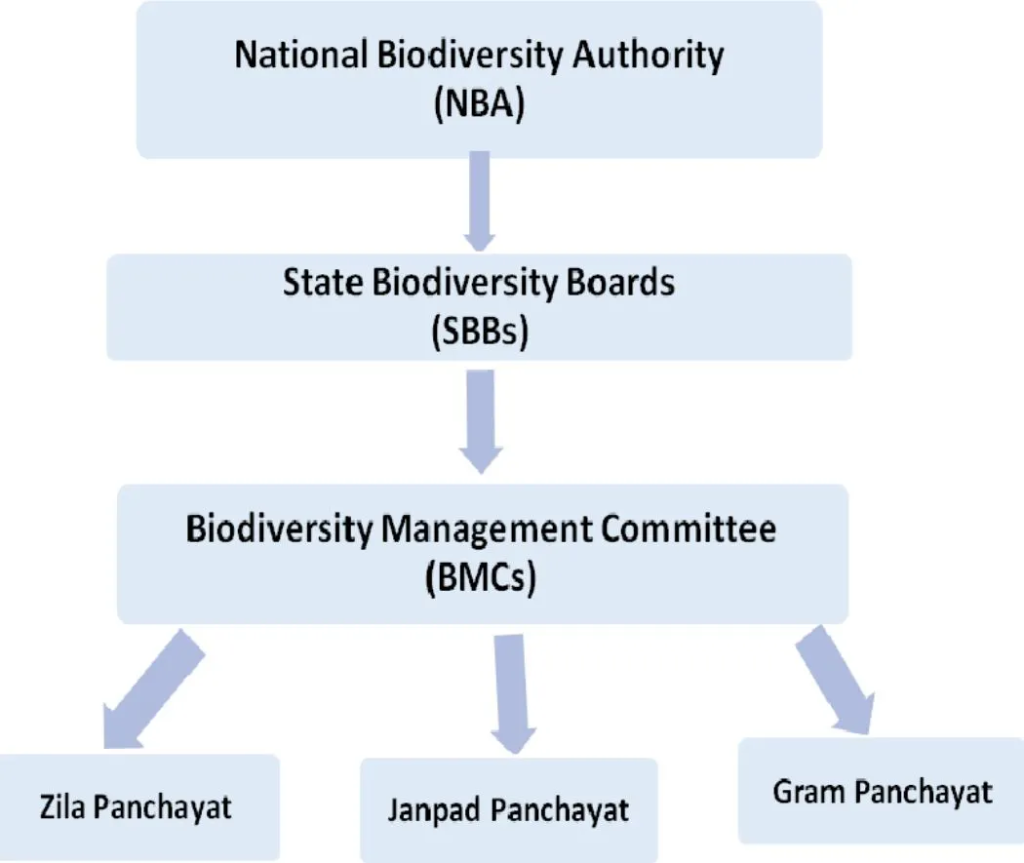
Context: Around 2.76 lakh Biodiversity Management Committees (BMCs) have been established across India. They also play a key role in ensuring fair benefit-sharing under the Nagoya Protocol.
About Biodiversity Management Committees (BMCs)
- BMCs are local-level bodies constituted under the Biological Diversity Act, 2002.
- They are set up by local bodies to promote conservation, sustainable use and documentation of biodiversity.
- Composition
- Consists of a Chairperson + up to 6 members nominated by the local body.
- At least one-third members must be women.
- Minimum 18% representation for SC/ST communities.
- Key Function
- The most important role of BMCs is to prepare the People’s Biodiversity Register (PBR).
- This is done in consultation with local communities, documenting local biological resources and traditional knowledge.
Nagoya Protocol
- The Nagoya Protocol is a legally binding international agreement under the Convention on Biological Diversity (CBD).
- It focuses on access to genetic resources and fair and equitable sharing of benefits arising from their use.
- Adopted: 2010 (Nagoya, Japan)
- Came into force: 12 October 2014
- Objective
- To ensure that benefits from the use of genetic resources are shared fairly and equitably.
- It supports one of the key goals of CBD: benefit-sharing.
- Key Features
- Provides a transparent legal framework for access and benefit-sharing (ABS).
- Ensures that countries and communities providing resources get a share in benefits.
- Covers both genetic resources and traditional knowledge (TK) linked to them.
- Benefits
- Encourages research and innovation in biotechnology with legal clarity.
- Ensures benefit-sharing (monetary or non-monetary) with provider countries.
- Protects the rights of indigenous and local communities, especially their traditional knowledge.
Operation Sankalp

What is Operation Sankalp?
- Operation Sankalp is an initiative of the Indian Navy to ensure maritime security and safe passage of Indian vessels in the Indian Ocean Region (IOR).
- Launched: 19 June 2019
- Initiated after security threats in the Gulf of Oman and Strait of Hormuz
Objectives
- Ensure safe movement of Indian merchant ships.
- Protect key sea routes like Strait of Hormuz and Gulf of Aden.
- Counter threats such as piracy and maritime attacks.
- Safeguard India’s energy and trade interests.
Key Features
- Continuous naval deployment in sensitive sea lanes.
- Conducts escort missions for merchant vessels.
- Uses maritime surveillance aircraft and special forces (MARCOS) for monitoring.
- Supported by the Maritime Anti-Piracy Act, 2022 for legal action against piracy.
Significance
- Secures critical oil supply routes, especially from the Persian Gulf.
- Highlights India’s role as a reliable maritime security provider in the region.
- Strengthens India’s position as a blue-water navy capable of protecting its interests.
Sahitya Akademi Literary Awards for 2025

Context: The Sahitya Akademi announced its awards for 2025 in 24 recognized languages.
More in News
- Former diplomat Navtej Sarna awarded in English category for novel Crimson Spring at this year’s ceremony.
- Hindi writer Mamta Kalia receives award for memoir Jeete Jee Allahabad in Hindi language category.
- Tamil author Sa Tamilselvan awarded for work Thamizh Sirukathaiyin Thadangal in literary criticism genre.
About Sahitya Akademi Awards
- The Sahitya Akademi Awards are given annually for the most outstanding books of literary merit in recognised Indian languages.
- Covers 22 languages listed in the Constitution, along with English and Rajasthani.
- Award includes a plaque, shawl and ₹1 lakh prize money.
Sahitya Akademi
- Established on 12 March 1954 by the Government of India.
- Registered under the Societies Registration Act, 1860.
- Functions as an autonomous body under the Ministry of Culture.
- Headquarters: New Delhi
- Role and Functions
- Acts as the central institution for literary promotion and dialogue in India.
- Supports publication, translation and literary activities.
- Works across 24 languages, making it unique in promoting linguistic diversity.
