


Premium Petrol vs Normal Petrol
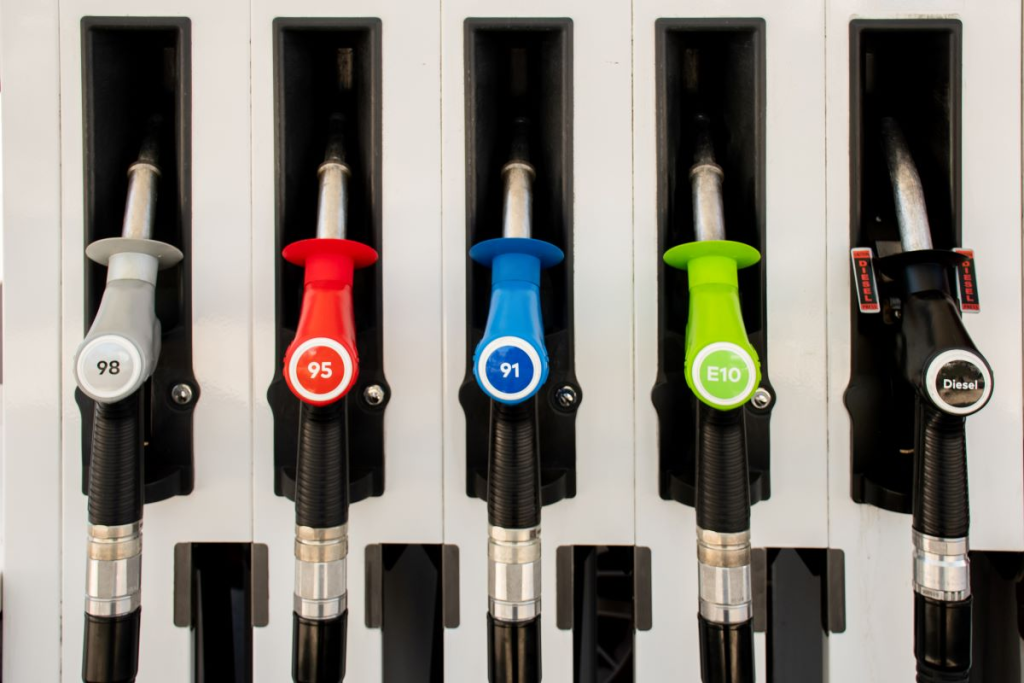
Context: Indian Oil-Marketing Companies (OMCs) increased premium petrol prices by about ₹2–₹3/litre and industrial diesel by ₹22/litre amid rising global crude oil prices.
Basic Difference
- Premium petrol differs mainly in higher octane rating and added detergents improving engine performance and efficiency.
- Normal petrol has lower octane rating and is suitable for regular vehicles used in daily commuting.
Octane Rating & Knocking
- Octane number measures fuel’s resistance to premature ignition or engine knocking during combustion process.
- Normal petrol in India usually has octane rating between 87–91, suitable for low-compression engines.
- Premium petrol has higher octane rating (91–95 or more), reducing knocking in high-performance engines.
Additives & Engine Maintenance
- Premium petrol contains detergent additives that clean fuel injectors and intake valves, reducing carbon deposits.
- Normal petrol lacks advanced additives, leading to comparatively higher chances of residue buildup over time.
Suitability of Use
- Premium petrol is ideal for high-compression engines, luxury cars, turbocharged and sports vehicles.
- Normal petrol is sufficient for mass-market cars, bikes, and scooters designed for regular driving conditions.
Cost & Efficiency
- Premium petrol is costlier due to additional refining processes and inclusion of performance-enhancing additives.
- In regular engines, using premium petrol generally does not improve mileage or performance significantly.
Godavari River
Basic Overview
- Godavari River is the largest peninsular river system and is popularly known as Dakshin Ganga.
- It originates from Trimbakeshwar near Nashik in Maharashtra and flows eastwards into Bay of Bengal.
- Total length of river is about 1465 km, making it second longest river in India.
- Godavari basin is bounded by Satmala hills (north), Ajanta and Mahadeo ranges (south).
- Eastern and Western boundaries are formed by Eastern Ghats and Western Ghats respectively.
- Basin covers Maharashtra, Telangana, Andhra Pradesh, Chhattisgarh, Odisha, with smaller parts in nearby regions.
Tributaries
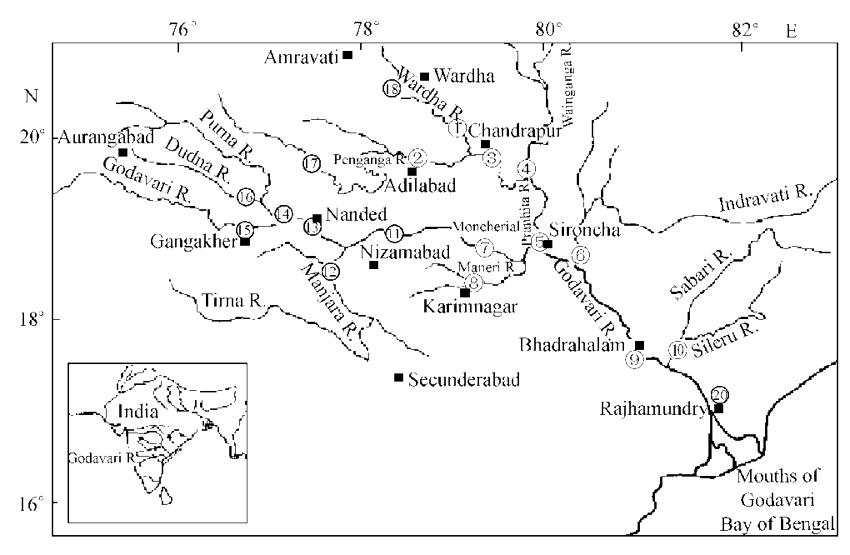
- Important tributaries include Pravara, Purna, Manjra, Penganga, Wardha, Wainganga, Indravati and Sabari rivers.
- Pranhita River is major tributary formed by combined flow of Wardha, Wainganga and Penganga rivers.
- Right bank tributaries include Pravara, Manjira and Maner rivers.
- Left bank tributaries include Purna, Pranhita, Indravati and Sabari rivers.
Cultural & Economic Significance
- Kumbh Mela is held at Nashik on banks of Godavari, making it culturally significant river.
- Major cities along basin include Nashik, Aurangabad, Nagpur and Rajahmundry.
- Basin supports industries like rice milling, cotton textiles, sugar processing and oil extraction units.
Important Projects
- Major projects include Polavaram Irrigation Project and Kaleshwaram Lift Irrigation Scheme.
- Other projects include Sriram Sagar Project, Inchampalli project and Sadarmatt Anicut.
Article 101

Basic Provision
- Article 101 deals with conditions under which seats of Members of Parliament become vacant.
- It applies to both Lok Sabha and Rajya Sabha, ensuring clarity and accountability in parliamentary membership.
Key Conditions for Vacancy
- Dual Membership in Parliament
- A person cannot be member of both Houses of Parliament simultaneously.
- If elected to both Houses, the member must vacate one seat within prescribed time period.
- Parliament and State Legislature
- A person cannot be member of Parliament and State Legislature at the same time.
- If elected to both, Parliament seat becomes vacant unless State Legislature seat is resigned within specified time.
- Disqualification
- Seat becomes vacant if member is disqualified under Article 102 provisions.
- Grounds include office of profit, unsound mind, insolvency, loss of citizenship, and anti-defection law.
- Resignation
- Member may resign by submitting written notice to Speaker (Lok Sabha) or Chairman (Rajya Sabha).
- Resignation must be voluntary and genuine, otherwise presiding officer may refuse to accept it.
- Absence from House
- Seat may be declared vacant if member is absent for 60 days without permission of House.
- Period excludes days when House is prorogued or adjourned for more than four consecutive days.
- Decision Authority
- Questions of disqualification are decided by President of India under Article 103.
- President acts based on opinion of Election Commission of India.
APEDA

Context: Parliamentary Standing Committee on Commerce recommended higher budget allocation to Agricultural and Processed Food Products Export Development Authority (APEDA) to support farmers and exporters.
About APEDA
- APEDA is a statutory body established under an Act of Parliament in December 1985.
- It replaced the earlier Processed Food Export Promotion Council (PFEPC) for promoting agri-exports.
- APEDA functions under the Ministry of Commerce and Industry.
- Headquarters of APEDA is located in New Delhi.
- It is headed by a Chairman appointed by the Central Government.
Objective & Scope
- Main objective is to develop and promote export of scheduled agricultural and processed food products.
- Products covered under APEDA Act are called scheduled products, requiring mandatory registration of exporters.
- Examples include fruits, vegetables, meat, poultry, dairy products, honey, jaggery, and bakery items.
- APEDA also monitors import of sugar, in addition to its export promotion role.
Institutional Role
- APEDA acts as Secretariat for National Accreditation Board (NAB) under organic certification framework.
- Implements accreditation of certification bodies under National Programme for Organic Production (NPOP).
- Plays key role in promoting organic exports and quality certification systems in India.
BHARATI Startup Challenge
- BHARATI initiative aims to promote innovation and entrepreneurship in agri and processed food export sector.
- Provides mentorship, market access, and policy support to export-oriented startups.
- Selected startups receive international exposure through global events like Gulfood and BIOFACH.
Foreign Exchange (ForEx) Reserves
Context: India’s forex reserves declined by $7.052 billion to $709.759 billion as per RBI data thus indicates volatility in external sector amid changing global financial conditions.
About ForEx
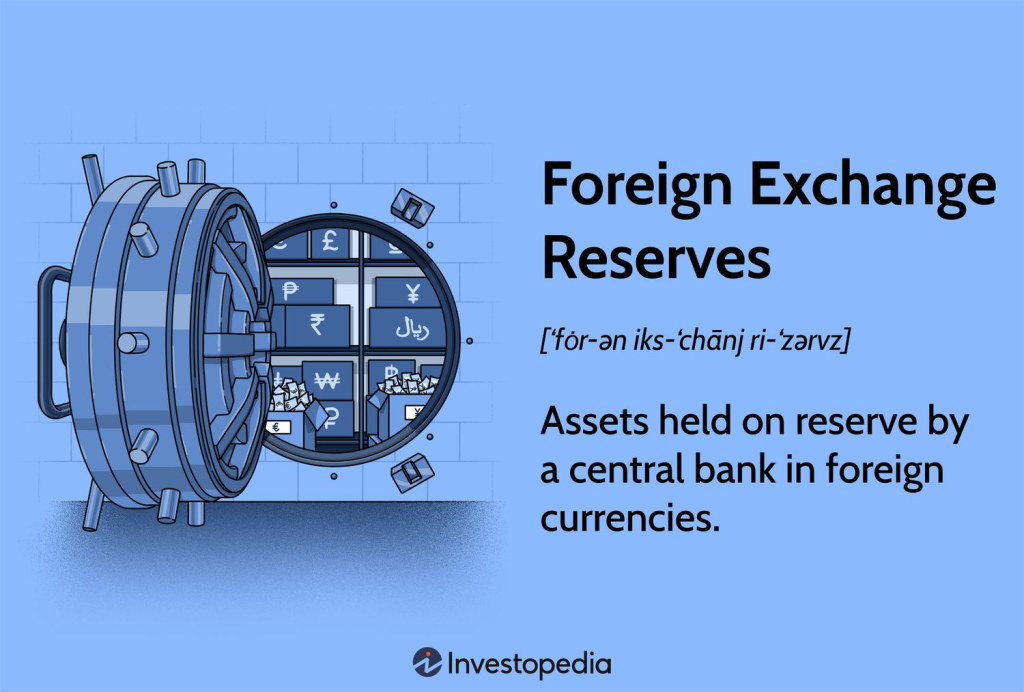
- Foreign Exchange Reserves (Forex Reserves) are reserve assets held by a central bank in foreign currencies.
- These include foreign currencies, bonds, treasury bills, and other government securities denominated in foreign currencies.
- Reserves are expressed in US dollar terms, which acts as the global reference currency.
- In India, Reserve Bank of India (RBI) is the custodian of foreign exchange reserves.
Components of ForEx Reserves
- Foreign Currency Assets (FCA) form largest share, held in currencies like US dollar, euro, pound, yen.
- Gold reserves are maintained as physical assets, contributing to overall reserve strength.
- Special Drawing Rights (SDR) are reserve assets allocated by International Monetary Fund (IMF).
- Reserve Tranche Position (RTP) represents India’s reserve capital with IMF, accessible for balance of payments needs.
Purpose and Functions
- Forex reserves help in stabilizing exchange rate and managing external sector shocks effectively.
- RBI uses reserves to intervene in foreign exchange market to control excessive rupee volatility.
- They act as buffer against external crises, ensuring ability to meet international payment obligations.
- Reserves support confidence in economy, improving credibility among global investors and trading partners.
Role in Currency Management
- When rupee depreciates, RBI sells foreign currency like US dollars to stabilize domestic currency value.
- Adequate reserves ensure protection against sudden capital outflows and external financial instability risks.
Variable Repo Rate (VRR)
Context: Reserve Bank of India (RBI) injected ₹25,101 crore liquidity via a 3-day Variable Rate Repo (VRR) auction.
Basic Concept
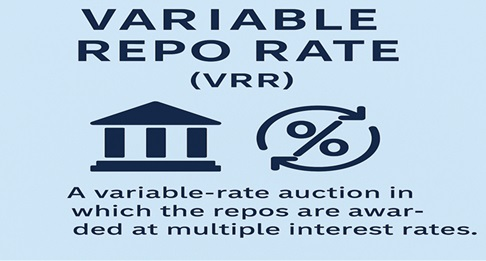
- Variable Repo Rate (VRR) is a liquidity tool where banks borrow short-term funds from RBI through auctions.
- Interest rate under VRR is market-determined, unlike fixed repo rate decided directly by RBI.
- It is part of RBI’s Liquidity Adjustment Facility (LAF) framework for managing short-term liquidity.
How VRR Works
- RBI conducts auction-based repo operations generally with maturities ranging from 1 day to 14 days.
- Banks submit bids specifying amount and interest rate at which they want to borrow funds.
- RBI accepts bids based on favourable rates, and final rate emerges through competitive bidding process.
- The VRR rate cannot fall below the reverse repo rate, ensuring a lower bound for interest rates.
Purpose and Need
- VRR is used when market interest rates fall below policy repo rate, making fixed repo unattractive.
- It helps align liquidity conditions with market realities without altering overall monetary policy stance.
- Ensures smoother transmission of policy rates and maintains stability in short-term money markets.
Role in Liquidity Management
- VRR helps in injecting short-term liquidity into banking system during tight liquidity conditions.
- It ensures market rates remain aligned within LAF corridor, between repo and reverse repo rates.
- Supports financial stability and efficient monetary policy transmission in evolving market conditions.
Variable Rate Reverse Repo (VRRR)
- Variable Rate Reverse Repo (VRRR) is used by RBI to absorb excess liquidity through auction mechanism.
- Banks deposit surplus funds with RBI, and interest rate is determined competitively through bidding.
- VRRR is important during excess liquidity situations, helping control inflationary pressures.
Hypercapnic Hypoxia in Mangroves

Context: Recent study shows most mangrove ecosystems are already experiencing mild to severe hypercapnic hypoxia conditions.
Overview
- Hypercapnic hypoxia refers to condition of high carbon dioxide levels combined with low oxygen availability.
- It creates a stressful chemical environment affecting survival of aquatic organisms in estuarine ecosystems.
- Commonly observed during low tide, low salinity conditions, and in warm tropical mangrove regions.
- Causes
- Rising atmospheric CO₂ levels due to climate change increase carbon dioxide concentration in coastal waters.
- Temperature rise reduces oxygen solubility in water, intensifying hypoxic conditions in mangrove ecosystems.
Impact on Biodiversity
- It threatens fish nurseries, as mangroves serve as critical breeding and feeding grounds for marine species.
- Leads to decline in biodiversity and deterioration of habitat quality for aquatic organisms.
- Affects fisheries and livelihoods of communities dependent on mangrove-based resources.
- Causes shift in species composition, reducing presence of large reef-associated fish species.
World Happiness Report

Context: World Happiness Report 2026 highlights that excessive social media use is negatively affecting well-being of young people globally.
Basic Features
- World Happiness Report is an annual global report measuring levels of happiness and wellbeing across countries.
- Published by Oxford Wellbeing Research Centre in partnership with Gallup and UN Sustainable Development Solutions Network.
- It is considered a leading global publication on wellbeing and quality of life indicators.
- Based on survey where people rate their life on a scale from 0 (worst) to 10 (best).
Methodology
- Rankings are based on responses from around 100,000 individuals across nearly 140 countries and territories.
- Focuses on self-reported life evaluation, not just economic indicators or objective measures.
Key Indicators Used
- GDP per capita reflecting economic prosperity and standard of living.
- Healthy life expectancy indicating overall health conditions of population.
- Social support measuring strength of family and community networks.
- Freedom to make life choices reflecting personal autonomy and liberty.
- Generosity capturing charitable behaviour and social trust.
- Perception of corruption indicating trust in institutions and governance.
Highlights of 2026 Report
- Top countries include Finland, Iceland, Denmark, Costa Rica, and Sweden.
- Least happy countries include Afghanistan, Sierra Leone, Malawi, and Zimbabwe.
- India improved its ranking from 126th in 2024 to 118th in 2025.
Additional Tier-1 (AT-1) Bonds
Basic Concept
- AT-1 bonds are perpetual bonds with no maturity date, meaning principal is not repaid to investors.
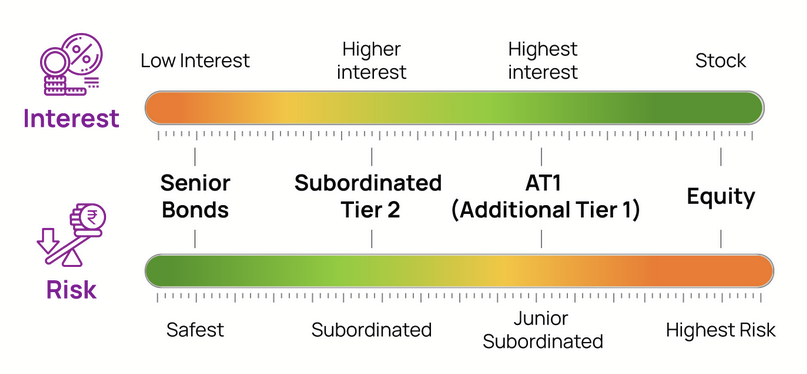
- Investors receive regular interest payments, generally higher than other bonds due to higher associated risks.
- These bonds are often treated as quasi-equity instruments rather than pure debt due to their structure.
- Issuance & Regulatory Framework
- AT-1 bonds are issued by banks under RBI guidelines to meet capital adequacy requirements.
- They form part of Tier-1 capital, helping banks maintain required Capital Adequacy Ratio (CAR).
- Capital adequacy norms are based on Basel III framework, introduced after the 2008 global financial crisis.
Key Features
- AT-1 bonds are contingent convertible bonds (CoCos), convertible into equity if bank’s capital falls below threshold.
- They include a call option, allowing banks to buy back bonds after a specified period.
- There is no put option, so investors cannot return bonds to issuing bank.
- Bonds are listed on stock exchanges, allowing investors to sell them in secondary market.
Risk Factors
- These bonds carry higher risk, as interest payments can be skipped during financial stress.
- RBI can direct banks to write down or cancel bonds without investor consent during crisis situations.
- AT-1 bonds are subordinate debt, meaning they rank lower than other debt during liquidation.
Purpose
- Funds raised act as a financial buffer or shock absorber during periods of financial instability.
- Helps banks strengthen capital base and absorb losses without immediate external support.
