

Context
- The Corruption Perceptions Index (CPI) 2025 published by Transparency International reveals that corruption is not receding but deepening globally, eroding democratic accountability and hollowing out public institutions.
- For the first time in over a decade, the global average score dropped to 42 out of 100, with 122 of 182 countries scoring below 50 and only 5 countries scoring above 80 compared to 12 a decade ago.
What the Data Show
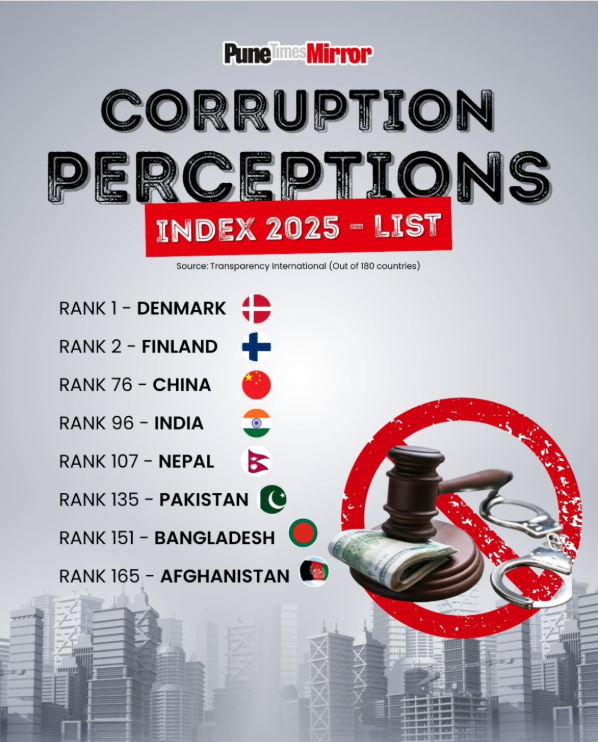
- India scored 39 out of 100, ranked 91 out of 182 countries in CPI 2025, remaining in the lower half of the global table.
- India’s score has fluctuated narrowly between 38 and 41 over the past decade. In 2014 it stood at 38, and a decade later it remains broadly similar despite India becoming the world’s fourth-largest economy.
- China scores 42; Sri Lanka stands close to India’s level; Bangladesh and Pakistan score lower, yet India is behind several upper-middle-income democracies and East Asian countries that once operated at comparable development levels.
- Corruption costs at least 5% of global GDP annually, equivalent to more than $2.6 trillion in lost output each year through bribes, illicit financial flows, and public spending inefficiencies.
- Corruption costs India 0.5% of GDP directly, rising to 1–1.5% including indirect losses annually.
Structural Challenges in India
- Indian entrepreneurs operate under the shadow of 26,134 imprisonment provisions embedded across business regulations, a staggering compliance burden that expands discretionary power and creates conditions for rent-seeking.
- A pharmaceutical startup with a single manufacturing unit must navigate 998 separate compliance obligations before commencing operations, with nearly 49% carrying potential criminal liability.
- Such extensive criminalisation within regulatory frameworks raises the cost of doing business and inadvertently creates incentives for corruption at every compliance checkpoint.
- Corruption increases transaction uncertainty, raises compliance expenses, and diverts entrepreneurial energy toward navigating rent-seeking systems rather than creating productive value.
- Rapid economic expansion without parallel institutional strengthening creates a dangerous imbalance and thus governance credibility has now become a competitive economic variable in global investment decisions.
Encouraging Trends
- Direct Benefit Transfers linked to bank accounts and digital identity have reduced leakages in welfare schemes, demonstrating that institutional design can curb corruption at scale.
- The RBI Digital Payments Index rose to 516.76 in September 2025 from 493.22 in March 2025, reflecting deepening payment digitalisation and reduced cash-based rent-seeking opportunities.
- The GST network has increased formalisation and traceability in indirect taxation, reducing the scope for evasion and discretionary enforcement.
- E-procurement portals and digital payment systems have reduced opportunities for rent-seeking in government contracting and public spending.
Way Forward
- Simplify the compliance architecture by systematically reviewing and eliminating unnecessary imprisonment provisions across business regulations to reduce discretionary power available to regulators.
- Strengthen judicial efficiency and institutional independence to improve the credibility of anti-corruption enforcement beyond episodic crackdowns.
- Expand digital public infrastructure across more governance domains i.e. from land records to procurement to licensing, to reduce human discretion at corruption-prone interfaces.
- Decouple regulatory oversight from criminal liability for minor procedural violations, reserving criminal sanctions only for genuinely serious offences.
Conclusion: Countries that climbed CPI rankings did so through cumulative, sustained reform. India’s economic ascent must now be matched with equal resolve in governance evolution toward its $10 trillion economy vision.
