


Index of Industrial Production
Context
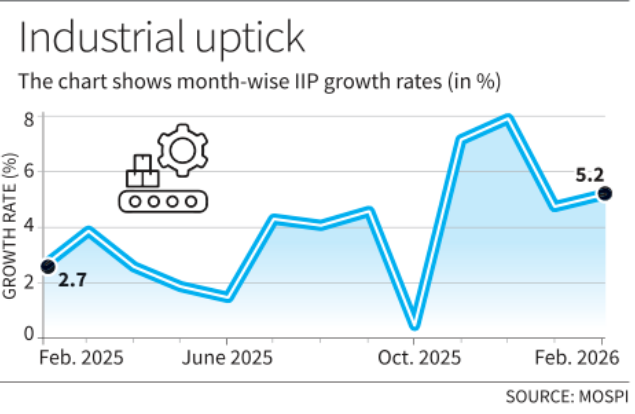
- India’s industrial growth, as measured by the Index of Industrial Production (IIP), increased to 5.2% in February, indicating a moderate acceleration in economic activity.
More in News
- The growth was primarily driven by improved performance in the manufacturing sector and capital goods segment.
- Manufacturing growth rose to 6% in February, compared to 5.3% in January, and was significantly higher than 2.8% in February of the previous year.
- The mining and quarrying sector recorded slower growth of 3.1%, down from 4.3% in January, though still higher than the previous year’s level.
- Growth in the electricity sector also moderated to 2.3%, compared to 5.1% in January.
- The growth pattern suggests an investment-led expansion, supported by sectors such as basic metals, automobiles, machinery, and capital goods, reflecting a capex and infrastructure-driven upcycle.
What is IIP?
- Index of Industrial Production (IIP) measures short-term changes in industrial output volume.
- Acts as a key indicator of industrial growth or contraction in the economy.
- Reflects performance trends across core productive sectors.
- Publishing Authority
- Compiled and released by the Central Statistics Office (CSO).
- CSO functions under the Ministry of Statistics and Programme Implementation (MoSPI).
- Base Year of IIP
- Current base year is 2011–12, ensuring relevance to modern industrial structure.
- Base year revised periodically to capture structural economic changes.
- Earlier base years included 1937, 1946, 1951, 1956, and subsequent revisions.
- Sectoral Composition of IIP (Weight-wise)
- Manufacturing: 77.63% weight, covering 809 industrial items.
- Mining: 14.37% weight, represented by 29 items.
- Electricity: 7.99% weight, represented by 1 composite item.
- Eight Core Industries
- Constitute 40.27% weight within the overall IIP index.
- Represent foundational infrastructure and industrial inputs.
- Core Industries (Descending Weight Order)
- Refinery Products
- Electricity
- Steel
- Coal
- Crude Oil
- Natural Gas
- Cement
- Fertilisers
Nuclear Non-Proliferation Treaty
Context: Iran’s Parliament is reviewing a possible exit from the Nuclear Non-Proliferation Treaty (NPT) amid ongoing geopolitical tensions.
More in News
- Iran has reiterated that its nuclear programme is for peaceful purposes and that, as an NPT signatory, it has the right to peaceful nuclear enrichment. The debate on withdrawal has emerged in the backdrop of attacks on Iran’s nuclear facilities by the U.S. and Israel.
About NPT
- Nature and Objective
- The Nuclear Non-Proliferation Treaty (NPT) is a multilateral international treaty (1970) aimed at:
- Preventing the spread of nuclear weapons
- Promoting peaceful use of nuclear energy
- Advancing nuclear disarmament
- The Nuclear Non-Proliferation Treaty (NPT) is a multilateral international treaty (1970) aimed at:
- Key Provisions
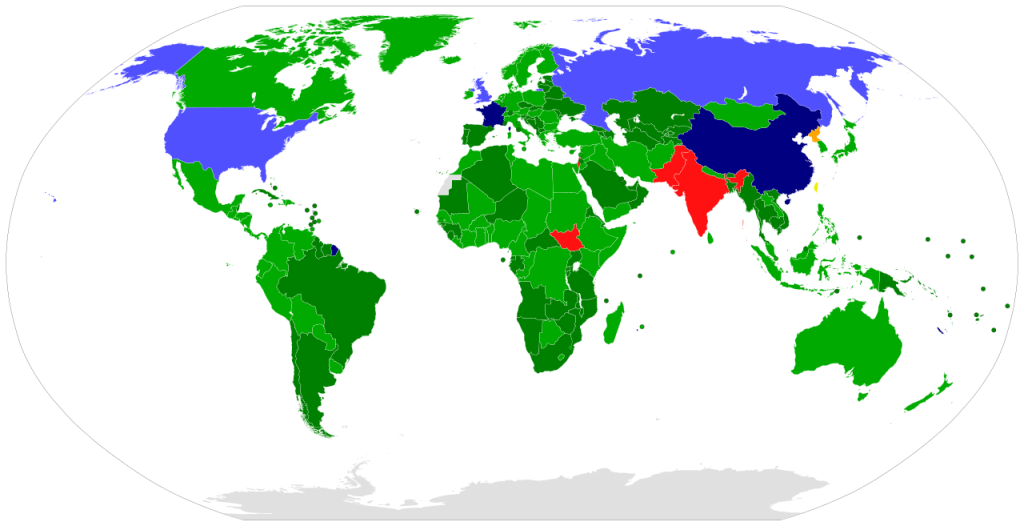
- The treaty recognises Nuclear-Weapon States (NWS) as those that manufactured and tested nuclear weapons before 1 January 1967.
- The five recognised NWS are USA, Russia, United Kingdom, France, and China.
- Non-nuclear weapon states agree not to acquire nuclear weapons, while NWS agree not to transfer nuclear weapons or technology.
- The treaty permits peaceful nuclear activities, including energy production.
- It includes a provision for withdrawal if national security interests are threatened.
- Membership and Monitoring
- The treaty has 191 member states, making it one of the most widely adhered-to arms control agreements.
- Compliance is monitored by the International Atomic Energy Agency (IAEA).
- The NPT Review Conference is held every five years to assess implementation.
- India and NPT
- India is not a signatory to the NPT.
- India has opposed the treaty as discriminatory, as it legitimises nuclear weapons for a select group of countries.
- India follows a policy of No First Use (NFU) and supports global nuclear disarmament.
Small Savings Schemes

About and Management
- Small Savings Schemes are government-backed savings instruments designed to encourage regular savings among citizens across all age groups.
- These schemes are popular due to their relatively higher returns than bank fixed deposits, sovereign guarantee, and tax benefits.
- Since 2016, the Finance Ministry reviews interest rates on a quarterly basis.
- All collections under these schemes are pooled into the National Small Savings Fund (NSSF). The fund is used by the Central Government to finance its fiscal deficit.
- The schemes are broadly classified into:
- Post Office Deposits
- Savings Certificates
- Social Security Schemes
Key Schemes and Features
- Post Office Deposits
- Includes Savings Account, Recurring Deposit (RD), Time Deposits (1–5 years), and Monthly Income Account.
- The Post Office Savings Account offers 4% annual interest and can be opened with a minimum ₹500.
- The Recurring Deposit provides 5.8% interest (compounded quarterly) with a maturity of 5 years, allowing monthly deposits starting from ₹100.
- The 5-year Time Deposit qualifies for tax deduction under Section 80C.
- Savings Certificates
- Includes National Savings Certificate (NSC) and Kisan Vikas Patra (KVP).
- NSC offers 6.8% annual interest, matures in 5 years, and qualifies for Section 80C tax benefits.
- Interest in NSC is reinvested automatically every year.
- KVP doubles the investment in 124 months (approx. 6.9% annual return).
- Minimum investment in KVP is ₹1000, with no upper limit.
- Social Security Schemes
- Public Provident Fund (PPF):
- Offers 7.1% annual interest with tax benefits under Section 80C.
- Maturity period is 15 years, extendable in 5-year blocks.
- Interest and maturity amount are fully tax-exempt.
- Sukanya Samriddhi Account (SSA):
- Launched under Beti Bachao Beti Padhao for girl child below 10 years.
- Offers 7.6% annual interest with Section 80C benefits.
- Tenure is 21 years, with a maximum annual investment of ₹1.5 lakh.
- Senior Citizens Savings Scheme (SCSS):
- Available for individuals above 60 years of age.
- Offers 7.4% annual interest, payable quarterly.
- Provides tax benefits under Section 80C with a 5-year maturity period.
- Public Provident Fund (PPF):
Accounting Standards (AS)
Accounting Standards
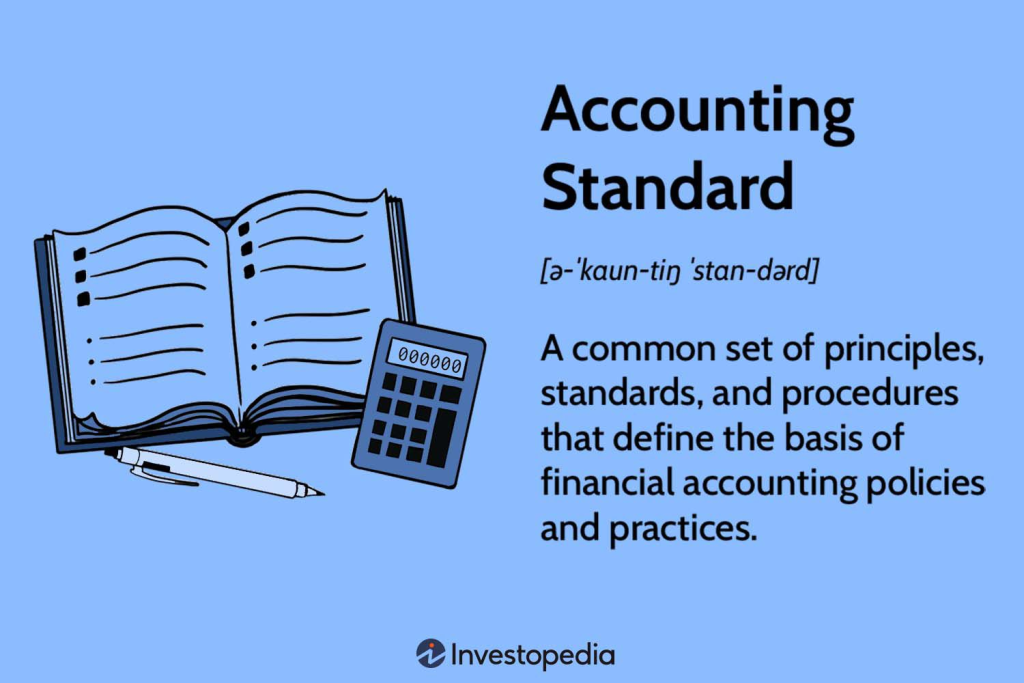
- Accounting Standards are a set of principles, rules, and guidelines issued by regulatory authorities for the preparation and presentation of financial statements.
- They specify how financial transactions are recognised, measured, recorded, and disclosed.
- Their key objectives include:
- Ensuring uniformity and comparability in financial reporting
- Enhancing transparency and reliability of financial information
- Preventing manipulation and misrepresentation of accounts
- Improving investor confidence and decision-making
Indian Accounting Standards (Ind AS)
- Ind AS are accounting standards notified by the Ministry of Corporate Affairs (MCA) in 2015.
- They are largely converged with International Financial Reporting Standards (IFRS).
- Ind AS follow a principle-based approach, focusing on:
- Fair value measurement
- Greater transparency
- Enhanced disclosures
Adoption of Ind AS (Phased Manner)
- Phase 1 (2016): Applicable to listed and unlisted companies with net worth ≥ ₹500 crore.
- Phase 2 (2017): Applicable to companies with net worth ≥ ₹250 crore but < ₹500 crore.
- Phase 3 (2018): Applicable to banks, NBFCs, and insurance companies with net worth ≥ ₹500 crore.
- Phase 4 (2019): Applicable to NBFCs with net worth ≥ ₹250 crore but < ₹500 crore.
International Financial Reporting Standards (IFRS)
- IFRS are global accounting standards issued by the International Accounting Standards Board (IASB).
- They provide a common international accounting framework, enabling comparability of financial statements across countries.
- The IASB was established in 2001, replacing the International Accounting Standards Committee (IASC).
- The IASB is headquartered in London and plays a key role in promoting consistent and transparent global financial reporting.
Project Cheetah

Overview and Objectives
- Project Cheetah is the world’s first intercontinental large carnivore translocation programme, launched by the Government of India in 2022.
- It was officially initiated on 17 September 2022, with the release of eight cheetahs from Namibia into Kuno National Park.
- The project aims to reintroduce cheetahs, which became extinct in India in 1952, into suitable habitats.
- It seeks to restore grassland ecosystems, enhance biodiversity, and maintain prey–predator balance.
- The initiative also contributes to global cheetah conservation, while promoting eco-tourism and local livelihoods.
- Currently, India hosts about 27 cheetahs, including 16 born in the wild, across Kuno National Park and Gandhi Sagar Wildlife Sanctuary.
About Cheetah
- Scientific Name: Acinonyx jubatus
- IUCN Status:
- Cheetah: Vulnerable
- Asiatic Cheetah: Critically Endangered
- Key Features
- The cheetah is the fastest land animal, capable of speeds of 97–113 km/h in short bursts.
- It has a slender body, long limbs, flexible spine, and non-retractable claws, which enhance speed and traction.
- Distinct black tear marks from eyes to mouth help in reducing glare and improving focus during hunting.
- Average body length ranges from 1.1 to 1.4 metres, with weight between 35–65 kg.
- Lifespan is about 14 years in the wild and up to 20 years in captivity.
- Cheetahs are generally solitary animals, except during mating or when females raise cubs.
- Male coalitions, often formed by siblings, may cooperate in territorial defence and hunting.
- The gestation period is about 93 days, with a litter size of 3–6 cubs.
- Cub mortality is very high (up to 90%), mainly due to predation by lions, leopards, and hyenas.
- Cubs remain with their mother for 18–24 months, learning essential survival skills.
- Cheetahs prefer open grasslands and savannas, feeding on animals such as antelopes, gazelles, and hares.
- They function as an indicator species of grassland ecosystems, reflecting the health of these habitats.
