

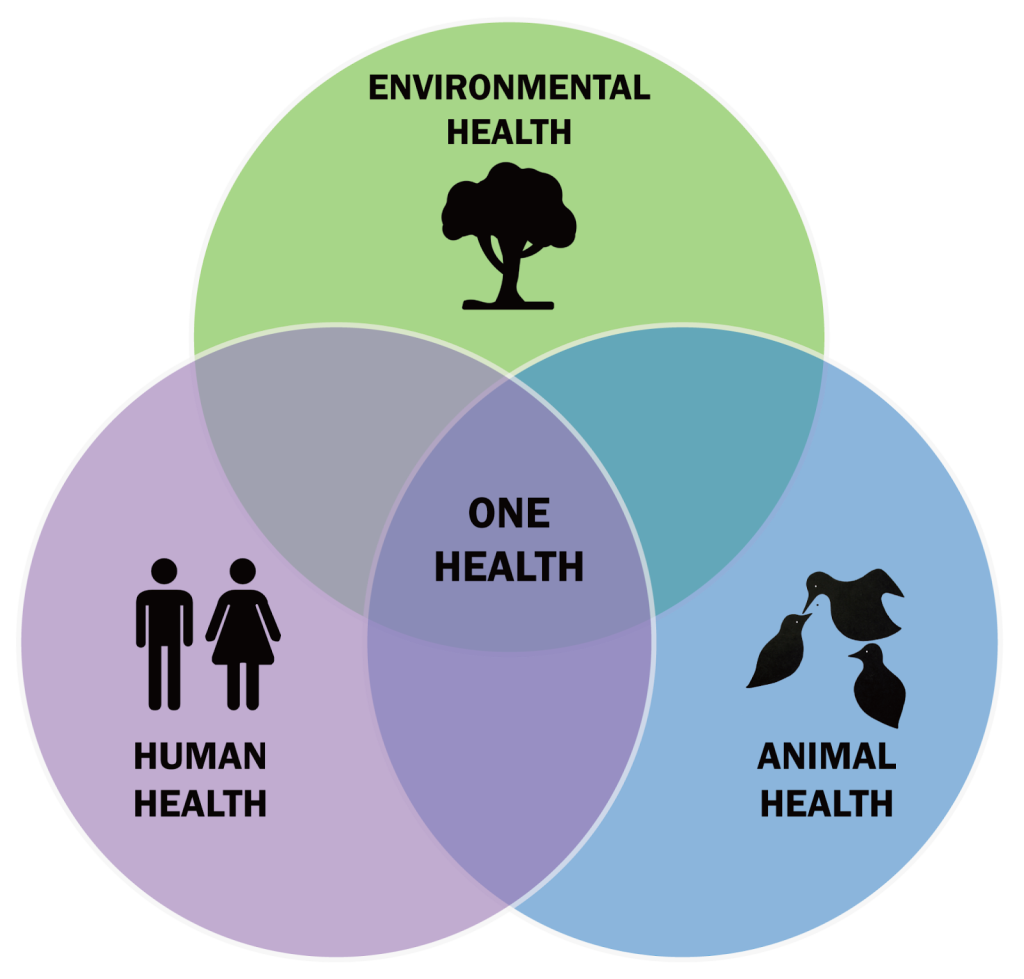
What is the ‘One Health’ Approach?
- The One Health approach is a collaborative framework that integrates human, animal, and environmental health to address shared health risks.
- It adopts an interdisciplinary approach, bringing together medical, veterinary, and ecological sciences for effective interventions.
- The framework has gained global recognition, as it is formally endorsed by WHO, FAO, UNEP, and WOAH (World Organisation for Animal Health).
- In India, the approach is institutionally anchored through the National One Health Mission, which promotes multisectoral coordination.
Operational Tools of One Health
- Mass immunisation of animals helps break zoonotic transmission chains and reduces disease spread.
- Continuous livestock monitoring and veterinary surveillance enable early detection of disease hotspots.
- Regulation of veterinary drugs ensures proper drug oversight, preventing antimicrobial resistance and ecological harm.
- Effective waste and carcass management reduces the spread of disease vectors and environmental contamination.
- Development of integrated databases linking human, animal, and environmental health strengthens surveillance systems.
Why is the One Health Approach Important?
- There is a rising incidence of zoonotic diseases such as Nipah and COVID-19, highlighting interconnected health risks.
- Nearly 60% of human pathogens originate from animals, and 75% of emerging infectious diseases have zoonotic origins.
- Around 80% of pathogens with bioterrorism potential are linked to animal sources.
- Animal diseases contribute to over 20% of global livestock production losses, affecting food security.
- Human activities have altered 75% of terrestrial and 66% of marine ecosystems, increasing human–animal interactions.
- Environmental degradation and pollution adversely affect both human and animal health systems.
- Increased globalisation, trade, and tourism have accelerated cross-border disease transmission.
- The rise of antimicrobial resistance (AMR) poses a major threat to both human and animal health.
- Climate change is expanding the range of pathogens and disease vectors, increasing disease risks.
One Health Joint Plan of Action (OH-JPA)
- The One Health Joint Plan of Action was launched in 2022 by FAO, UNEP, WHO, and WOAH.
- It is a five-year global framework aimed at strengthening collaboration across sectors.
- The plan focuses on improving communication, coordination, capacity building, and integrated responses.
- It addresses health challenges at the human–animal–environment interface.
Structural Challenges in Implementation
- Institutional fragmentation persists, as health, veterinary, and municipal systems function in silos.
- Weak infrastructure, especially limited diagnostic laboratory capacity, delays disease detection and response.
- Funding disparities exist, with animal health receiving significantly lower investment than human health.
- Social barriers, including misinformation and resistance, hinder vaccination and surveillance efforts.
- Climate change continues to intensify risks by expanding disease vectors and ecological disruptions.
India’s Steps on One Health
- India’s One Health vision is aligned with the tripartite-plus alliance of FAO, WHO, WOAH, and UNEP, supported by UNICEF and the World Bank.
- The National One Health Mission (2022) was endorsed by the Prime Minister’s Science, Technology and Innovation Advisory Council (PM-STIAC).
- During India’s G20 Presidency, the One Health approach received global endorsement for strengthening surveillance capacity.
- The Integrated Disease Surveillance Programme (2004) improved outbreak detection but lacks full integration of human and animal data.
- A National Road Map to Combat Zoonoses (2008) was developed for integrated surveillance and response.
- The government established the Centre for One Health at Nagpur under ICMR to address zoonotic diseases.
- The Department of Biotechnology launched India’s first One Health Consortium (2021) involving 27 organisations to study zoonotic and transboundary diseases.
Way Forward
- India must deepen the National One Health Mission through stronger inter-ministerial coordination.
- Animal vaccination programmes should be expanded, particularly for diseases such as rabies and avian influenza.
- A network of district-level integrated laboratories should be developed for timely diagnosis.
- The One Health approach must be integrated with a robust AMR strategy to regulate antimicrobial usage.
- Digital tools such as AI and GIS-based surveillance systems should be adopted for real-time monitoring.
- Policy frameworks must ensure sustained coordination across sectors to build resilient health systems.
Conclusion
- The One Health approach recognises that human well-being is inseparable from animal and environmental health. By strengthening surveillance, coordination, and preventive strategies, it offers a pathway towards a resilient, sustainable, and health-secure future, aligned with SDGs 2, 3, and 13.
