


Monetary Policy Committee (MPC) – Composition, Functions, and Repo Rate Impact
Context
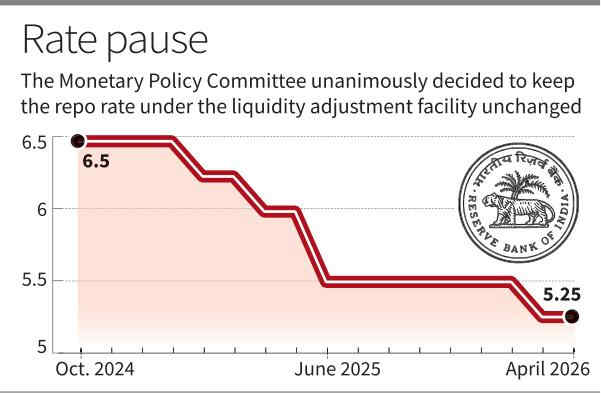
- The Monetary Policy Committee (MPC) of the Reserve Bank of India (RBI) decided to keep the repo rate unchanged at 5.25%.
- The decision came shortly after the announcement of a temporary ceasefire in West Asia, which has significant implications for global energy markets and inflation.
About Monetary Policy Committee (MPC)
- Monetary policy refers to the use of central bank instruments to regulate:
- Interest rates
- Money supply
- Availability of credit
- Constituted under Section 45ZB of the RBI Act, 1934. It is responsible for determining the policy interest rate (repo rate) to achieve the inflation target.
- Primary Function: To maintain inflation within the target range by adjusting the repo rate.
- Objective: Maintain price stability while supporting economic growth.
- Legal and Institutional Framework
- The RBI conducts monetary policy under the RBI Act, 1934.
- In 2016, the Act was amended to introduce the Flexible Inflation Targeting (FIT) framework.
- The inflation target is set by the Government of India in consultation with RBI every 5 years.
- Composition: Total 6 members:
- RBI Governor (Chairperson)
- RBI Deputy Governor (Monetary Policy)
- 1 RBI-nominated member
- 3 external members appointed by the Government
- Tenure of External Members: 4 years
- Decision-Making Process
- Decisions are taken by majority vote.
- In case of a tie, the RBI Governor has a casting vote.
- The decision of MPC is binding on the RBI.
- Functioning
- Quorum: Minimum 4 members (including Governor/Deputy Governor).
- Meets at least 4 times a year.
- Assisted by RBI’s Monetary Policy Department (MPD).
About Repo Rate and Reverse Repo Rate
- The Repo Rate is the interest rate at which the Reserve Bank of India (RBI) lends short-term funds to commercial banks against government securities.
- It is a key monetary policy instrument used to regulate liquidity and credit flow in the economy.
- The Reverse Repo Rate is the interest rate at which RBI borrows funds from commercial banks, thereby absorbing excess liquidity from the banking system.
- Impact of Repo Rate Changes
- Increase in Repo Rate:
- Makes borrowing costlier for banks
- Reduces money supply and demand
- Helps control inflation
- Decrease in Repo Rate:
- Makes borrowing cheaper for banks
- Increases liquidity and credit flow
- Stimulates investment and economic growth
- Increase in Repo Rate:
Lead Poisoning

Context
- A recent study by Toxics Link found high levels of lead contamination in soil near lead-acid battery recycling units in Delhi-NCR. Soil samples showed contamination ranging from 100 ppm to 43,800 ppm, including areas near residential zones and schools.
About Lead Poisoning
- Lead poisoning occurs when lead accumulates in the body, leading to toxic effects.
- Lead is a cumulative toxicant with no safe level of exposure.
- Health Impacts
- Children (most vulnerable):
- Learning disabilities
- Neurological impairment
- Stunted growth
- Adults:
- High blood pressure
- Cardiovascular diseases
- Kidney damage
- Pregnancy-related risks:
- Reduced foetal growth
- Preterm birth
- Children (most vulnerable):
Status in India
- Around 20 crore children have blood lead levels above WHO safe limits.
- High-burden states include: Bihar, Uttar Pradesh, Madhya Pradesh, Jharkhand, Chhattisgarh, Andhra Pradesh
- Lead exposure contributes to learning gaps and reduced productivity, affecting economic development.
Causes and Sources
- Informal recycling of lead-acid batteries (major source)
- Poor waste management infrastructure
- Increase in vehicle usage and battery disposal
- Unsafe practices leading to release of lead dust and acid into soil and environment
Government Initiatives and Regulations
- Battery Waste Management Rules, 2022: Strengthen EPR framework and recycling standards
- Lead Battery Waste Management Rules, 2016: Safe disposal and recycling
- National Health Mission (NHM): Screening and treatment support
- Import Ban (2013) on non-compliant lead-acid batteries
UNFCCC

Context
- India has withdrawn its bid to host COP33 (2028), citing a review of its commitments for 2028. India last hosted a COP in 2002 (COP8).
- Recently, India also announced its updated Nationally Determined Contributions (NDCs):
- 60% installed electricity capacity from non-fossil sources by 2035
- 47% reduction in emissions intensity of GDP
- Creation of 3.5–4 billion tonnes CO₂ equivalent carbon sink
About UNFCCC
- The United Nations Framework Convention on Climate Change (UNFCCC) is the primary international treaty for coordinating global action on climate change.
- Its objective is to:
- Stabilise greenhouse gas concentrations
- Limit global temperature rise
- Enable adaptation to climate impacts
- Ensure food security and sustainable development
- Membership and Structure
- Has 198 Parties (197 countries + European Union), making it one of the most widely ratified treaties.
- Parties meet annually in the Conference of Parties (COP) to:
- Review progress
- Negotiate commitments
- Advance climate action
- Origin and Evolution of UNFCCC
- Adopted at the Rio Earth Summit (1992).
- It is one of the three Rio Conventions:
- UNFCCC (Climate Change)
- Convention on Biological Diversity (CBD)
- UN Convention to Combat Desertification (UNCCD)
- It forms the foundation for major climate agreements:
- Kyoto Protocol (1997)
- Paris Agreement (2015)
Role of COP (Conference of Parties)
- COP is the decision-making body of UNFCCC.
- It meets annually and rotates among regional groups.
- Key functions:
- Review implementation of agreements
- Set climate targets and frameworks
- Facilitate global cooperation and negotiations
Scientific Basis: IPCC
- The UNFCCC relies on assessments by the Intergovernmental Panel on Climate Change (IPCC).
- IPCC:
- Established in 1988 by UNEP and WMO
- Provides scientific evidence and reports on climate change
- Guides policy decisions and negotiations
Türkiye – Geography, Strategic Straits (Bosporus, Dardanelles), and Geopolitical Importance
Location and Physical Features
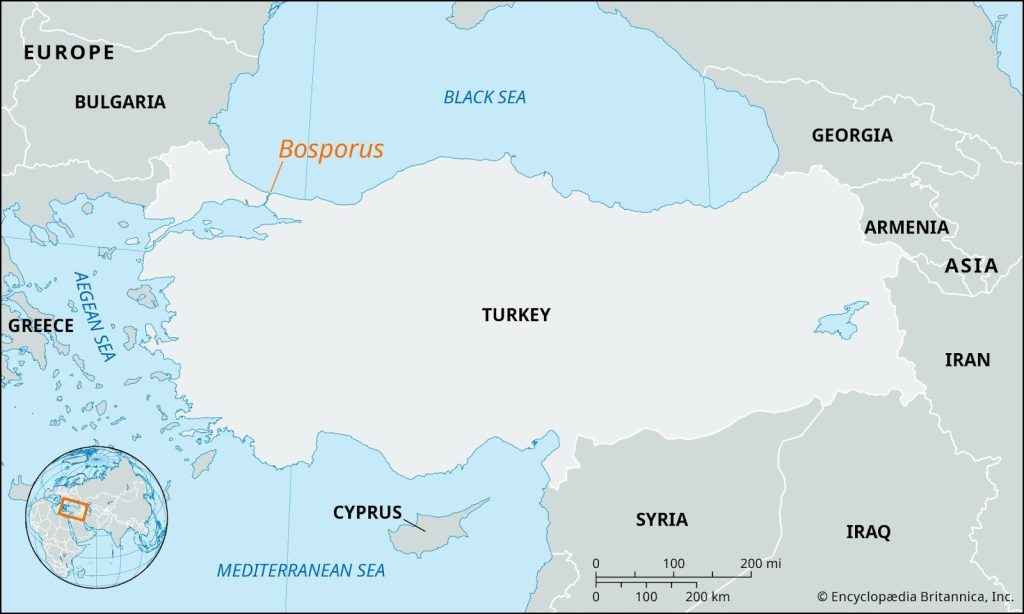
- Türkiye is a transcontinental country, located in both Europe and Asia.
- The major portion lies in Asia (Anatolia/Asia Minor), while a smaller part lies in Europe (Thrace region).
- It is surrounded by seas on three sides:
- Black Sea (north)
- Mediterranean Sea (south)
- Aegean Sea (west)
- Strategic Straits:
- Bosporus Strait: Connects Black Sea → Sea of Marmara
- Dardanelles Strait: Connects Aegean Sea → Sea of Marmara
- These straits make Türkiye a critical maritime and geopolitical gateway between Europe and Asia.
Boundaries and Neighbouring Countries
- West: Bulgaria, Greece
- East: Armenia, Azerbaijan, Iran
- Northeast: Georgia
- South: Syria
- Southeast: Iraq
Strategic and Geopolitical Importance
- Acts as a bridge between Europe and Asia (Eurasian location).
- Controls access between the Black Sea and Mediterranean Sea through Bosporus and Dardanelles.
- Holds importance in:
- Global trade routes
- Energy transit corridors
- Regional geopolitics (West Asia, Europe, NATO region)
PM Surya Ghar: Muft Bijli Yojana

Context
- The Government is promoting a Utility-Led Aggregation (ULA) model to accelerate rooftop solar adoption under the scheme.
- The initiative aims to achieve the target of 1 crore households by March 2027.
- Additional incentives for States are being considered to improve participation and implementation.
About the Yojana
- Launched in 2024 to promote rooftop solar adoption and provide free electricity to households.
- Aims to enhance energy access, affordability, and sustainability.
- Key Features
- Subsidy Structure:
- 60% subsidy for systems up to 2 kW capacity
- 40% subsidy for additional capacity between 2–3 kW
- Subsidy limited up to 3 kW
- Model Solar Village Component: Establishment of one model solar village per district to promote adoption.
- Incentives to Local Bodies: Provision of ₹1,000 per rooftop installation to Urban Local Bodies (ULBs) and Panchayati Raj Institutions (PRIs).
- Subsidy Structure:
Implementation Mechanism
- Implemented through:
- National Programme Implementation Agency (NPIA) at the national level
- State Implementation Agencies (SIAs) at the state level
- Role of DISCOMs:
- Act as State Implementation Agencies
- Ensure net metering, inspection, and commissioning
- Receive performance-linked incentives for capacity addition
Eligibility Criteria
- Applicant must be an Indian citizen.
- Must possess a residential house with suitable rooftop space.
- Must have a valid electricity connection.
- Must not have availed any other subsidy for solar panels.
Elephanta Caves – UNESCO Site, Trimurti Sculpture, and Rock-Cut Architecture
Context
- The Archaeological Survey of India (ASI) has unearthed a ~1,500-year-old stepped reservoir on Elephanta Island (Mumbai coast). The structure reflects advanced water management practices in a rocky island environment with high runoff.
- The excavation has also revealed artefacts indicating long-distance maritime trade and cultural exchanges.
More in News
- The reservoir is a T-shaped stepped structure (~14.7 m long) with well-aligned stone blocks transported from the mainland.
- Excavations have revealed brick structures, terracotta figurines, beads, bangles, and storage vessels.
- Discovery of ~3,000 amphorae and West Asian torpedo jar sherds indicates Mediterranean and Mesopotamian trade links.
- Around 60 coins (copper, lead, silver) have been found, including those of Kalachuri ruler Krishnaraja (6th century CE).
- The reservoir represents a planned hydraulic architecture, crucial due to low groundwater retention on the island.
About Elephanta Caves
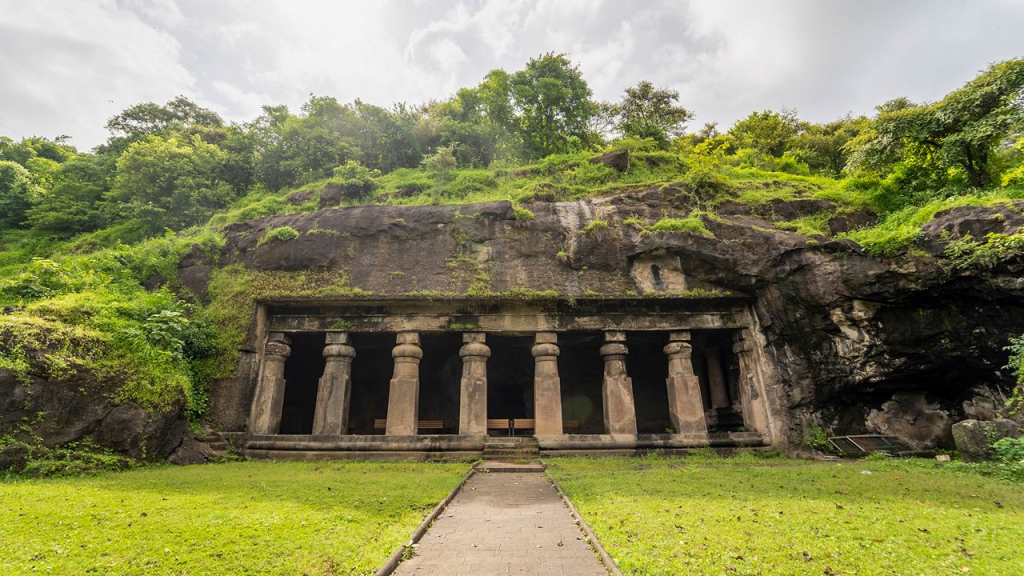
- Located on Elephanta Island in Mumbai Harbour, Maharashtra.
- Designated as a UNESCO World Heritage Site.
- Constructed between the 5th and 8th centuries CE.
- Associated with dynasties such as the Chalukyas and Rashtrakutas.
- Reflects a significant phase of early medieval Indian cultural and religious development.
- Architectural Features
- Exemplifies rock-cut architecture carved out of basalt rock.
- Comprises:
- Main Cave (Great Cave)
- Smaller subsidiary caves
- Mandapas (pillared halls) and intricately carved panels
- The layout follows Hindu temple architectural principles.
- Sculptural Significance
- Dominated by Shaivite themes, focusing on Lord Shiva.
- Major depictions include:
- Nataraja (cosmic dancer)
- Ardhanarishvara (union of male and female principles)
- Mahayogi (meditative form)
- Trimurti Sculpture (Maheshmurti):
- Iconic three-faced depiction symbolising creation, preservation, and destruction.
- Sculptures display high artistic excellence, with emphasis on expression, balance, and symbolism.
- Cultural and Symbolic Importance
- Represents the Rishi-Shaiva tradition and philosophical depth of Hinduism.
- Symbolises the cosmic cycle of life, death, and rebirth.
- Demonstrates India’s ancient expertise in art, engineering, and religious expression.
Virtual Private Network (VPN)

Concept and Definition
- A Virtual Private Network (VPN) is a technology that establishes a secure digital connection between a user’s device and a remote server operated by a VPN provider.
- It creates an encrypted tunnel through which data is transmitted securely over the internet.
Key Features and Working Mechanism
- Encryption:
- VPN converts data into encrypted code, making it unreadable to unauthorised users.
- IP Address Masking:
- The user’s real IP address is hidden, and a new IP from the VPN server is used.
- Secure Tunnel:
- Establishes a point-to-point connection between the device and VPN server.
- Meaning of “VPN”:
- Virtual: No physical infrastructure; operates over the internet.
- Private: Ensures confidentiality of data and browsing activity.
- Networked: Connects multiple systems (user device and remote server).
Advantages of VPN
- Data Security: Protects sensitive data from cyber threats and interception.
- Privacy Protection: Prevents tracking by Internet Service Providers (ISPs) and third parties.
- Bypassing Restrictions: Enables access to blocked or restricted websites by masking location.
- Anonymity: Enhances online anonymity by hiding identity and browsing patterns.
Limitations and Concerns
- Misuse Potential: Can be used for bypassing legal restrictions or illegal activities.
- Dependence on Provider: Trust in VPN provider is critical, as they may have access to user data.
- Performance Issues: Encryption may reduce internet speed.
