

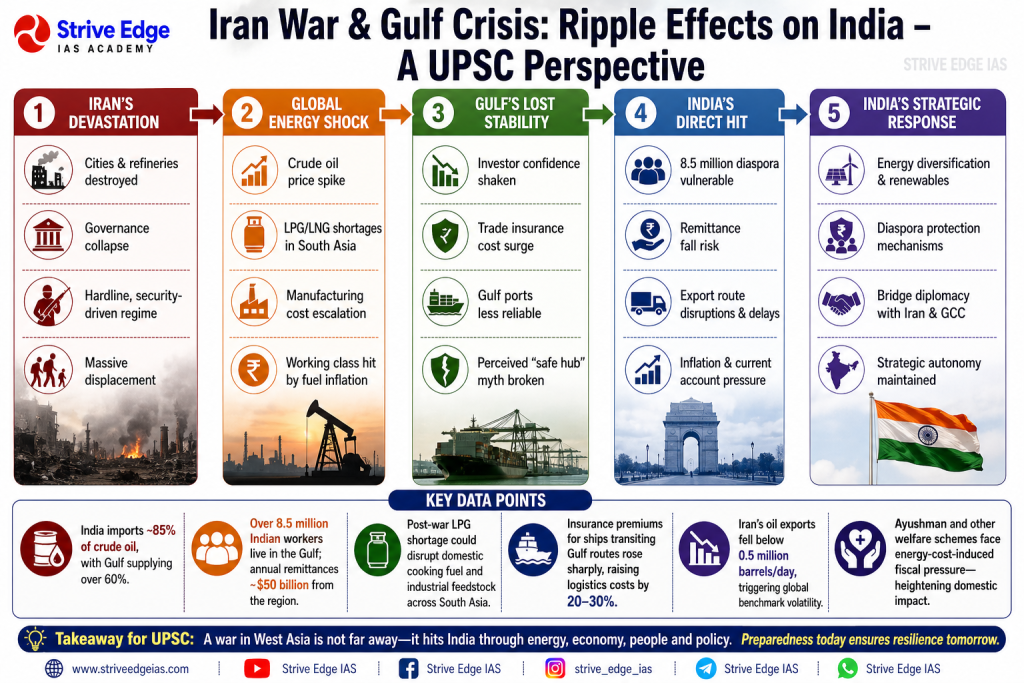
Context: The ongoing war in Iran has extended beyond battlefield destruction to reshape the political, economic, and strategic landscape of West Asia, exposing the fragility of regional stability. The conflict has not only weakened Iran but also undermined the Gulf’s long-standing image as a stable hub for capital, energy, and migration, with direct implications for India.
Impact on Iran
- Physical Devastation: Destruction of cities, refineries, transport networks, and industrial infrastructure has crippled economic capacity.
- Governance Collapse: Disruption of leadership and administrative systems has weakened state authority and institutional functioning.
- Humanitarian Crisis: Massive displacement, loss of livelihoods, and erosion of social cohesion have deepened human suffering and instability.
- Political Consequences: Post-war leadership is likely to be more hardline and security-driven, with limited scope for reform.
- Iran emerges as a weakened yet potentially volatile state, with implications beyond its borders.
Global and Regional Economic Consequences
- Decline in Iranian oil exports has led to rising crude prices and volatility in global energy markets.
- Shortages of LPG and LNG have disrupted industries across South Asia and East Africa, affecting production and trade.
- Rising fuel costs have translated into higher prices, disproportionately affecting the working class.
- Manufacturing sectors dependent on stable energy supply face cost escalation and operational disruptions.
- The Gulf’s Shattered Illusion of Stability
- The Gulf’s image as a secure destination for investment and business has been significantly weakened.
- Investors and sovereign wealth funds now face heightened risk perceptions and reduced confidence.
- Trade and Connectivity Disruptions:
- Increased insurance costs and delays in trade routes
- Reduced reliability of Gulf ports as global transit hubs
- The belief that the Gulf was insulated from regional conflict has been fundamentally challenged.
Implications for India
- Energy Security Risks: India’s dependence on Gulf hydrocarbons makes it vulnerable to price shocks and supply disruptions.
- Diaspora Concerns: Indian migrant workers in the Gulf face job insecurity, income loss, and uncertainty, affecting remittance flows.
- Trade Disruptions: Gulf ports act as gateways for Indian exports; instability increases costs, delays, and logistical risks.
- Macroeconomic Impact: Rising energy prices contribute to inflationary pressures and external sector vulnerabilities.
- Thus, the India’s deep economic and strategic ties with the Gulf translate regional instability into direct domestic challenges.
Way Forward
- Possibility of Regional Cooperation
- Shared Incentives for Stability: Gulf states recognise that a stable Iran is preferable to a chaotic one.
- Reconstruction as Opportunity: Post-war rebuilding can become a platform for regional cooperation and trust-building.
- Need for Collective Security Approach: Regional actors must move beyond rivalry to collaborative stabilisation efforts.
- India’s Role and Strategic Response
- Bridge Diplomacy: India can leverage its ties with both Iran and Gulf countries to facilitate dialogue and reconstruction.
- Energy Diversification: Reduce dependence by investing in renewables and alternative energy sources.
- Diaspora Protection Mechanisms: Strengthen systems to support and secure Indian workers abroad.
- Strategic Autonomy: Maintain a balanced approach amid competing geopolitical interests.
- India must adopt a proactive and multi-dimensional strategy to safeguard its interests.
Conclusion
- The war in Iran has fundamentally altered the narrative of West Asia, from a region of economic promise to one of fragility and uncertainty. It underscores a critical lesson: prosperity without stability is inherently unsustainable, and long-term peace requires cooperation, resilience, and shared responsibility.
