

Context: Recent policy developments, including the implementation of the new Labour Codes and replacement of MGNREGA through the Viksit Bharat-Guarantee for Rozgar and Ajeevika Mission (Gramin) Bill, 2025, have revived concerns regarding rising inequality and welfare insecurity in India.
Understanding Inequality in India
- Inequality in India extends beyond income disparities and includes inequalities in:
- Wealth
- Consumption expenditure
- Access to education, healthcare, and opportunities
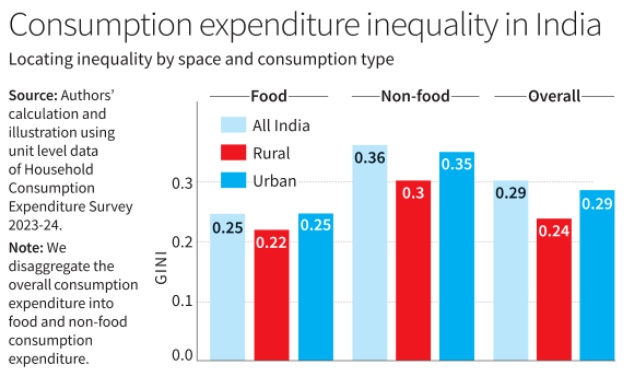
- Estimates from the Household Consumer Expenditure Survey (HCES 2023-24) place India’s consumption expenditure inequality (Gini Index) at 0.29, higher than the World Bank estimate of 0.25.
- Existing surveys often fail to adequately capture the consumption and wealth patterns of the super-rich, leading to underestimation of actual inequality levels.
- Inequality in India is multidimensional, structural, and often inadequately reflected in aggregate indicators.
Key Dimensions of Inequality in India
- Rural–Urban Inequality
- Urban India remains significantly more unequal and affluent than rural India.
- Average urban non-food monthly per capita expenditure (MPCE) is approximately 1.5 times the all-India average, while rural expenditure remains substantially below it.
- Urban-centric growth patterns have widened disparities in consumption and living standards.
- Consumption Expenditure Inequality
- Non-food expenditure inequality is substantially higher than food expenditure inequality, particularly in urban areas.
- In urban India:
- The top 10% account for nearly 27% of total non-food expenditure
- The mean MPCE of the top decile is almost six times that of the bottom decile
- The MPCE of the richest urban decile is nearly nine times that of the poorest rural decile.
- Class-Based Inequality
- Economic growth since the 1980s has disproportionately benefited urban professionals, managersand business-owning classes.
- In contrast informal workers, small farmers and agricultural labourers have witnessed comparatively limited welfare gains.
- Between-Group Inequality
- A significant share of inequality arises from disparities between economic groups rather than within groups.
- Between-decile inequality contributes disproportionately to non-food expenditure inequality in both rural and urban sectors.
Reasons for Inequality in India
- Urban-Centric Growth Model
- Economic growth has remained concentrated in urban and service-oriented sectors, while agricultural distress persists in rural India.
- Informalisation of Employment
- A large section of India’s workforce remains engaged in informal employment characterised by low wages, limited social security and employment insecurity.
- Unequal Access to Human Capital
- Disparities in access to quality education, healthcare, skilling, and digital infrastructure reinforce intergenerational inequality.
- Debt-Led Consumption
- A significant proportion of households rely on borrowing to sustain consumption, reflecting underlying economic vulnerability.
- Weak Redistributive Capacity
- Welfare measures have not sufficiently reversed structural inequalities in income and asset ownership.
Associated Concerns
- Weakening Inclusive Growth
- Excessive concentration of income and consumption limits broad-based economic participation and demand generation.
- Social and Regional Polarisation
- Persistent inequality may intensify social fragmentation and deepen regional disparities.
- Employment and Livelihood Insecurity
- Informal workers and rural populations remain highly vulnerable to economic shocks and policy changes.
- Democratic and Governance Challenges
- High inequality can reduce trust in institutions and weaken perceptions of fairness and social mobility.
- Distorted Welfare Outcomes
- Policy assumptions based on underestimation of inequality may adversely affect vulnerable populations.
Way Forward
- Promote Inclusive and Employment-Centric Growth: Strengthen labour-intensive manufacturing, rural industries, and agricultural productivity.
- Expand Social Protection Systems: Ensure universal access to healthcare, food security, pensions, and livelihood support mechanisms.
- Improve Quality and Transparency of Data: Strengthen income, consumption, and wealth surveys for better assessment of inequality trends.
- Invest in Human Capital: Expand access to quality education, healthcare, skilling, and digital connectivity for disadvantaged groups.
- Reduce Regional and Class Disparities: Focus on balanced regional development and welfare measures targeting informal and rural workers.
Conclusion
- India’s growth trajectory has undoubtedly expanded economic opportunities, but the gains remain unevenly distributed across regions, classes, and occupational groups. Sustainable and democratic development requires moving beyond aggregate growth indicators towards a model centred on equity, employment generation, and social justice.
