

Kaziranga National Park
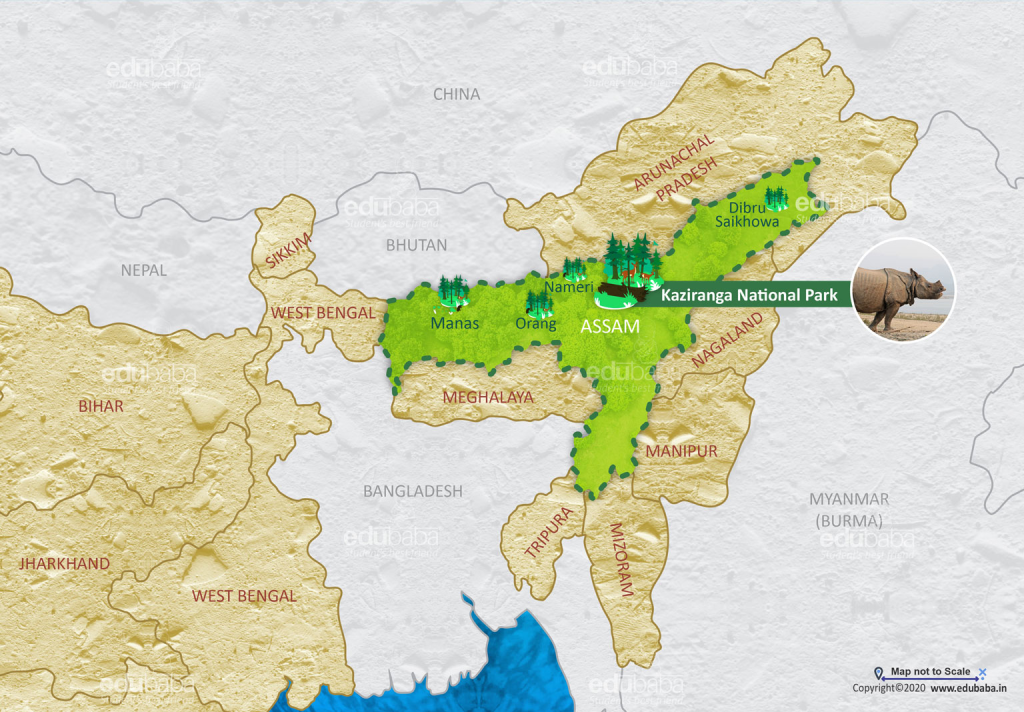
Context: A rapid bird survey at Kaziranga National Park, Assam recorded 30 raptor species and 6 stork species, released on World Environment Day (June 5).
More in News
- India is home to 112 raptor species; Kaziranga and its adjoining landscape harbour about 50 species.
- India houses 8 of the 20 stork species found globally; all 8 are found in Assam, while Kaziranga recorded 6.
- Asian Openbill (Anastomus oscitans) was the most abundant stork with 92 individuals spotted.
- Greater Adjutant Stork (Leptoptilos dubius) was the rarest stork with only 3 individuals recorded.
- Himalayan Griffon Vulture (Gyps himalayensis) was the most common raptor.
About Kaziranga National Park
- Located along the Brahmaputra River in Assam, it contains over 250 seasonal water bodies and the Diphlu River flows through the landscape.
- It was established as a Reserve Forest in 1908 to protect the Indian Rhinoceros.
- It became a Wildlife Sanctuary (1950), National Park (1974), UNESCO World Heritage Site (1985), and Tiger Reserve (2007).
- It is known for the Big Five: Rhinoceros, Tiger, Elephant, Asiatic Wild Buffalo, and Eastern Swamp Deer.
- Nearly the entire population of Eastern Swamp Deer is found in Kaziranga.
DNA Paternity Testing and Right to Privacy
Context: The Supreme Court upheld a DNA test order in a paternity dispute, balancing the child’s right to know parentage against the father’s right to privacy under Article 21.
More in News
- The court held that neither the child has an unrestricted right to demand DNA testing nor can the father’s right to privacy be completely abandoned.
- Earlier, the Supreme Court consistently held that DNA tests should not be ordered routinely in paternity disputes.
- Post the Puttaswamy judgment (2017), courts ruled that compulsory DNA testing interferes with right to privacy and bodily autonomy.
- In Nandlal Wasudeo Badwaik v. Lata Nandlal Badwaik (2014), the Supreme Court held that scientific proof must prevail over conclusive legal proof when both conflict.
- The N.D. Tiwari paternity case (2014) established a significant precedent on privacy, scientific evidence, and rights of children born out of wedlock.
Key Legal Provisions
- Section 112 of the Evidence Act, 1872 (now Section 116 of Bharatiya Sakshya Adhiniyam) presumes a child to be legitimate unless the disputing party proves non-access during the relevant period of marriage.
- DNA testing became commercially available in India by the 1980s, though Section 112 was enacted in 1872 when no scientific method existed.
- Right to Privacy is a fundamental right under Article 21, established by the Puttaswamy v. Union of India (2017) judgment.
Electronic Gold Receipt (EGR)
Context: NSE unveiled Electronic Gold Receipts (EGR) and is in the preparatory stage to operationalise the system within one to two weeks.
More in News
- EGR will be available in five denominations each for 995 and 999 purity gold.
- It is estimated that approximately 25,000 tonnes of gold are held as savings by people and another 25,000 tonnes are with temples.
About EGR
- EGRs are dematerialised securities representing ownership of physical gold stored in SEBI-regulated vaults.
- Investors hold EGRs in their demat accounts, similar to shares or ETFs.
- Each EGR is backed by actual physical gold, ensuring authenticity and standardisation.
- EGRs are operated under SEBI guidelines.
- A Vault Manager is a new entity registered by SEBI to provide vaulting services for gold deposited for EGR creation.
Working of EGR
- Physical gold is deposited at accredited vaults, then converted into EGR units credited to a demat account.
- EGR units can be traded on the exchange or converted back into physical gold, offering flexibility.
- Participants include jewellers, refiners, traders, and retail and institutional investors.
Chitin
Context: A study found that Europeans have gene variants that significantly reduce chitin-digesting enzymes, putting them at a disadvantage in digesting insect-based foods.
About Chitin
- Chitin is the most prevalent amino polysaccharide polymer found in nature.
- It is formed from N-acetylglucosamine, an amide derivative of glucose, forming a long-chain polymer.
- It forms the exoskeletons of crustaceans and insects and the cell walls of fungi, providing structural strength.
- Chitin is primarily detected in the stomach or lungs, where it activates innate and adaptive immune cells.
- It stimulates leukocyte recruitment, cytokine production, and alternative macrophage activation.
- Chitin can be deacetylated chemically or enzymatically to produce its well-known byproduct chitosan.
- Key Finding
- People in tropical regions had gene variants that improve chitin digestibility, while Europeans had variants reducing chitin-digesting enzyme levels.
- These genetic differences were confirmed to have existed approximately 9,000 years ago.
Sambhar Lake
Context: A study using satellite data (1984 to 2023) found Sambhar Lake’s surface shrinking while nearby industrial salt pans expanded between 2022 and 2023.
About Sambhar Lake
- Sambhar is India’s largest inland saltwater lake, located in the Nagaur and Jaipur districts of Rajasthan.
- It is elliptical in shape, measuring 35.5 km in length and 3 to 11 km in breadth, covering over 200 sq. km.
- It is surrounded on all sides by the Aravalli Hills.
- Five streams feed the lake: Rupangarh and Mendha are the main ones; Samoad, Khari, and Khandela are the lesser ones.
- It was designated as a Ramsar site in 1990.
- It accounts for nearly 9% of India’s total salt production.
- It is the most important wintering area for flamingoes in India outside the Rann of Kachchh.
Beaufort Castle
Context: Beaufort Castle gained renewed attention after Israel’s military invasion of southern Lebanon on June 1, 2026.
About Beaufort Castle
- Beaufort Castle was built by European Crusaders in 1139 atop older fortifications in southern Lebanon.
- Its original Arabic name is Qalaat al-Shaqif, meaning “Castle of the High Rock.”
- The name Beaufort is an Old French term meaning “beautiful fort.”
- It sits beside the Litani River with an unobstructed view of northern Israel and the Beqaa Valley.
- It covers an area of 15,000 square metres and has a 300-metre sharp drop on one side, providing natural protection.
- UNESCO and Heritage Status
- Beaufort Castle is on Lebanon’s tentative list for UNESCO World Heritage Site status.
In November 2024, UNESCO granted it provisional enhanced protection under the 1954 Hague Convention.
