

Special Intensive Revision of Electoral Rolls
Context
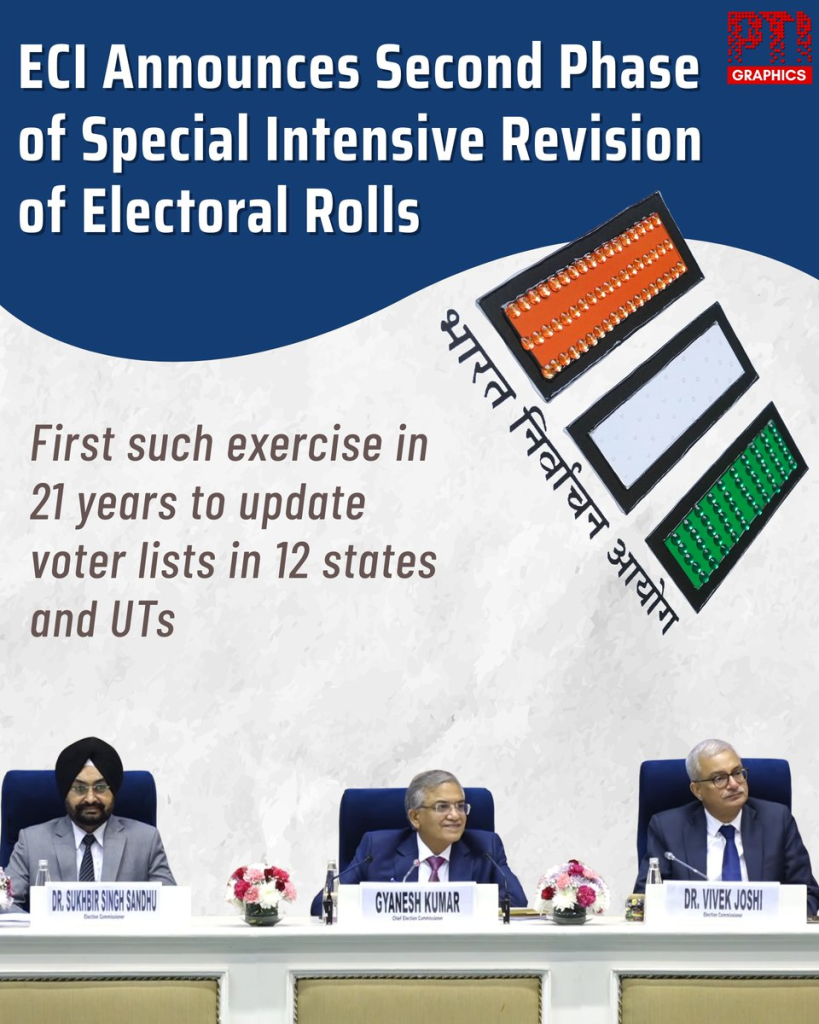
- The Supreme Court delivered a 124-page judgment upholding the Special Intensive Revision (SIR) of electoral rolls. The SIR was conducted in Bihar just months before the 2025 Assembly elections raising serious concerns about timing and intent.
- The judgment has far-reaching implications for the right of Indian citizens to be included in electoral rolls.
Constitutional and Statutory Provisions
- Article 325 declares one general electoral roll per constituency and no person can be excluded on grounds of religion, race, caste or sex.
- Article 326 guarantees adult suffrage and ensures every citizen aged 18 years and above is entitled to voter registration.
- Article 324 confers power to prepare electoral rolls and conduct elections on the Election Commission of India (ECI).
- Electoral roll revision is governed by the Representation of the People Act, 1950 and Registration of Electors Rules, 1960.
- Section 21(2) provides for revision before general elections or by-elections and allows only summary revision at that stage.
- Section 21(3) allows special revision only in a constituency or part of a constituency and not the entire State.
Concerns and Controversy
- Wrong Legal Provision: ECI conducted intensive revision under Section 21(3) which does not authorise such revision.
- Improper Timing: Summary revision alone was legally permissible before scheduled Assembly elections under Section 21(2).
- Misinterpretation of Law: “Any constituency” in Section 21(3) means a single constituency and not the entire State.
- Usurpation of Authority: ECI announced citizenship documents independently, encroaching upon the Ministry of Home Affairs’ constitutional domain.
- Voter Deletions: Millions were removed from electoral rolls without being provided any effective redress mechanism.
Observations of the Supreme Court
- The Court accepted all arguments of the ECI and refused to concede even a single point raised by petitioners.
- It cited “cumulative inaccuracies” and “structural deficiencies” in past electoral rolls to justify the SIR, amounting to a damning indictment of ECI’s past work.
- The Court granted ECI authority to determine citizenship documents for electoral roll inclusion, which is a constitutionally questionable concession.
Significance
- Statutory Deviation: The judgment validates ECI’s departure from the prescribed legal framework for electoral roll revision.
- Threat to Franchise: Millions of Indian citizens may permanently lose their right to vote in elections.
- Encroachment on Citizenship Authority: Granting ECI power over citizenship documents violates the constitutional domain of the Home Ministry.
- Expanded ECI Powers: The ruling signals a troubling expansion of ECI’s powers beyond its constitutional mandate.
Indictment of Past Work: Citing structural deficiencies in past rolls unnecessarily undermines ECI’s decades of electoral roll preparation work.
