Fake Patents & Research Integrity: UPSC Mains Notes
In News: Fake Patents Threaten India’s Academic Excellence
- A report in the International Journal of Educational Integrity flagged a worrying new trend.
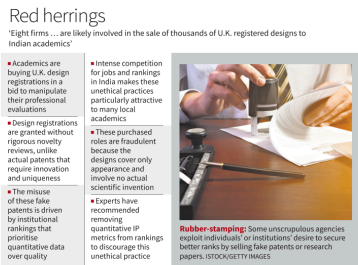
- Eight firms are likely involved in selling thousands of UK registered designs to Indian academics.
About: Design Registrations vs Real Patents
- Design registrations in the UK are usually granted in around 11 days without novelty checks.
- Patent offices do not examine design applications for novelty, innovation or uniqueness before granting them.
- Design registrations cover the way an object looks and not how it actually functions.
- Real patents undergo a more stringent process and are used to commercialise a genuine new discovery.
- Design patents issued in the US must pass a novelty review and have a good chance of rejection.
- The real value of a patent comes only when industry uses it for a process or product.
- What academics buy are ownership positions on design registrations — not genuine inventorship on patents.
- The academic has not invented anything, the device does not exist and what they obtained is not a patent.
Causes: Ranking Pressure & Quantitative Metrics
- Large Population: A large population seeking education and jobs creates intense pressure for credentials.
- Quantitative Metrics: Use of quantitative metrics without serious quality assessment drives fake patent purchases.
- Ranking Agency Dependence: Nearly all national and international ranking agencies rely heavily on quantitative parameters.
- Private University Race: Many private Indian universities file thousands of utility patents in India to pump up ranking numbers.
- Low Grant Rate: Less than 2% of these utility patents actually end up being granted by the patent office.
- Black Market Emergence: Selling fake patents has emerged almost exclusively on the academic black market in India.
Concern: Research Misconduct & Eroding Credibility
- Fake Inventorship: Academics gain assessment points by claiming authorship on non-existing entities and inventions.
- Shady Agencies: Companies act as patent-filing facilitators selling fake authorship positions for academic advancement.
- Employer Deception: Academics tell employers they have obtained international patents to gain promotions fraudulently.
- Multiple Lies: The academic invented nothing, the device does not exist, what is obtained is not a patent.
- IIT Comparison: Many private universities file more utility patents than the IITs combined yet fewer than 2% are granted.
- Independent Verification Gap: In the absence of independent verification institutions unethically inflate quantitative data freely.
Way Forward: Quality-Based Assessment & Stronger Oversight
- Stop Quantitative Rankings: Experts urge stopping all institutional rankings based solely on quantitative data urgently.
- Industry Use Criterion: Only patents actually used by industry should be counted in academic assessments.
- Filing vs Grant: The mere filing of a patent must not be used for academic performance assessment.
- Agency Accountability: Agencies that broker fake patents and research publications must be taken to task severely.
- Retraction Indicators: Funders like Anusandhan National Research Foundation are exploring using retractions as research integrity indicators.
- Nimble Governance: A nimble regulatory oversight and governance system must be built to identify and respond to scientific misconduct.
- Misconduct Catalogue: Stronger mechanisms must be developed to identify, catalogue and respond to scientific misconduct systematically.
Source: The Hindu