Three-Language Policy: UPSC Mains Notes
In News
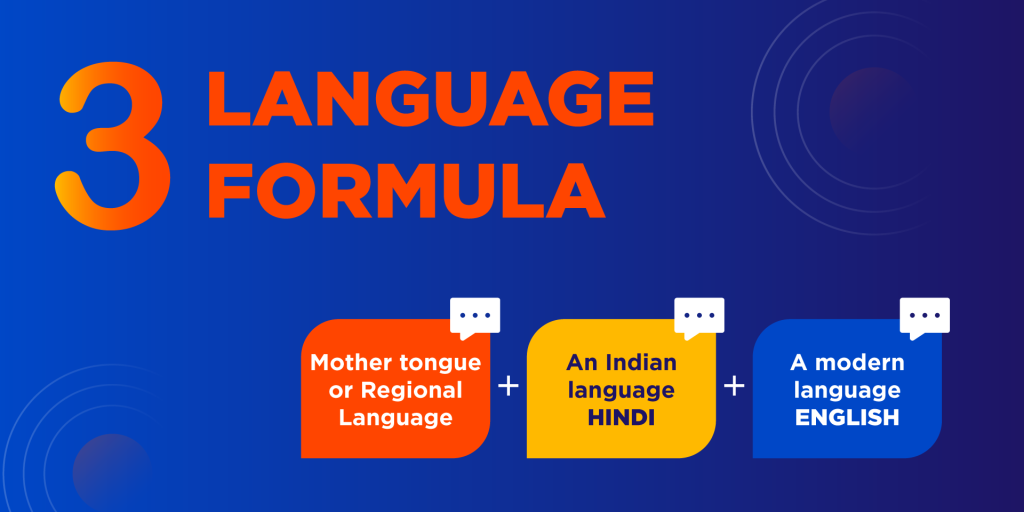
- CBSE has introduced the Three-Language Policy from Class 6 in accordance with the recommendations of NEP 2020. The policy requires students to study three languages, with at least two languages being native to India.
Three-Language Policy
- NEP 2020 recommends that every student should learn three languages, with at least two belonging to the Indian linguistic tradition.
- Language Flexibility allows States and students to choose languages according to their regional, cultural and educational preferences.
- Unlike NEP 1968, the present policy avoids prescribing a fixed language combination for students across the country.
- The policy seeks to promote multilingual education while preserving India’s rich linguistic and cultural diversity.
Evolution of Three-Language Formula
- Article 351 directs the Union to promote the spread of the Hindi language while encouraging its wider development across the country.
- The Kothari Commission (1964–66) first proposed the Three-Language Formula to strengthen national integration through multilingual education.
- National Education Policy 1968 encouraged the use of regional languages at school and recommended their gradual expansion in higher education.
- The Programme of Action 1992 recommended the mother tongue or regional language as the preferred medium of instruction at the pre-school stage.
- The Right to Education Act 2009 states that the child’s mother tongue should be the medium of instruction wherever practicable.
- NEP 2020 recommends using the home language or mother tongue as the medium of instruction until Grade 5, preferably Grade 8.
Issues Associated
- Academic Burden: Making two Indian languages compulsory may increase the learning load, especially for students already pursuing foreign language education.
- Learning Disruption: Students may have to discontinue French or Spanish, rendering their previous years of language learning academically unproductive.
- Board Examination: Mid-course changes in language subjects may adversely affect students’ preparation and performance in the Class 10 Board Examination.
- Institutional Resources: Schools may find their investments in foreign language teachers and learning infrastructure becoming significantly underutilised.
- Policy Contradiction: The policy recognises English as essential for STEM education while limiting its role within the three-language framework.
- Global Mobility: Restricting language choices may reduce opportunities for higher education, international employment and global academic mobility.
Way Forward
- Student-Centric Approach: Language policy should prioritise the best interests of students over administrative uniformity or ideological preferences.
- Balanced Language Learning: Schools should strengthen proficiency in the mother tongue and English to support conceptual and professional development.
- Bilingual Resources: High-quality teaching materials should be developed to improve learning outcomes in science and mathematics across languages.
- Flexible Choice: Students should retain the freedom to choose a third language according to their interests, aspirations and institutional availability.
- Future Readiness: Language education should balance cultural preservation with the skills needed for global education and employment opportunities.
Source: The Hindu