

Women’s Employment in Urban India: UPSC Mains Notes
Why is Women’s Employment in Urban India in News?
- The PLFS 2025 presented labour market estimates for India’s 46 million-plus cities for the first time.
- The survey highlights better salaried employment opportunities alongside persistent gender disparities in workforce participation and earnings.
Status of Women’s Employment in Urban India
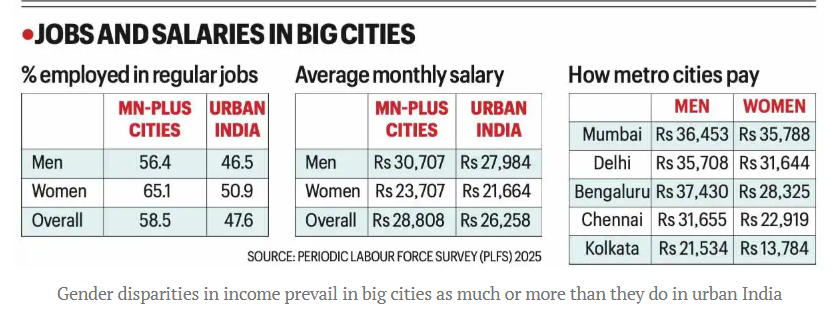
- Regular Employment: Women hold regular salaried jobs more frequently in million-plus cities than urban India overall.
- Employment Share: About 65.1% of employed women hold regular salaried jobs in million-plus cities.
- Worker Population Ratio: Only 25.5% of women are employed compared with 72.6% of men.
- Labour Force Participation: Female labour force participation declines to 25.5% in million-plus cities.
- Employment Structure: Million-plus cities provide more regular jobs than self-employment and casual employment opportunities.
- Urban Advantage: Women in regular employment earn at least 10% more than urban India averages.
Challenges to Women’s Labour Force Participation
- Low Participation: Women’s workforce participation remains significantly lower despite better availability of salaried employment.
- Care Burden: Childcare and household responsibilities keep nearly seven in ten women outside the labour force.
- High NEET Population: Around 67% of women aged 30 to 59 remain outside employment, education or training.
- Persistent Inequality: Better employment opportunities have not translated into proportional workforce participation.
- Employment Barriers: Social responsibilities continue restricting women’s access to stable and productive employment.
Gender Wage Gap in Urban India
- Regular Employment: Women earn only 77.2% of men’s salaries in regular salaried employment across urban India.
- Income Gap: Salary differences remain wider in million-plus cities despite higher overall wages.
- Self Employment: Women entrepreneurs earn substantially lower incomes than self-employed men in most cities.
- Casual Employment: Female casual workers receive significantly lower daily wages than their male counterparts.
- Regional Variation: Some cities demonstrate near or complete gender pay parity in regular salaried employment.
Way Forward to Enhance Women’s Economic Participation
- Care Support: Reducing childcare responsibilities can encourage greater female participation in the labour market.
- Equal Opportunities: Expanding regular salaried employment can improve women’s long-term economic security.
- Pay Equity: Bridging gender wage gaps should remain a priority across organised and informal sectors.
- Labour Inclusion: Policies should focus on bringing women outside the workforce into productive employment.
- Evidence Based Policy: PLFS data should guide targeted interventions addressing city-specific gender employment disparities.
Source: Indian Express
