

UPSC MainsGS Paper IIJudiciary & Social Justice
Supreme Court’s Handbook on Gender Sensitivity
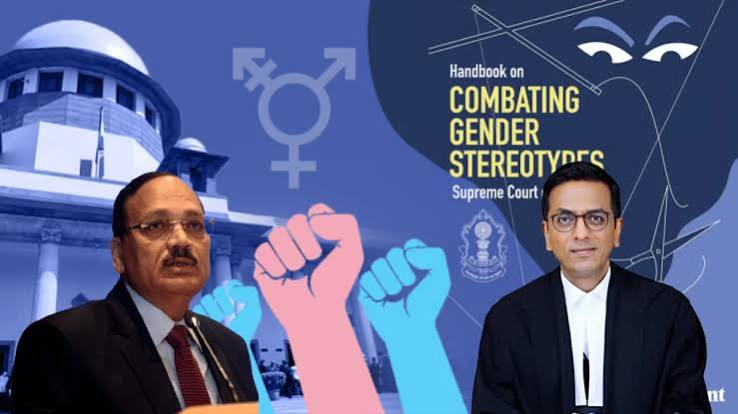
📰 The Supreme Court’s updated 2026 Handbook on Combating Gender Stereotypes reopens the debate on language reform versus structural change in the judiciary.
Handbook First Released
2023 (under CJI Chandrachud)
Women High Court Judges
~14%
Women Supreme Court Judges
~9%
📖
SC Gender Sensitivity Handbook: News
- The Supreme Court released an updated “Handbook on Combating Gender Stereotypes” in 2026.
- The first edition was released in 2023 under CJI D.Y. Chandrachud’s tenure as Chief Justice.
- The 2026 handbook expands coverage to address stereotypes in judicial language and courtroom conduct.
- It provides alternative gender-neutral terminology replacing stereotypical language in judgments and proceedings.
- The handbook is directed at judges, lawyers and all judicial officers across all court levels.
🚫
Need for Gender-Sensitivity Guidelines in Judiciary
- Stereotyping in Judgments: Courts have historically used language implying women must dress modestly, behave virtuously and avoid compromising situations.
- Survivor Credibility Bias: Rape survivors’ testimonies have been questioned based on prior sexual history or behaviour after assault.
- Marital Rape Perception: Many judicial observations historically treated marriage as implied consent to sexual intercourse.
- Two-Finger Test Legacy: Despite Supreme Court prohibition, observations legitimising the two-finger test persisted in some lower court judgments.
- Mediation in Domestic Violence: Some courts improperly directed domestic violence victims to mediation with their abusers.
- Character Evidence Misuse: Women’s character was treated as relevant evidence in sexual assault trials contrary to statutory provisions.
- Class and Caste Blindness: Judicial reasoning has often ignored intersections of gender with caste, class and disability.
❗
Issues Still Present in Judicial Gender Sensitivity
- Implementation Gap: Guidelines exist but no enforcement mechanism ensures compliance by judges at lower court levels.
- Lower Court Lag: High Courts and district courts still produce judgments using stereotypical language despite Supreme Court guidelines.
- Training Deficit: Judicial training academies do not adequately integrate gender sensitivity into regular curricula.
- Awareness Asymmetry: Senior judges may be aware but newly recruited judicial officers lack adequate gender sensitisation.
- Language Persistence: Problematic terms like “eve-teasing,” “affair,” “loose character” continue appearing in judicial proceedings.
- Intersectionality Blind Spot: Judiciary often fails to recognise how caste and poverty compound gender-based discrimination.
- Bail Conditions: Courts sometimes impose bail conditions restricting women’s movements, reflecting paternalistic judicial attitudes.
Structural Exclusion: Women constitute only about 14% of High Court judges and about 9% of Supreme Court judges — a representation gap that keeps gender-sensitive perspectives thin at the bench itself, not just in judicial language.
🧭
Way Forward for Gender-Sensitive Judicial Practice
Mandatory Training
Make gender sensitivity training mandatory for all judicial officers at appointment and at periodic intervals.
Judgment Audit
Establish a mechanism for periodic audit of judicial language in judgments at all court levels.
Increase Women Judges
Set time-bound targets to increase women’s representation in High Courts and the Supreme Court.
Handbook Integration
Integrate the handbook into judicial academy curricula and bar council training programmes immediately.
Survivor-Centred Procedures
Develop survivor-centred trial procedures eliminating unnecessary character questioning in sexual offence cases.
Intersectionality Framework
Train judges to recognise intersections of gender with caste, class and disability in all cases.
Complaints Mechanism
Establish a confidential complaints mechanism for reporting gender-insensitive judicial conduct.
A handbook without implementation is aspiration without accountability. True gender sensitivity in the judiciary requires structural reform alongside language reform, simultaneously — justice cannot be gender-blind in a society where gender shapes every experience of law and power.
📰
Source: The Hindu
