

UPSC Mains
GS Paper III
Indian Economy
UPI’s Dramatic Growth and Its Next Challenge
A decade after launch, UPI processes 28,174 crore transactions a year — but two private players handle 80% of them, and nobody has figured out who pays for the infrastructure
DIGITAL TRANSACTIONS (2025-26)
28,174 crore
TOP 2 PLAYERS’ SHARE
80% (PhonePe + GPay)
UPI OPERATIONAL IN
9 countries
📰
Context and Background
- UPI completed 10 years since its April 2016 pilot launch recently.
- India recorded 28,174 crore digital transactions in 2025-26 — an astonishing leap.
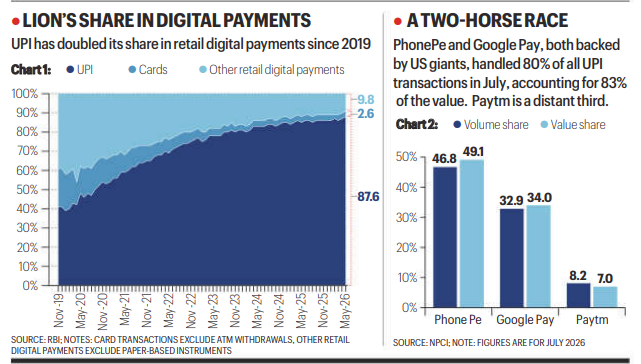
- Approximately 86% of these payments were from a system that didn’t exist a decade ago.
Drivers Behind UPI’s Adoption
- Demonetisation (2016) spiked cashless activity, but UPI’s real growth came later.
- The Covid-19 pandemic eliminated human contact in payments, accelerating UPI adoption.
- Zero MDR policy removed the barrier to merchant acceptance completely.
- Government subsidised UPI and RuPay debit card payments up to ₹2,000 for small merchants.
🏇
Market Concentration: The Two-Horse Race
- PhonePe and Google Pay — both backed by US giants — handled 80% of all UPI transactions in July 2026.
- Together they account for 83% of the total value of UPI transactions.
- Paytm is a distant third with only 7% value share.
- Even State Bank of India cannot catch up with these two players.
- Regulations restricting any one player to 30% market share have been postponed multiple times, with the current deadline being December 2026.
Two US-backed private apps now control ~80% of India’s core digital payments rail — a market-concentration risk in critical public infrastructure that regulators keep deferring action on.
💸
The MDR and Funding Challenge
Rising Infrastructure Costs
Volume of UPI transactions has risen, leaving behind more traditional non-cash payment methods like cards.
Credit Card Growth
Credit and debit card transactions excluding ATM withdrawals were 17% higher at 70 crore in May 2026.
Subsidy Unsustainability
Government subsidises MDR, but that money doesn’t cover payment infra costs of ₹20,000 crore a year.
Bank Dependence
Traditional banks including SBI cannot reach the volume levels built by PhonePe and Google Pay.
🧭
Way Forward for UPI’s Next Phase of Growth
Calibrated MDR
An MDR of 0.3-0.6% on payments above ₹2,000 to large merchants could fund the ecosystem sustainably.
Value Per Transaction
The next phase must focus on creating more value per transaction, not just processing more transactions.
International Expansion
UPI is already operational in 9 countries including France, UAE, Qatar, Cambodia and Singapore, with more scope.
Tourism and Remittances
UPI’s global expansion targets countries with large Indian tourist and migrant worker populations.
Conclusion: Subsidies alone are not viable for UPI’s next wave of growth. The future lies in international expansion, value creation and a calibrated MDR framework for larger merchants.
