

UPSC Mains
GS Paper II & III
India-China Relations & Border Security
India–China Boundary Talks: The “Early and Substantial Harvest” — Larger Ambition, but Not Necessarily a Safer Deal
On 25 August 2026, India and China held the 25th Special Representatives’ Talks in Beijing, agreeing to an “Early and Substantial Harvest” on boundary delimitation — a phased shift away from the 2005 Agreement’s “package settlement” approach.
Eastern Sector Dispute
~90,000 sq km (Arunachal Pradesh)
Western Sector
~38,000 sq km under China (Aksai Chin)
Next Round of SR Talks
26th round, in India, 2027
📰
Why in News
- On 25 August 2026, India and China held the 25th Special Representatives’ Talks in Beijing, agreeing to work towards an “Early and Substantial Harvest” on boundary delimitation and border management.
- The 26th round will be held in India in 2027, marking a shift towards a phased, sector-wise approach instead of the earlier “package settlement” approach.
“Early Harvest”: A phased/piecemeal approach — settling the easier, less-disputed sectors first, rather than waiting for a full settlement of all sectors together.
The Four Sectors of the India–China Boundary
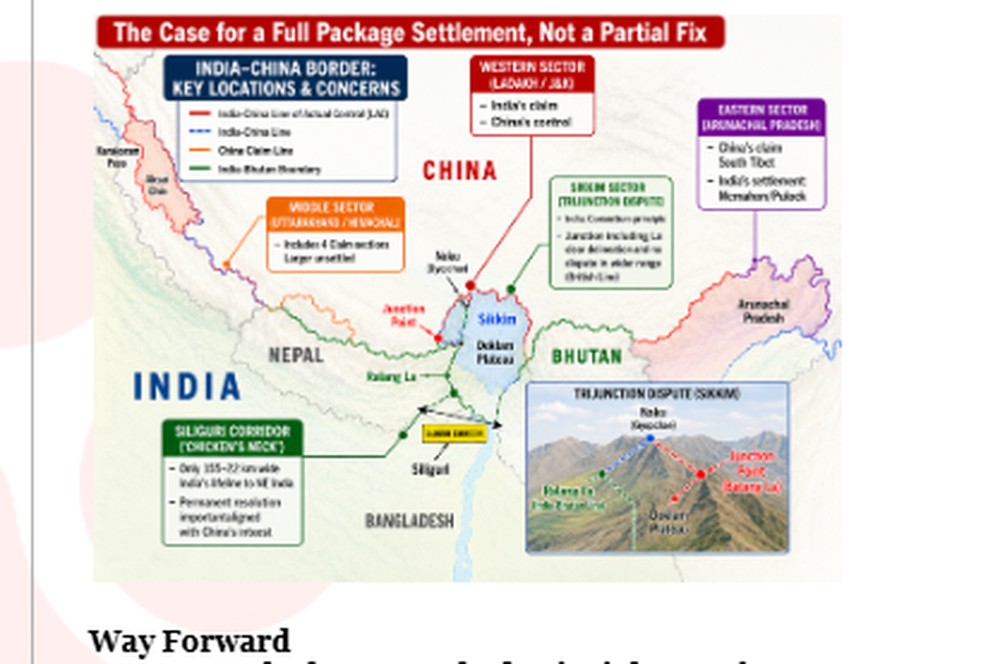
- Western Sector (Ladakh–Aksai Chin): ~38,000 sq km under Chinese control. China takes a hardline position here.
- Middle Sector (Himachal Pradesh–Uttarakhand): Least disputed; small pockets — Barahoti, Giu-Kaurik, Nilang-Jadhang, Sangcha Malla, Lapthal (~2,450 sq km claimed by China south of the watershed).
- Sikkim Sector: Broadly settled, based on the Anglo-Chinese Convention of 1890. China recognised Sikkim as part of India in 2003–2005.
- Eastern Sector (Arunachal Pradesh): Largest dispute (~90,000 sq km); China claims almost all of Arunachal (“South Tibet”). Boundary based on the McMahon Line (1914), which China rejects.
🤝
Key Highlights of the “Eight Points” Consensus
- Early Harvest: Accelerate progress via an Expert Group on Boundary Delimitation and a Working Group on Border Management, under the Working Mechanism for Consultation and Coordination (WMCC).
- Terms of Reference (ToR): The two groups will first finalise their ToR — defining roles, meeting frequency and decision coordination.
- Military Communication: Additional hotlines and meeting points in the Eastern and Middle Sectors to prevent border tensions.
- Kailash Yatra & Border Trade: Both sides agreed to continue the Kailash Manasarovar Yatra and border trade through designated passes.
- Trans-border Rivers: An Expert-Level Mechanism meeting in September 2026 will discuss hydrological data sharing and MoU renewal.
- Boundary Settlement: Both countries reaffirmed the 2005 Agreement and committed to a framework for resolving the boundary question.
Significance
- Restoring Momentum: Improves India–China ties after the 2020 Galwan clash.
- Confidence Building: New hotlines and communication mechanisms reduce risk of accidental clashes along the LAC.
- More Diplomatic Space: Stable ties help cooperation on BRICS and SCO platforms.
- Gradual Trust Building: Resuming pilgrimage, border trade and river-data talks strengthens practical cooperation.
🔍
Analytical Insight — The Risks Behind the “Harvest”
- Dilution of the 2005 “Package Settlement” Principle: Article III of the 2005 Agreement mandates settling ALL sectors together. “Early harvest” risks cherry-picking — settling sectors where India is strong (Sikkim, Middle) while leaving the hard sectors (Eastern, Western) open on China’s terms.
- The “Agreement with Holes” Risk: A settlement covering only stretches where claims already coincide — leaving trijunctions and contested pockets undefined — gives India an asymmetric outcome, mirroring China’s “dong tiao xi rang” logic (India adjusts in the East, China “compensates” in the West).
- Sikkim is NOT Open-and-Shut: The 1890 Convention is self-contradictory on the trijunction location — India/Bhutan place it at Batang La, but China exploits a literal reading to push it south to the Jampheri Ridge.
- The Doklam–Siliguri Corridor Threat: A southward-shifted trijunction gives China a path overlooking the Siliguri Corridor (“Chicken’s Neck”) — India’s only ~20–22 km-wide land link to the Northeast.
- The Bhutan Angle: A hasty Sikkim deal would weaken India’s standing to counsel Bhutan against China’s package proposal involving Doklam.
- Delimitation without a Framework: Article X of the 2005 Agreement requires an “agreed framework” before delineation/demarcation — launching an Expert Group on Delimitation without one puts the cart before the horse.
- The Silence on the Medog Mega-Dam: The Eight Points are silent on China’s Yarlung Tsangpo (Brahmaputra) mega-dam project near the Eastern Sector, in a seismically active zone — a lower-riparian risk for India, underscored by the August 2026 Nepal flash floods.
✅
Way Forward
Apply the Watershed Principle
Use the highest-watershed principle consistently across Sikkim and Middle Sectors, not selectively.
Protect Trijunctions
Keep Batang La and third-country points outside the Expert Group’s direct mandate; consult Bhutan.
Safeguard the 2005 Agreement
Ensure it is not reinterpreted or weakened as the key substantive framework.
Build on Existing Proposals
The new groups’ ToR should build on India’s 2019 proposal, negotiated in good faith.
Avoid Artificial Progress
Focus on genuine, lasting solutions over short-term diplomatic optics.
Strengthen Water Security
Use the September 2026 river talks to push for a stronger water-data sharing mechanism.
The 25th SR talks reflect a welcome de-escalation and restoration of dialogue after Galwan. But the shift from a holistic “package settlement” to a phased “early harvest” carries the risk of asymmetric concessions — India yielding where it is strong while the Eastern and Western sectors remain frozen on China’s terms. Larger ambition must be matched by principled safeguards — otherwise a bigger harvest may prove a less secure one.
📰
Source: The Hindu
