

Why in News : A recent study by the Wildlife Institute of India, published in Scientific Reports, has revealed that wind farms in Rajasthan’s Thar Desert have the highest bird mortality rates in the world.
About the Study
Study Location: Conducted in 3,000 sq. km of Jaisalmer, Rajasthan, an area with ~900 wind turbines and 272 bird species, including the critically endangered Great Indian Bustard.
Findings:
- 124 carcasses found across 90 turbines.
- Estimated mortality: 4,464 birds per 1,000 sq. km annually after adjusting for detection and scavenging.
Comparison with Other Sites:
- 2019 study in Kutch and Davangere reported 0.47 deaths/turbine/year.
- Thar Desert estimate: 1.24 deaths/turbine/month — a much higher rate.
Contributing Factors to High Mortality
- Location on Central Asian Flyway – a major migratory route.
- High bird density and raptor populations.
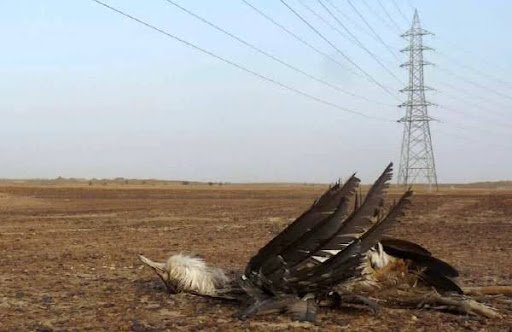
- Power lines associated with wind farms also contribute to bird collisions (unlike earlier studies which excluded power line collisions).
- Geography: Thar’s flat and treeless terrain provides few natural obstacles or visual markers, making wind turbines harder for birds to detect.
- Seasonal Variations: Spring & Autumn): These seasons see a spike in bird movement, increasing the risk of collisions with wind turbines and power lines.
Most Affected Bird Species
- Raptors (e.g., eagles, vultures) due to poor frontal vision and soaring flight patterns.
- Great Indian Bustard – critically endangered, highly vulnerable to collisions.
Suggested Mitigation Measures
- BirdLife International recommends: Painting one blade of the turbine to increase visibility.
- Timed shutdowns during high bird activity periods.
- Careful site selection before installation of wind farms to avoid high-density avian habitats.
- Bird Diverters on Power Lines: Install visual markers like bird flappers, spirals, or reflective devices to make lines more visible and prevent collisions.
- Undergrounding Power Cables: Burying transmission lines in high-risk zones to reduce collision risk (especially effective in bustard habitats).
- Radar-Based Shut-down-on-Demand (SDOD) Systems: Use real-time radar to detect approaching bird flocks and automatically shut down turbines during high-risk events (e.g., during mass migration).
Conclusion:
Wind energy is crucial for India’s clean future, but high bird deaths in the Thar Desert show the need for careful planning. Balancing renewable growth with wildlife protection through smart site selection and mitigation can make wind power truly sustainable.
UPSC RELAVENCE
GS Paper 1
- Geography: Wind energy potential and migratory bird routes (Central Asian Flyway)
General Studies Paper 3:
- Environment: Discussing the environmental challenges posed by wind energy expansion and potential mitigation strategies.
Mains Practice Question:
Q. Evaluate the ecological challenges posed by wind energy projects in the Thar Desert and propose sustainable mitigation strategies to harmonize renewable energy development with biodiversity conservation.
