

Why in News: India’s commitments under the India-UK (CETA), especially Article 13.6 on intellectual property, have raised concerns about dilution of India’s stance on compulsory licensing and access to affordable medicines, as well as weakening its long-standing demand for favourable technology transfer.
Context: India–UK Comprehensive Economic and Trade Agreement (CETA)
- Chapter 13 of the draft agreement addresses Intellectual Property Rights (IPR).
- Article 13.6 promotes voluntary licensing as the “preferable” way to ensure access to medicines.
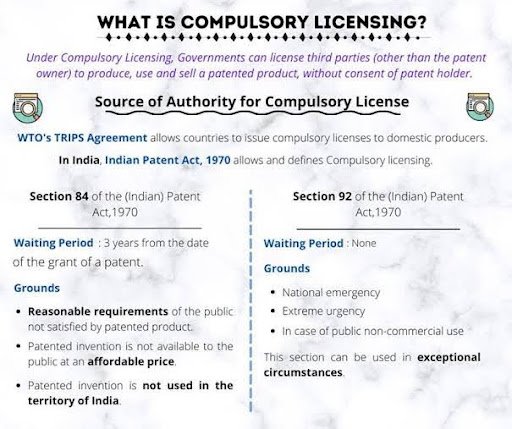
Key Concerns:
1. Shift from Compulsory to Voluntary Licensing
- Article 13.6 of the FTA makes voluntary licensing the “preferable and optimal” route to access medicines.
- This undermines India’s historic defence of compulsory licensing at the WTO and TRIPS forums.
2. Barriers to Affordable Medicines
Voluntary licences often:
- Create unequal bargaining power.
- Come with geographical restrictions and price controls.
- Example: Cipla’s remdesivir cost more in India (in PPP terms) under Gilead’s licence than in the US.
3. Dilution of the ‘Working of Patent’ Requirement
- Indian law mandates local “working” of patents.
- Under the FTA, the requirement to report working is relaxed from annually to once every 3 years.
- This weakens the legal basis to issue compulsory licences.
4. Undermining India’s Global Advocacy for Technology Transfer
- India has consistently demanded favourable tech transfer in climate change and development contexts.
- By accepting voluntary mechanisms and weaker tech-sharing provisions, India’s negotiating strength at global forums is reduced.
Implications:
- Public Health: Reduces India’s ability to ensure affordable access to essential medicines.
- Legal Precedent: Sets a precedent for future trade deals to prioritise corporate interests over public good.
- Climate Action: Weakens India’s ability to negotiate for low-cost access to green technologies.
- Sovereignty and Self-Reliance: Restricts India’s autonomy to design IP laws based on domestic developmental priorities.
Conclusion
India’s shift from compulsory to voluntary licensing in the UK trade pact weakens its public health safeguards and technology access demands. Future trade deals must protect national interests and ensure affordable access to essential medicines.
UPSC Relevance
GS Paper 2: International Relations
- Impact of bilateral trade agreements on India’s policy autonomy.
GS Paper 3: Science & Technology / Economic Development
- Issues related to Intellectual Property Rights and access to affordable medicines.
Mains Practice Question:
Q. “India’s shift from compulsory to voluntary licensing in trade negotiations reflects changing priorities in balancing public health and trade interests.” Critically analyse this trend in the context of the India–UK trade agreement. (250 words)
