

Why in News: U.S. President Donald Trump announced an additional 25% penalty tariff on Indian goods due to India’s continued import of Russian oil. This is in addition to the 25% reciprocal tariffs announced on July 31 after failure of India-U.S. FTA negotiations.
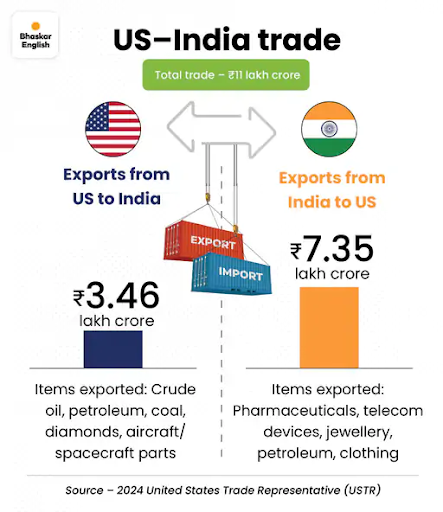
Reasons for U.S. Tariffs on India
1. Russian Oil Imports
- India continues to buy large quantities of Russian crude despite U.S. pressure.
- Post-Ukraine war, Russian oil now makes up 35–40% of India’s crude imports.
- U.S. claims India is helping Russia profit by reprocessing and reselling oil via refineries like Vadinar.
2. Breakdown of India–U.S. FTA Talks
- Negotiations for a Free Trade Agreement failed on July 31.
- Main sticking point: U.S. demand for greater access to India’s agricultural market.
- India unwilling to compromise on protecting farmers, fishermen, and dairy sector.
3. Perceived Double Standards Argument from India
- U.S. and EU themselves continue certain trades with Russia (minerals, chemicals, LNG, etc.).
- India views U.S. targeting as “unfair, unjustified, unreasonable.”
4. Strategic Pressure on Russia
- Tariffs also serve as leverage to isolate Russia economically and push towards ending Ukraine war.
- Trump left room to modify tariffs if Russia takes significant steps toward peace.
5. Domestic Political Messaging (U.S. Side)
- Tariffs presented as defending U.S. economic and strategic interests.
- Part of Trump’s broader “America First” trade stance.
India’s Response to U.S. Tariffs on Russian Oil Imports
1. No Overt Retaliation So Far: India has not taken any direct retaliatory action against U.S. tariffs so far.
2. Official Statements from Ministry of External Affairs (MEA): Condemnation of U.S. actions as “extremely unfortunate.”
3. PM Modi stated he is willing to “personally pay a price” to protect farmers and other domestic interests, signaling a tough stance.
4. India faces a difficult choice between giving up Russian oil or allowing U.S. market access to agriculture.
5. Hope for Diplomatic Resolution: India hopes the upcoming Trump-Putin summit and possible peace deal could lead to tariff rollback.
6. Trade Negotiations Ongoing: U.S. trade negotiators will visit India soon; limited concessions might reduce tariffs.
7. Maintaining Strategic Autonomy: India stresses its strategic autonomy and continues diplomatic engagement with Russia.
8. Broader Diplomatic Efforts: High-level visits are planned between India, Russia, and China amid ongoing tensions with the U.S.
Possibility of Resolution: India-U.S. Tariff Issue
- Trump-Putin Meeting (Aug 15): Could lead to rollback of India’s tariff if Russia makes peace progress.
- Tariff Modification: Trump’s order allows tariff changes if Russia takes steps to end Ukraine war.
- Trade Talks (Aug 25): U.S. negotiators visiting India; mini-deal possible if India concedes on market access.
- India’s Stance: Ready to face short-term losses to protect farmers and key sectors; maintains strong Russia ties.
- Upcoming Summits: SCO and Quad summits may influence future India-U.S. relations.
India’s Russian Oil Imports
Before Feb 2022: Russian oil was ~1% of India’s imports.
After EU sanctions: Prices dropped; India increased purchases.
By May 2023: Over 2 million barrels/day from Russia (35–40% of imports).
Economic Benefit: ~$13B saved in 2024, $3.8B in 2025.
Imports reduced slightly recently; India increasing intake from U.S., Iraq, Kuwait, UAE, Saudi Arabia.
Comparison with Iran/Venezuela Oil Case
- 2018–2019: India initially resisted U.S. pressure to stop imports from Iran/Venezuela.
- By May 2019, India stopped imports, leading to economic losses due to refinery needs and pricing.
- Current stance on Russia shows greater resistance to U.S. demands.
India-Russia Strategic & Business Ties
- Oil Imports: India increased Russian oil imports to 2 million+ barrels/day (35-40% of its oil basket) after 2022 EU sanctions.
- Investments: Indian PSUs invested $5 billion in Russian oil fields; Rosneft bought 49% of Essar Oil, forming Nayara Energy.
- Refinery: Vadinar refinery in Gujarat processes Russian oil; Reliance and others also reprocess and export it.
- Savings: India saves about $13 billion by 2024 through discounted Russian oil.
- Strategic Partnership: Energy ties strengthen political and diplomatic relations, backed by high-level summits.
Foreign Policy Implications
Strained India-U.S. Relations:
- U.S. tariffs on Indian goods over Russian oil imports have worsened trade talks, especially on agriculture, risking broader cooperation in defense, technology, and counter-terrorism.
India’s Strategic Autonomy:
- India refuses to yield on Russian oil, criticizes U.S. and EU for hypocrisy, and is ready to bear economic costs to protect national interests.
Strong India-Russia Ties:
- Russia remains a major oil supplier (35-40% of imports), with significant Indian investments in Russian energy. India aims to maintain this partnership despite Western pressure.
Geopolitical Balance:
- India manages relations with U.S., Russia, China, and regional groups (SCO, Quad), maintaining an independent foreign policy amid global tensions.
Economic and Diplomatic Risks:
- Giving in to U.S. pressure risks domestic backlash and loss of economic benefits (savings of ~$13 billion). Tariffs may damage India’s international trade and standing.
Conclusion
India faces a difficult choice between yielding to U.S. pressure on Russian oil or protecting its strategic and economic interests. While U.S. tariffs impact Indian exports, India values its ties with Russia and is unlikely to fully comply.
UPSC Relevance
GS Paper 2 — International Relations & Governance
GS Paper 3 — Economy & Energy Security
- Impact of U.S. tariffs on Indian exports and trade negotiations.
Practice Question:
Q. “Examine the challenges India faces in maintaining strategic autonomy in the context of U.S. sanctions on Russian oil imports and its implications on India-U.S. relations.”
PRELIMS RELATED QUICK FACTS
Brent Crude
Definition:
- Brent Crude is the most widely used global benchmark for pricing crude oil.
Origin:
- Named after the Brent oil field discovered in the 1970s in the North Sea.
Significance:
- Approximately two-thirds of all internationally traded crude oil is priced relative to Brent.
Properties:
- It is a light and sweet crude oil.
- Extracted from multiple oil fields in the North Sea.
- Low density and low sulfur content make it easier to refine into high-value products like gasoline.
Transportation:
- Being water-borne, Brent crude is easy to transport to distant markets.
Price Influencers:
- Brent crude oil prices are affected by:
- Supply and demand dynamics
- Geopolitical events
- Production disruptions
- Economic factors
Sweet Crude
Definition:
- Crude oil containing very low amounts of sulfur.
Importance of Low Sulfur:
- Sulfur is undesirable as it reduces the yield of valuable refined products like gasoline and plastics and requires costly processing to remove.
Other Major Oil Benchmarks
West Texas Intermediate (WTI):
- Primarily used as a benchmark for U.S. crude oil prices.
- Light and sweet crude similar to Brent but sourced mainly from the U.S.
Dubai Crude:
- Used as a benchmark for pricing Middle Eastern crude oil exports, especially in Asia.
- Generally heavier and sourer (higher sulfur content) than Brent and WTI.
