

Why in News: TCS’s job cuts and hiring freeze highlight AI-driven changes reshaping India’s IT sector. AI is boosting productivity but causing restructuring, pushing firms to adapt by focusing on AI solutions and modernizing legacy systems.
1. Current Scenario in Indian IT
- Recent TCS announcements: hiring freeze on experienced professionals and planned removal of 12,000 employees.
- The Indian IT industry generates $280 billion in revenue and employs over 5.8 million people.
- The sector is undergoing a major transformation, not just job cuts due to AI but a complete business and talent strategy overhaul.
2. Why is the IT Industry Restructuring?
- AI is driving unprecedented efficiencies across software development lifecycles.
- Tools like AI-powered coding assistants, code generators, and intelligent debuggers are boosting productivity by over 30%.
- AI is transforming resource-intensive processes such as software testing and maintenance with greater accuracy and fewer errors.
- Companies are prioritizing cost optimization, pushing for AI-led productivity to maintain investor confidence.
- Organisations are revising hiring practices and organisational structures in response to AI integration.
3. Impact on Jobs
- AI is no longer experimental; it is embedded in enterprise workflows globally.
- In 2025, over $1 trillion is projected to be spent worldwide on AI infrastructure, model training, and applications.
- Automation, AI chatbots, and intelligent back-end systems reduce the need for large workforces.
- Workforce reductions and attrition are becoming common, as seen in global firms like Wells Fargo.
4. Why Indian Firms Must Reposition Themselves
- Global clients face challenges: legacy systems, poor data quality, fragmented infrastructure.
- New AI regulations (e.g., EU’s AI Act) require responsible AI, privacy compliance, and fairness.
- Indian IT companies can help by:
- Modernizing legacy systems
- Organizing and cleansing data
- Developing AI solutions compliant with regulations
- This positions Indian firms as indispensable AI partners rather than being displaced by AI.
5. What TCS’s Announcements Reflect
- TCS, with over 600,000 employees, sets industry trends.
Moves signal:
- Cost discipline and market adaptation to investors
- Commitment to AI-driven solutions to clients
- Call for employees to upskill and adapt continuously
- The traditional IT outsourcing model is ending; scale advantage is diminishing.
6. The Future of Indian Tech Sector
- Shift from large coding teams to lean, AI-native firms solving complex problems in sectors like healthcare, defence, fintech, sustainability, and education.
- Small teams (e.g., 50 people) can out-innovate massive teams (e.g., 5,000 people).
- Physical IT parks are no longer essential to serve global clients.
7. Implications for Indian Tech Professionals
- AI will not immediately replace roles requiring critical thinking, creativity, and domain expertise (e.g., tech architects, UI/UX designers, product managers).
- Coding in core languages like C++ for secure, gaming, and OS-level applications remains human-driven.
- Talent with strong math skills and imagination will dominate the coming decade.
Conclusion:
AI is reshaping India’s IT sector by boosting efficiency and changing business and hiring models. Job cuts and hiring freezes, like at TCS, reflect this shift, not just job loss. Indian firms can lead by helping global clients adopt AI and modernize systems.
UPSC Relevance:
GS Paper III (Science and Technology): AI
GS Paper III (Economic Development): Role of IT in India’s economy
Mains Practice Question:
Q. “Examine how Artificial Intelligence is transforming India’s IT sector and discuss the challenges and opportunities it presents for India’s economic and strategic future.”
Prelims Related Quick Facts
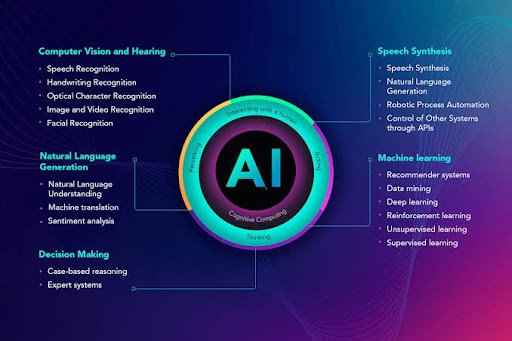
What is Artificial Intelligence (AI)?
Machines performing human-like tasks.
Main components:
- Machine Learning (algorithms that learn from data)
- Neural Networks (brain-inspired models)
- Natural Language Processing (understanding human language)
AI systems take inputs, process via algorithms, produce intelligent outputs mimicking human cognition.
Brief History of AI
1950s:
- Alan Turing proposes Turing Test
- John McCarthy coins “Artificial Intelligence”
1960s-70s:
- Early symbolic AI & expert systems (rule-based)
- Examples: DENDRAL (chemistry), MYCIN (medical diagnosis)
1980s:
- Shift to machine learning (data-driven)
- Algorithms: decision trees, neural networks
1990s-2000s:
- Rise of neural networks & deep learning
- Success in computer vision, NLP
21st century:
- Resurgence due to big data, GPUs, algorithmic advances
- 2010s-present: Breakthroughs in NLP (ChatGPT), computer vision, reinforcement learning (AlphaGo), widespread adoption.
Elements of AI
Machine Learning: Systems learn without explicit programming.
Example: Spam filters.
Deep Learning: Subset of ML using multi-layer neural networks.
Example: Facial recognition.
Natural Language Processing (NLP): Enables understanding/generation of human language.
Example: Siri, Alexa.
Computer Vision: AI interprets digital images/videos.
Example: Self-driving cars.
Neural Networks: Models inspired by brain neurons, recognize patterns.
Example: Netflix recommendations.
Types of AI: By Capabilities
- Narrow AI (Weak AI): Task-specific AI. Examples: Virtual assistants, chess programs.
- General AI (Strong AI): Human-like reasoning across tasks (not yet achieved).
- Super AI: Surpasses human intelligence (future concept).
By Functionality:
- Reactive Machines: No memory, react to current data. Example: Deep Blue.
- Limited Memory Machines: Use past data for decisions. Example: Self-driving cars.
- Theory of Mind AI: Understand human emotions & thoughts (early stage).
- Self-aware AI: Possesses consciousness (speculative).
