

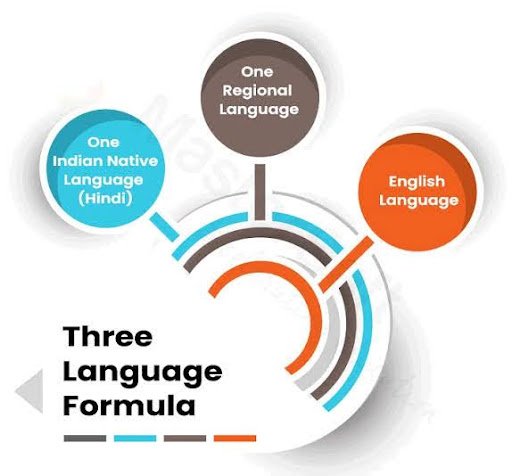
Why in News: Tamil Nadu and Karnataka are resisting the NEP 2020’s three-language policy, favouring a two-language formula prioritising their regional language and English, opposing the perceived imposition of Hindi.
Policy Divergence
- National Education Policy (NEP) 2020 recommends a three-language formula, with Hindi or another Indian language as the third language.
- Tamil Nadu and Karnataka are taking a different approach, favouring a two-language formula that prioritises the local language and English.
Tamil Nadu’s Approach: Retains two-language policy
- Tamil compulsory up to Class 10 across all boards.
- English as the second compulsory language.
Additional priorities:
- Promote critical thinking, digital literacy, climate education, and social justice.
- Implement STEAM approach (Science, Technology, Engineering, Arts, Mathematics).
- Special support for tribal students, first-generation learners, and students with disabilities.
Karnataka’s Approach:Commission for Karnataka’s State Education Policy recommends
- Kannada or the child’s mother tongue as medium of instruction up to Class 5 (preferably till Class 12).
- Kannada/mother tongue and English as the two compulsory languages.
Proposed changes:
- Discontinuation of the three-language policy (which included Hindi).
- Move away from NCERT textbooks; develop Karnataka-specific curriculum.
Advantages of the Three-Language Formula
1. Access & Inclusion – Enables learning in familiar languages, boosts parental involvement, and includes marginalised groups.
2. Better Learning Outcomes – Enhances socio-emotional skills, cognitive abilities, and academic performance.
3. Sustainable Development – Preserves culture, promotes social harmony, supports economy (e.g., Switzerland: 10% GDP from multilingualism), and safeguards indigenous environmental knowledge.
4. National Integration – Improves inter-regional communication and fosters unity in diversity.
Issues with the Centre’s Approach to Language Policy
1. Perceived Hindi Imposition: NEP’s three-language policy is seen as pushing Hindi, causing resistance in non-Hindi States.
2. Ignoring State Autonomy: Disregards States’ existing language policies like Tamil Nadu’s and Karnataka’s two-language formulas.
3. Neglect of English Demand: Overlooks the widespread preference for English as medium of instruction nationwide.
4. Distracts from Core Education Needs: Focus on language diverts attention from improving quality, inclusion, infrastructure, and teacher training.
5. Delayed Funding: Education funds pending release (e.g., ₹2,152 crore for Tamil Nadu) hamper State efforts.
6. Risks Federal Tensions: Central insistence on language policy strains Centre-State cooperation.
7. Language politicisation fuels “sons of the soil” sentiments, threatening national integration.
Way Forward
1. Focus on teaching quality and learning outcomes rather than just adding languages.
2. Enhance Centre-State dialogue to ensure smooth implementation and timely funding.
3. Use data-driven policies based on sociolinguistic and educational research.
4. Develop learning materials and assessments in local languages.
5. Train teachers fluent in mother tongue and second language.
6. Engage communities and parents in multilingual education planning.
UPSC Relevance
GS-II: Polity and Governance
- Centre-State relations and cooperative federalism (language policy conflicts between Centre and States).
GS-I: Indian Society
- Language diversity and its role in cultural identity and social integration.
UPSC Mains Practice Question
Q. “The imposition of Hindi through the three-language formula has sparked resistance in several States. Critically analyse the challenges posed by the National Education Policy’s language provisions in the context of India’s linguistic diversity.
PRELIMS RELATED QUICK FACTS
National Education Policy 2020 – Key Points
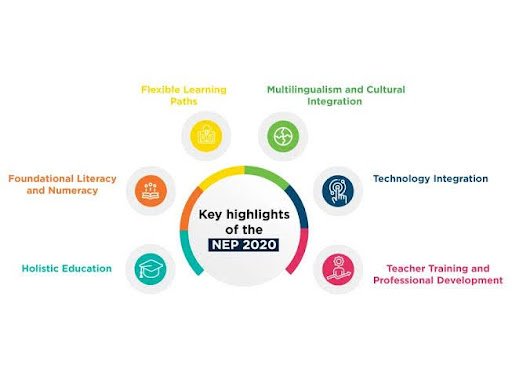
- Holistic Education: Integrates arts, sciences, and humanities for all-round development.
- Early Childhood Education: Includes Early Childhood Care & Education (ECCE) in formal schooling for strong foundational skills.
- New School Structure: Replaces 10+2 with 5+3+3+4 to focus on foundational, preparatory, middle, and secondary stages.
- Multilingualism: Promotes learning regional languages along with Hindi and English.
- Assessment Reform: Moves from rote learning to competency-based, continuous assessments; establishes PARAKH regulator.
- Digital Learning: Emphasizes technology and e-learning to improve access and quality.
- Higher Education: Encourages multidisciplinary studies, research, industry linkages, and foreign universities in India.
- Teacher Training: Focuses on teacher empowerment and learner-centric teaching methods.
- Inclusion: Ensures gender equality and social inclusion in education.
- Flexibility: Introduces Multi Entry Multi Exit (MEME) for flexible educational pathways.
