

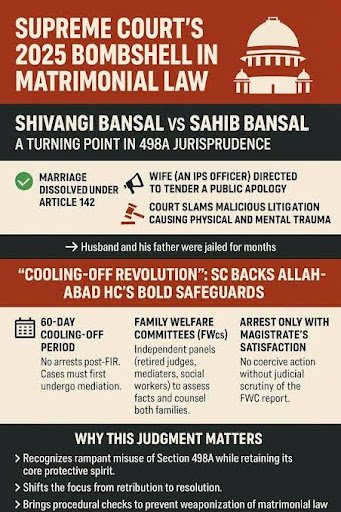
Why in News: SC upheld a two-month “cool-off” period before arrest in Section 498-A cases (now Section 85, Bharatiya Nyaya Sanhita), raising concerns over protection for victims of domestic cruelty.
Introduction
The Supreme Court of India, in Shivangi Bansal vs Sahib Bansal (July 2024), endorsed suspension of arrest or coercive action under Section 498-A IPC (now Section 85 of the Bharatiya Nyaya Sanhita)
Section 498-A – Indian Penal Code (Now Section 84, Bharatiya Nyaya Sanhita, 2023)
1. Introduction
Section 498-A IPC: Deals with cruelty against a married woman by her husband or his relatives.
Year Introduced: 1983.
Corresponding BNS Provision: Section 84 of Bharatiya Nyaya Sanhita, 2023.
2. Punishment
- Imprisonment up to three years.
- May also include a fine.
3. Definition of Cruelty: Any willful conduct likely to
- Cause grave injury or danger to life, limb, or health of the woman.
- Drive her to commit suicide.
4. Filing a Complaint: Can be filed by
- The aggrieved woman.
- Relative of the woman by blood, marriage, or adoption.
- If no such relative exists, a public servant notified by the State Government.
Legislative Intent:
- Passed in response to rising dowry deaths and severe cruelty cases.
- Intended to work alongside laws like the Dowry Prohibition Act, 1961.
Consequences of the Judgment – Shivangi Bansal vs Sahib Bansal
- Delayed justice: No arrest for two months even in strong evidence cases.
- Increased victim risk: Accused remains free during “cool-off” period.
- Discourages complaints: Fear of inaction deters women from filing cases.
- Legitimises police delay: Weakens prompt investigation in domestic violence cases.
- Erodes gender justice: Aligns with “misuse” narrative without solid data.
- Undermines deterrence: Reduces effectiveness of Section 498-A/BNS Sec. 84.
- Inconsistent law application: Creates selective suspension in a cognizable, non-bailable offence.
- Contradiction with Past SC Principles – Misuse not a ground to dilute or suspend a law (Sushil Kumar Sharma, 2005).
Misuse Narrative and Judicial Stand
- Popular Argument: Section 498-A is often misused.
- Past Supreme Court Observations:
- Preeti Gupta vs State of Jharkhand (2010): Many non-bona fide cases filed.
- Sushil Kumar Sharma vs Union of India (2005): Warned of “legal terrorism” through misuse.
- Arnesh Kumar vs State of Bihar (2014): Issued guidelines to avoid automatic arrests.
Misuse of Legal Measures
1. False Allegations for Personal Gain
- Used to harass husbands and in-laws by filing false complaints.
- Often leveraged in disputes over property, maintenance, or child custody.
2. Coercion for Financial Settlements
- False cases used to pressure the accused into paying large sums or alimony.
- Fear of arrest or lengthy trials compels settlement.
3. Immediate Arrest without Preliminary Investigation
- Section 498A is non-bailable & cognizable.
- Allows arrest without prior investigation, leading to wrongful detentions.
4. Social & Psychological Damage
- Allegations cause stigma, mental distress, and career setbacks.
- Harm persists even after acquittal.
5. Judicial Observations
- Courts have recognised misuse in several judgments.
Critique of Supreme Court Judgment on Section 498A Misuse
1. Ignores Social Realities
- Women face serious domestic violence; Section 498A protects them against cruelty including dowry harassment and suicide.
2. Blanket Protection to Accused
- Suspends arrest for two months even if strong evidence exists, risking victim safety and discouraging complaints.
3. Judicial Overreach
- The court bypassed legislative intent and state inputs, disturbing the uniform application of criminal law.
4. Weak Basis on ‘Misuse’ Claims
- No empirical evidence of large-scale misuse.
- NCRB conviction rate ~18% in 2022 (higher than many offences as per NCRB data).
- Low convictions due to investigation issues, social pressure, high burden of proof, and difficulty proving violence in private space
5. Under-Reporting of Violence
- Rising case numbers reflect increased awareness, not false complaints.
Way Forward
1. Clear Legal Categorization
- Define clear distinctions between bailable and non-cognizable offenses to avoid misuse and confusion.
2. Thorough Investigation Before Arrest
- Ensure comprehensive investigations are conducted before any arrest to protect innocent individuals.
3. Proportionality in Arrests
- Apply the principle of proportionality when arresting family members, considering the severity of harm caused.
4. Accountability for False Complaints
- Enforce strict penalties for filing false or misleading complaints to prevent abuse of the law.
5. Gender-Just Laws
- Develop and implement laws recognizing domestic violence against all genders, ensuring equality and protection for everyone.
6. Inclusive Legal Frameworks
- Establish laws addressing discrimination, violence, and economic inequality to foster an inclusive society.
UPSC RELEVANCE
1. GS Paper 1 (Indian Society, Social Justice, and Polity)
Mains Practice Question
Q. “The misuse of Section 498A IPC (Section 85 of the new Bharatiya Nyaya Sanhita) affects the very purpose of protecting women from domestic violence.” Discuss the challenges and suggest measures for reform.
