


PRELIMS
Export Promotion Mission Revision
Why in News: The government is revising its Export Promotion Mission to help Indian exporters, especially MSMEs in sectors hit by new U.S. tariffs, by providing credit guarantees, faster clearances, and export incentives.
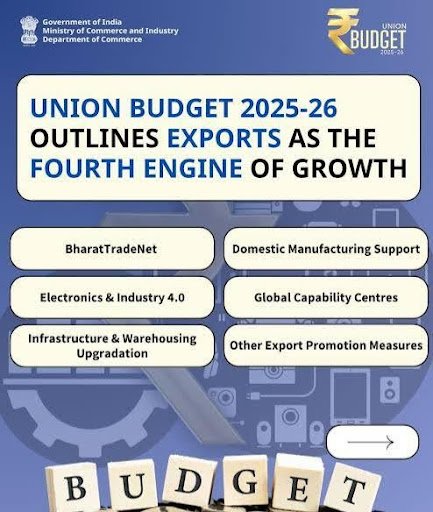
1. The Indian government is revising its Export Promotion Mission announced in the 2025-26 Union Budget with a ₹2,250 crore allocation to better shield exporters from new U.S. tariffs.
2. Key focus sectors affected by U.S. tariffs include textiles, apparel, organic chemicals, shrimp, and machinery.
3. The revamped plan will prioritize MSME exporters by providing:
- Credit guarantees and easier access to export credit.
- Faster clearances to smoothen export processes.
- Export incentives tailored to the worst-hit sectors.
4. The Mission now involves coordinated efforts across Ministry of Commerce, Finance, MSME, Textiles, and Fisheries to provide sector-specific relief.
5. The government is also working on trade diversification to reduce dependence on the U.S. market, exploring opportunities in Europe, West Asia, and others.
6. This initiative is critical as U.S. tariffs on Indian labor-intensive goods have risen sharply, posing challenges to export growth and employment.
7. Other components of the Mission include facilitating cross-border factoring, overseas warehousing, and efforts to align with WTO norms.
8. The proposal is under consideration by the Finance Ministry’s Expenditure Finance Committee and awaits Cabinet approval for rollout.
Forest Rights Titles Issue
Why in News: Thousands of forest rights titles (IFR & CFRR) in Chhattisgarh districts have “vanished” or reduced in state records over the last 17 months.
Numbers:
Total IFR titles: 4.82 lakh (as of May 2025)
Total CFRR titles: 4,396 (as of May 2025)
Example: Bastar IFR titles dropped from 37,958 (Jan 2024) to 35,180 (May 2025)
Reason (as per State Govt.): “Miscommunication and reporting errors” at gram sabha, subdivisional, and district levels; claimed correction of records.
Legal Context:
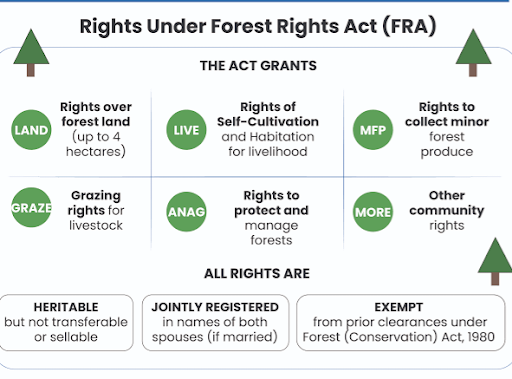
- Under Forest Rights Act (FRA), 2006, titles granted to Scheduled Tribes & forest-dwelling communities are inalienable and non-transferable, can only be inherited.
- No formal process exists to withdraw granted titles.
Significance: FRA implementation in Chhattisgarh accounts for over 43% of forest area with titles; concerns over record integrity, governance, and tribal rights.
The Forest Rights Act, 2006
It recognizes and vests forest rights and occupation in forest land to:
- Forest Dwelling Scheduled Tribes (FDST)
- Other Traditional Forest Dwellers (OTFD) residing for ≥3 generations (75 years) before 13 Dec 2005.
Purpose:
- Ensures livelihood and food security of FDST & OTFD.
- Strengthens forest conservation alongside rights.
- Authority: Gram Sabha initiates process to determine Individual Forest Rights (IFR) or Community Forest Rights (CFR).
Types of Rights:
1. Title Rights: Ownership of land actually cultivated (max 4 hectares).
2. Use Rights: Access to Minor Forest Produce, grazing, and other livelihood resources.
3. Relief & Development Rights: Rehabilitation in case of illegal eviction or displacement; access to basic amenities.
4. Forest Management Rights: Rights to protect, regenerate, conserve, and manage community forest resources.
Significance: Balances tribal/community rights with sustainable forest management.
Earth Observation Satellite Constellation under PPP
Why in News: India’s first private Earth Observation (EO) satellite constellation under PPP will be set up by PixxelSpace India, boosting data sovereignty and supporting climate, disaster, and security applications.
What: PixxelSpace India-led consortium selected to design, build, and operate India’s first fully indigenous commercial Earth Observation (EO) satellite constellation under PPP model.
Investment & Scale:
12 state-of-the-art EO satellites

Applications:
- Climate change monitoring
- Disaster management
- Agriculture
- Marine surveillance
- National security
- Urban planning
- Global geospatial intelligence
Significance:
- Generates high-resolution indigenous data, reducing reliance on foreign sources
- Ensures data sovereignty
- Marks the maturity of India’s private space sector in leading advanced commercial missions
Public-Private Partnership (PPP) Model –
Definition: Collaboration between government and private sector for providing public assets/services with shared risks.
Selection: Private partner chosen via competitive bidding; payments linked to performance.
Types of PPP:
BOT (Build-Operate-Transfer): Private builds & operates for a period, then transfers to government.
BOO (Build-Own-Operate): Private owns & operates indefinitely, earning via user charges/leases.
DBFO (Design-Build-Finance-Operate): Private manages design to operation; government ensures compliance.
HAM (Hybrid Annuity Model): Mix of government funding & private investment to reduce financial risk.
Muthuvan Tribe
Why in News: Recently Muthuvan tribe held a community convention to preserve language, culture, and forest traditions.
Location:
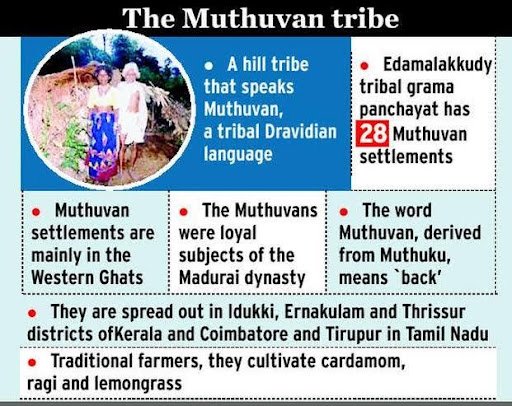
- Hill forests along Kerala–Tamil Nadu border.
- Two groups: Malayalam Muthuvan and Pandi Muthuvan (different dialects).
Population & Leadership:
- Recently, 2,000+ members & 130 village heads (Kanis) attended a community convention.
Social Structure:
- Organized into 6 clans (Koottams) with sub-clans.
Marriage: community endogamy, clan exogamy.
Governance: Kani System, led by Kani; traditional laws enforced with punishments for violations.
Religion & Beliefs:
- Animism and spirit/forest deity worship.
- Ancestors believed to be first settlers of hill forests.
Livelihood & Agriculture:
- Main occupation: shifting cultivation (Virippukrishi).
- Crops: ragi, maize, Italian millet, varagu, chama rice.
- Vegetables: tomato, carrot, sweet potato, potato.
- Focus on self-sufficiency and forest conservation.
Cultural Preservation:
- Muthuvan Adivasi Samudaya Sangam organizes events.
- Recent 3-day conference near Suryanelli (on International Day of World’s Indigenous Peoples).
Commitments: maintain tribal language, respect elder Kanis, adapt to modern world while preserving traditions.
