

1) Historical Background
British Mandate (1920–1948): Palestine was under British rule; major landmarks like the King David Hotel symbolized colonial administration.
Zionist Attacks: In 1946, Irgun, a Zionist militia, bombed the King David Hotel, killing 91, marking early violent resistance against British rule.
UN Partition Plan (1947): Proposed dividing Palestine into:
- Independent Arab State
- Independent Jewish State
- Jerusalem as an international city
Response: Jewish Agency accepted; Arab nations rejected.
Creation of Israel and the Nakba (1948)
- Israel Declares Independence: May 14, 1948, David Ben-Gurion proclaimed the State of Israel.
- Arab-Israeli War: Egypt, Syria, Jordan, Iraq attacked; Israel gained more territory than allocated by the UN.
- Palestinian Displacement (Nakba): ~750,000 Palestinians displaced; villages destroyed; major loss of life and property.
Post-1948 Conflicts
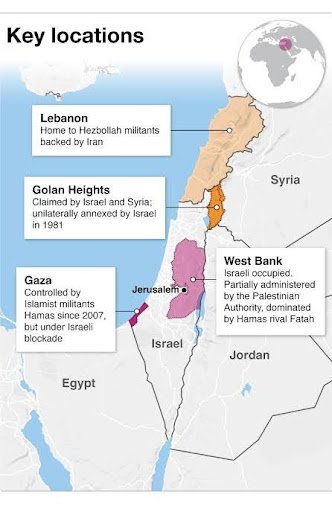
- 1967 Six-Day War: Israel captured Gaza, West Bank, East Jerusalem, Golan Heights, and Sinai Peninsula.
- Result: Israel controlled almost all of historical Palestine; Palestinians were left without a sovereign state.
Recognition and Reality of Palestinian Statehood
International Recognition:
- As of August 2025, 147 out of 193 United Nations member states (about 76%) recognize Palestine as a sovereign state
- It has observer status at the UN, but not full membership due to U.S. opposition.
What Is Recognized? Recognition is mostly symbolic.
- No defined borders; Israel controls movement and security in key areas.
- No unified government; West Bank and Gaza are ruled by rival factions (Fatah and Hamas).
- Limited autonomy: The Palestinian Authority administers civil affairs in some areas, but Israel retains overall security and administrative control, especially in Area C (60% of the West Bank).
- East Jerusalem: Claimed as capital by Palestinians, but annexed by Israel and heavily settled.
Barriers to Statehood
a) Israeli Policies
- Settlements: Over 500,000 Israelis live in West Bank settlements and 233,000 in East Jerusalem, making partition and a contiguous Palestinian state increasingly difficult.
- Military Occupation: Israel controls borders, air space, movement, and resources in Palestinian territories.
- Political Opposition: Current Israeli government rejects a two-state solution, continues to expand settlements, and resists dividing Jerusalem.
b) Internal Palestinian Divisions
- Fatah (West Bank) vs Hamas (Gaza): Rivalries undermine cohesion and effective governance, complicating diplomatic efforts.
- Corruption and Governance: Issues within the Palestinian Authority further weaken the quest for statehood.
c) International Diplomacy
- U.S. Veto Power: The United States consistently blocks Palestinian full UN membership.
- Two-State Solution Stalled: The Oslo Accords (1993, 1995) set up steps toward Palestinian autonomy, but the roadmap was never realised due to leadership changes and violence.
- Recent Shifts: Some Western countries like France, UK, Australia, and Canada are moving towards recognizing Palestine, especially after renewed conflict in Gaza, but practical obstacles remain.
d) Jerusalem and Refugees
- Status of Jerusalem: Both sides claim rights; Israel has annexed east Jerusalem, while Palestinians demand it as their capital.
- Right of Return: Palestinian refugees from 1948 want acknowledgment and rights to return—Israel rejects this.
Conclusion: Symbolic recognition continues to grow—but practical progress towards an independent, contiguous, and viable Palestinian state faces formidable political, territorial, and diplomatic challenges that remain unresolved in 2025.
UPSC RELEVANCE
GS Paper 2: International Relations, Conflict and Peace in West Asia, Role of International Organizations (UN).
Mains Practice Question
Q. The Israel-Palestine conflict remains unresolved despite decades of negotiations and international interventions. Analyse the reasons for the failure of a two-state solution and discuss the role of regional and global actors in achieving peace
