

PRELIMS
Jellyfish Swarms
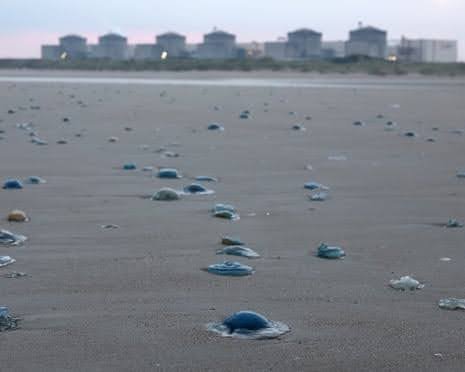
Why in News: France’s Gravelines Nuclear Power Station recently shut down reactors after jellyfish clogged its cooling system.
Mechanism:
- Nuclear plants use seawater for cooling.
- Intake pipes with grated screens get blocked when jellyfish blooms occur.
- Blockage risks overheating → forces shutdown until cleared.
Reasons for Rising Incidents:
- Global warming → warmer oceans, faster jellyfish reproduction.
- Plankton growth ↑ (food source).
- Overfishing → fewer predators (tuna, sea turtles).
- Plastic pollution → low oxygen “dead zones” & artificial breeding grounds.
Implications:
- Reactor shutdowns → energy supply disruptions & economic loss.
- Reflects broader ocean health issues (climate change, pollution).
- Threat to coastal nuclear plants.
Mitigation Strategies:
- Advanced intake screening systems.
- Jellyfish bloom monitoring & forecasting.
- Reduce overfishing & marine pollution.
- Long-term → climate action to curb ocean warming.
Runoff DNA

Why in News: Researchers in French Guiana have used runoff DNA collected from rainwater washing off rainforest leaves to identify hundreds of species, providing a low-cost, non-invasive method to study tropical canopy biodiversity and assess human disturbance effects.
Method:
- Collect DNA fragments washed off rainforest leaves by rain.
- Used repurposed umbrellas + filters to trap samples.
Findings:
- Detected DNA of hundreds of species – trees, frogs, birds, monkeys, insects.
- Old forests showed higher species diversity compared to plantations → indicates impact of human disturbance.
Significance:
- Non-invasive, cost-effective biodiversity monitoring tool.
- Helps assess ecosystem health & conservation needs.
Runoff DNA
Definition:
- Runoff DNA refers to environmental DNA (eDNA) fragments carried away from plants, animals, and microbes by rainfall, runoff water, or surface wash.
Source:
- Cells, hair, scales, feces, saliva, pollen, spores, and other biological residues.
Collection Method:
- Rainwater runoff from leaves, soil, or water bodies is collected and filtered.
Applications:
- Detects cryptic or rare species without capturing them.
- Helps in biodiversity surveys, monitoring ecosystem disturbance, tracking invasive species, and conservation planning.
Squids’ colour change
Context: Researchers discovered how squids control colour and transparency using special skin cells.
Mechanism:
- Skin cells called iridophores in squid’s dorsal mantle contain columns of reflective platelets.
- These platelets have a wave-like refractive index pattern → manipulate light.
- Allows squids to show vibrant colours or become transparent on demand.
Research Outcome:
- Scientists created artificial materials mimicking squid skin.
- These materials can change colour/transparency under visible light.

Applications:
- Camouflage technology.
- Heat regulation systems.
- Advanced displays & optical sensors.
Cephalopods with dynamic colour-changing ability: Squids, octopuses, cuttlefish.
Key skin cells involved:
- Chromatophores → pigment-filled sacs that expand/contract.
- Iridophores → reflectors that manipulate light interference.
- Leucophores → scatter light, aiding in brightness and camouflage.
Significance in nature:
- Predator avoidance (camouflage).
- Communication during mating and social interactions.
- Hunting (ambush camouflage).
Ionic liquids
Why in News: Scientists found that rocky super-Earths with volcanic activity and little water may still host life.
Key Finding:
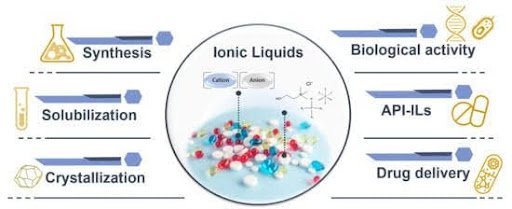
- Ionic liquids (salts that remain liquid even in vacuum) can act as solvents for biological molecules.
- In experiments, ionic liquids were formed by mixing volcanic sulphuric acid with nitrogen-based organic molecules (likely present on planets).
- These liquids are stable, versatile, and can replace water as the medium for life.
Significance:
- Expands the definition of habitable worlds beyond “water-based life”.
- Provides insights for astrobiology & exoplanet habitability studies.
Ionic Liquids
Definition: Ionic liquids are salts that are liquid at or near room temperature.
Properties:
- Made of positively and negatively charged ions.
- High thermal & chemical stability.
- Low vapour pressure → remain liquid even in vacuum.
- Excellent solvents for biological and chemical reactions.
Applications on Earth:
- Green chemistry (eco-friendly solvents).
- Energy storage (batteries, supercapacitors).
- Catalysis, drug delivery, and material science.
Astrobiological Relevance:
- Could support non-water-based life.
- Useful for studying extremophile survival in harsh planetary conditions.
Connexin proteins
Why in News: Harvard University researchers discovered how arteries rapidly coordinate blood flow to active brain regions through connexin proteins. Published in Cell (July).
Key Mechanism – Neurovascular Coupling:
- The brain consumes ~20% of resting energy, with little reserve.
- When neurons fire, blood flow must rise instantly without depriving nearby regions.
- Gap junctions in arterial walls allow rapid ionic/molecular signals to pass between cells.
Role of Connexins:
- Proteins Cx37 and Cx40 found abundant in arteries.
- They allow vessel-widening signals to spread quickly along arteries → boosts blood flow to active brain areas.
Experimental Evidence:
- Normal mice → signals spread >1 mm in 0.25 sec.
- Modified mice without Cx37 & Cx40 → signals spread slower, weaker, and stuck near source.
Significance:
- Explains rapid brain fuel supply mechanism.
- Helps refine fMRI models linking brain activity with blood flow.
- Potential applications in detecting vascular problems, testing drugs, and developing therapies.
Future Implications:
- Could explain age-related or disease-related declines in brain blood flow.
- May lead to drugs targeting connexin activation to improve brain function.
Neurovascular Coupling:
- Mechanism by which neuronal activity ↔ increased blood flow to specific brain areas.
- Essential as the brain consumes ~20% of resting energy with minimal reserves.
Connexins:
- Family of proteins forming gap junctions between endothelial cells of blood vessels.
- Act as portals for ions & small molecules → enable rapid signal transmission.
