

Why in News: The UN SOFI Report 2025 shows global hunger has declined (688 mn in 2023 → 673 mn in 2024). India played a key role, reducing undernourishment from 14.3% to 12% (30 mn fewer hungry people).
Introduction
- Global hunger is witnessing a slow but steady decline, with the SOFI Report 2025 noting a reduction in undernourishment from 688 million (2023) to 673 million (2024).
- India, home to one-sixth of humanity, has emerged as a decisive player in this progress through reforms in food security, digital governance, and nutrition-sensitive programmes.
- Its experience holds critical lessons for the world in achieving SDG 2: Zero Hunger.
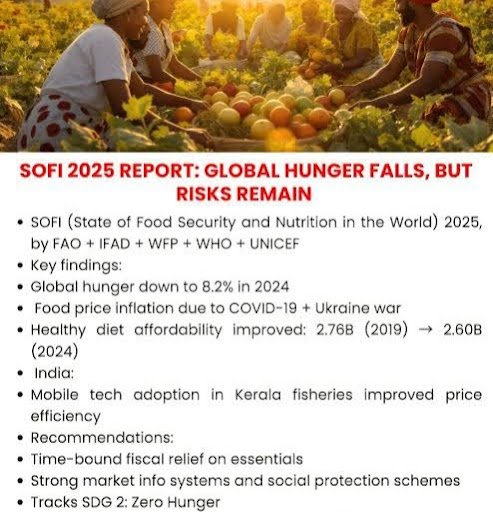
India’s Contribution to Hunger Reduction
- Declining Undernourishment: Reduced from 14.3% (2020–22) to 12% (2022–24) → 30 million fewer hungry people.
- Public Distribution System (PDS) Reform:
- Digitisation, Aadhaar-linked targeting, real-time inventory tracking.
- One Nation One Ration Card enabled portability → crucial for migrants.
- 800+ million people covered, especially during COVID-19.
- Real-time inventory tracking + e-PoS systems increased efficiency.
- Shift from Food Security to Nutrition Security:
- PM Poshan Shakti Nirman (2021) → school feeding with focus on dietary diversity.
- Integrated Child Development Services → enhanced nutrition sensitivity.
Challenges Ahead
1. Affordability of Healthy Diets: >60% Indians still unable to afford nutrient-rich diets due to high costs, weak cold chains, and market inefficiencies.
2. Triple Burden of Malnutrition:
- Persistence of undernutrition.
- Rising obesity and micronutrient deficiencies.
- Concentrated among poor urban and rural households.
3. Post-Harvest Losses: 13% of food lost between farm and market.
4. Agricultural Imbalance: Overemphasis on cereals vs. underproduction of pulses, fruits, vegetables, and animal products.
The Way Forward: Agrifood System Transformation
- Boost production of nutrient-rich foods: Pulses, fruits, vegetables, animal products, and climate-resilient crops.
- Invest in post-harvest infrastructure: Cold storage, warehouses, and digital logistics to cut losses and stabilise prices.
- Promote inclusive institutions: Women-led food enterprises, Farmer Producer Organisations (FPOs), cooperatives.
- Leverage digital tools:
- AgriStack → farmer-centric data ecosystem.
- e-NAM → national agricultural market for better price discovery.
- Geospatial data tools → planning, monitoring, and nutrition-sensitive interventions.
India’s Global Contribution
- FAO Recognition: India’s agrifood system transformation is not just national but a global contribution.
- India as a leader of the Global South can share:
- Innovations in digital governance.
- Social protection systems (like ONORC, PDS digitalisation).
- Data-driven agriculture models.
- Demonstrates that hunger reduction is possible and scalable with political will, inclusion, and smart investment.
Conclusion
With only five years left for SDG 2 (Zero Hunger), India’s progress provides hope. The challenge now is not just about filling stomachs with calories but ensuring nutrition, resilience, and opportunity.
UPSC Mains Relevance
GS Paper 3 (Agriculture, Economy, SDGs):
- Food security vs. nutrition security.
GS Paper 2 (Governance & Social Justice):
- Issues related to poverty, hunger, malnutrition, and social sector interventions.
Practice Question
Q. “The path to ending global hunger runs through India.” Critically examine India’s role in global hunger reduction with reference to recent policy reforms.
