

Why in News: 2025 marks the centenary year of M.S. Swaminathan’s birth. A new biography titled “M.S. Swaminathan: The Man Who Fed India” by Priyambada Jayakumar has been published, highlighting his personal and professional journey.
Introduction
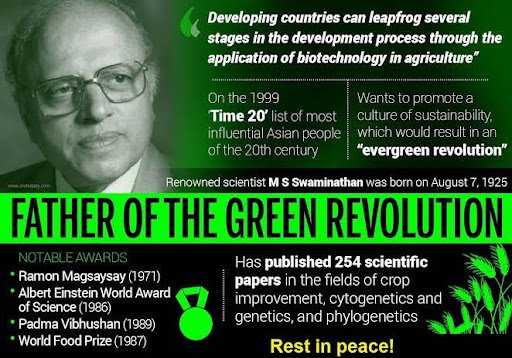
- Known as Father of the Green Revolution in India.
- Helped India overcome food scarcity and attain self-sufficiency in grains.
- Centenary year brings renewed focus on his contributions and lessons for today.
Historical Context
- 1960s: India heavily dependent on food imports under PL-480 (U.S.).
- Frequent famines, low productivity, and rising population created food insecurity.
- Green Revolution introduced high-yielding wheat varieties with modern inputs.
- Collaboration with Norman Borlaug (Mexico) + adaptation to Indian conditions.
- Within a decade → India became largely self-sufficient in food grains.
Lessons from His Life and Work
1. Collaboration and Knowledge Exchange
- Innovations came through global cooperation (Japan dwarf wheat, Borlaug’s varieties).
- Active international networking + openness to new ideas.
- Lesson: Science thrives on collaboration, not isolation.
2. Political Leadership and Support
- Bureaucratic hurdles delayed adoption.
- Breakthrough when leaders (Shastri, C. Subramaniam) directly engaged with scientists.
- Lesson: Political will + scientist–policy interface crucial for progress.
3. Decisive Policy-Making amid Opposition
- Large seed import (18,000 tonnes, ₹5 crore) faced resistance:
- Finance Ministry → foreign exchange concerns.
- Planning Commission → skeptical of yield.
- Shastri and later Indira Gandhi took bold decisions after evidence-based persuasion.
- Lesson: Conflicting opinions are natural, but leaders must take timely, bold decisions.
4. Productivity vs Sustainability
- Green Revolution = huge gains in yield but also unintended consequences:
- Overuse of groundwater.
- Soil degradation.
- Excessive fertilizer and pesticide use.
- Swaminathan later stressed the need for an “Evergreen Revolution” focused on sustainability.
Lesson: Scientific progress must anticipate ecological consequences.
5. Importance of Research and Institutions
- India spends only 0.43% of agri-GDP on research (China double).
- No Indian institute in world’s top 200 agricultural research rankings; China dominates.
- Weak institutional autonomy + bureaucratic constraints limit innovation.
- Lesson: Invest in R&D, ensure autonomy, merit-based recruitment, and adequate funding.
Contemporary Relevance of His Vision
- Food Security: Population growth and nutritional security challenges remain.
- Climate Change: Erratic monsoons and rising temperatures threaten yields. Climate-smart agriculture needed.
- Self-Reliance: Just as food self-sufficiency was achieved, similar efforts are needed in health, energy, and digital sectors.
- Science–Policy Connect: Effective communication and respect for scientific advice still essential in decision-making.
Ethical and Philosophical Dimensions
- Swaminathan symbolised science for social good.
His vision resonates with:
- Gandhi’s principle: Technology must uplift the poor.
- Amartya Sen’s capability approach: Freedom from hunger as expansion of human freedom.
Emphasis on compassion + equity alongside scientific progress.
Conclusion:
True tribute to him: pursue an Evergreen Revolution ensuring productivity, sustainability, and inclusivity. As India moves towards Viksit Bharat by 2047, Swaminathan’s vision remains a guiding light—linking knowledge with compassion, and development with dignity.
UPSC RELEVANCE
GS Paper III – Economy, Agriculture, Science & Environment
- Food security and agricultural reforms
Mains Practice Question
Q. “M.S. Swaminathan’s vision went beyond the Green Revolution; it was about linking science with sustainability and compassion.” Discuss the relevance of his ideas for contemporary India’s developmental challenges.
